Monday, February 25, 2008

Baikasai: Memories 2007

Photobucket
Naohiro, geiko of Kamishichiken.

Kitano Tenmangu Shrine's famous Baikaisai, or Plum Blossom Festival, is held every February 25th in memory of the deified patron saint of scholarship, Sugawara Michizane, a Heian Era court official and avid plum blossom admirer. After graduating from the national academy, he began his ill-fated career at court as a scholar. Although he was elevated in rank under the grace of Emperor Uda, his rivalry with a member of the powerful Fujiwara family resulted in his banishment from court. Demoted to the rank of a minor official in Kyushu, he died a lonely death with a dishonored name.

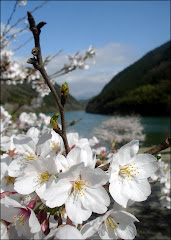
Plum blossoms in full bloom beneath the brightly covered eves of Kitano Tenmangu Shrine.

After his death, plague and drought spread throughout the capital. The emperor's sons began to die in rapid succession. The Imperial Palace's Great Audience Hall (shishinden) was repeatedly struck by lightning as the city was drenched by rainstorms and floods. Attributing this to the angry spirit of the exiled Sugawara, the imperial court built and dedicated Kitano Tenmangu shrine to him, posthumously restoring his title and office. All mention of his exile was struck from the record and Sugawara was deified as Tenjin-sama, or kami of scholarship. Today many Shinto shrines in Japan are dedicated to him.


Umeshizu prepares to perform the tea ceremony.

I never really got around to uploading many of the pictures I took at last year's Baikasai, and since I can't be there this year, I'd like to share these with you now. Enjoy!

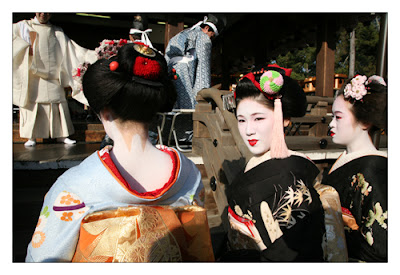
"Living flowers" beneath the plum blossoms. From right to left: Umesato, Naokazu, Satoyuki, and Naohiro.

Photobucket
Katsuya leads her younger sister to the grounds of Kitano Tenmangu shrine.


The breath-takingly beautiful Umeha.

Photobucket
Naokazu and Satoyuki.

Katsuya smiles as she serves guests.

Photobucket
Satoyuki took part in the 2007 Baikasai as part of her training to become a geisha. She did not make her debut until afterwards. I was captivated by her stunning M.C. Escher-esque kimono.


Umeshizu gently smiles before offering a cup of matcha, a bitter powdered green tea whipped to frothy perfection, to guests.

Photobucket
The elegant Naozome, a high ranking maiko, never fails to make an impression.

Photobucket
Katsuryu concentrates on correct ettiquette as she serves the guests during her first Baikasai. She had only made her debut as a maiko earlier that month.


Satoyuki smiles.


Umeha and Naohiro in shades of lavender and plum.


Umeha laughs.


Tamayuki is a senior geiko of the Kamishichiken district. As geiko grow in experience and skill, they rely less on their flashy kimonos, hair, and make-up, and more on their skill, which is where there true beauty lies.


Katsuryu: Can you say KAWAII! So cute!


Naozome and Ichiteru.


Katsue in her final appearance as a maiko at the annual Baikasai. Now a geiko, she will soon be performing in the Kitano Odori as a full-fledged geisha.


Ichifumi, the famous blogging maiko Ichimame's little sister, laughing with guests during her first Baikasai.


Yasunari Kawabata, the first Japanese to win the nobel prize (1968) once wrote "If for no other reason than to preserve traditional hairstyles, the geisha's existance is vital. I wonder how and when these hairstyles developed."

"Japanese men, as a rule, feel about a woman's neck and throat about the same way as men in the west feel about a woman's legs. This is why geisha wear the collars of their kimono so low in the back...I suppose that its like a woman in Paris wearing a short skirt."

~Sayuri, in 'Memoirs of a Geisha' by Aurthur Golden.


Ichimame laughs as she entertains guests.


Sisters Ichimame and Ichifumi admiring the plum blossoms.

Friday, February 22, 2008

Go Speedracer, Go!

Here he comes, here comes SPEEDRACER!


One of the great things about being back in the good ol' US of A is the relative ease and inexpence of going to the movies. Sure, in a big city like Tokyo, Osaka, or Nagoya, a movie theater may not be far away, but it's always expensive. A ticket usually costs about ¥1800, but if you're lucky enough to live in a beautiful place like Ena (inaka: countryside), you also have to factor in the roughly hour-long train ride into town at ¥1100 each way. Altogether that's about $35, not to mention the total investment of a day since the entire affair will take no less than four and a half hours. All this for the rare privledge of watching a movie that's probably already available on mininova on an unusually small screen(compared to their counterparts in the States, that is.)

In my hometown, movie theaters are many and the prices are right. Before 6'o clock a mere $6.25 will get you a comfy reclining seat in a spacious stadium-style theater complete with a perfect, puffy hair-free view of an enormous screen. WhatI saw on that screen the last time I went to the movies was a teaser-trailer for none other than the classic Japanese anime SPEEDRACER!

Perhaps I'm exposing my overwhelming nerdiness by admiting it (if I haven't already), but I think it looks most cool... Like anime- ALIVE!

Check out the original Japanese opening:


Here's the Americanized version:


And may I just say, Anime has come a LONG way (^_<)

Tuesday, February 12, 2008

Supernova : English Translation : Bump of Chicken


Supernova: Bump of Chicken
Translation by Melissa Chasse ©

When I get a fever I realize
That I have a body
When my nose gets stuffy I realize
That I’ve been breathing all this time

You’re existence
I make sure of it so many times but
You know how truly precious someone is
Once they’re gone

When I refused your outstretched hand
There might have been a big earthquake
When I protected your outstretched hand
The one I wanted to protect may have been myself

You’re existence
I always held on to it so tightly but
I’m really afraid so
I just can’t let go

La la la…

Talking to people I realize
There’s nothing I want to say
When I try to put the words together
I understand I’m full of feelings I want to express

Your existence
I can keep talking about it like this but
true gratitude
Can’t be expressed by a mere “thank you”

La la la…

In our clock (In the time we have)
We want
to grasp just one truth
and pass it on…

When I try to count the years, I realize
However slight, I had a history
At almost the same time I understand
An end will come to that, too

I can remember you whenever I want but
What I really want is
Not memories, it’s the present

It's after I forget you that I remember
I had a history with you
It's after I loose you that I discover
I met you by chance

A person’s existence
In this world is worthless, but
Somebody’s world
Can be built on it

Your existence
I confirm it so many times, but
Your true existence is that
Even when you’re gone, you’re here

Our clock doesn’t stop
It’s moving

La la la…

Wednesday, February 06, 2008

Setsubun: Maiko Hairstyles

Photobucket
Beautiful and charming Tsunemomo of Gion Higashi sporting a special hairstyle for the Setsubun mamemaki, or bean throwing, ceremony at Yasaka Shrine.

The classic wareshinobu hairstyle of a young maiko on the left is worn during a her first three years of service, until her coming of age ceremony.

Left: Ofuku, worn by maiko from the time of their coming of age ceremony until they are ready to turn their collars and become geiko. Far right: Wareshinobu.

Konomi, close up, is accompanied by Maori, who's wears her own hair styled just as Meiji period schoolgirls once did as part of her Setsubun obake, or costume.

Left: Umemodoki / Osomemage hairstyle. Right: It's a mystery!

Maiko of the Gion Kobu district make their way to the main stage of Yasaka Shrine to participate in the mamemaki, or bean throwing ceremony.


Setsubun festivities at Yasaka Shrine, including dances by Miyagawa-cho, Gion Kobu, and Gion Higashi. Thanks to ericity for uploading it to YouTube!

Unfortunately I was not able to attend the Setsubun festivities this year, but I look forward to shooing away devils and ushering in good fortune next year in Kyoto! Oni wa soto! Fuku ha uchi! If you'd like to Learn more about Setsubun, check out my posts from last year.


Thursday, January 31, 2008

Pooping on Gion : Geisha Beware!


Japan's wealthy playboys and camera-toting tourists are not the only ones drawn to the soft, red glow of Gion's paper lanters. Kyoto's most famous hanamachi, or geisha entertainment district, is also the preferred hangout of murders of young crows!

(Narrator): "Gion is crowded with people, but they're all worried about what's overhead..."

(Geisha Customer): "I was just saying, right? (maiko: Yes, you were.) You have to be careful with good kimono.

Geisha: That's right.

(Maiko in green, Yukako): "It's nasty, isin't it! Lately its always falling right before my eyes. I can't stand it!

(Narrator): Just then...

It's raining poop! An innocent bystander is splatter with white bird droppings!

(Maiko): Oh no! You went out (from under the covered walkway).

(Geisha): I was suprised! Onii-san (big brother),the timing! Poor thing!

(Poor thing): It doesn't come out!

(Geiko): But it's dangerous over there, too. There are so many (birds) up there.

(Narrator): And again... (Another poop bomb splatters the pavement).

Blah, blah, blah... I just thought that first bit was hilarious! Especially since I have seen people fall victim to the occasional poop bomb, although I myslef have yet to be targeted. (^_^)x <--- That's me keeping my fingers crossed.

Monday, January 28, 2008

Snow Smile : スノースマイル: English Translation : Bump of Chicken


Another one of my favorites!

Snow Smile by Bump of Chicken

It’s a really good thing winter is cold
Because there's no better reason
To invite your chilly left hand
Into my right pocket

“I wish it would snow!” you say with a pout
Well, if it doesn’t go the way you like
Don’t kick away the fallen leaves
We can still fall down in them
Why do you look like you’re having so much fun
Even though you’re angry?

In the still beautiful, untouched carpet of snow
Together we carve parallel lines of footprints
Even if this dream story never comes true
Smiles will overflow
This snowless road

There’s a little trick to our walking together
Your stride is so small
I look at the scenery as long as I can
Looking back at the scenery of you

Into the still dry curtain of the sky
Together we chime an orchestra of footsteps
Look! Before this dream story comes true
You will smile for me
I know it

Snow Smile

In the still beautiful, untouched carpet of snow
Together we carve parallel lines of footprints
Yes, even if you don't wish for this dream story
You taught me to smile
On the path that I take

I’m so happy we met
The same season has come around again
In my right pocket, the memory I put away
Just as I thought, I put it away and walk
On a path without you

Wednesday, January 23, 2008

Made of Japan : I ♥ Onitsuka Tigers!


How cool is this ad art for Onitsuka, inspired by Japanese wood block prints with Japanese proverbs. On the left: "Deception is like a monkey. It's only a matter of time before it bites you". On the right: "Debating with a fool is like spitting on a fish. It's best not to bother." Can I get an Amen?


Lately a lot of visitors to my little blog here have been coming over from the awesome concept ad site, Made of Japan. A classic mosaic Onitskua (AKA Asics in the US,) made up of thousands of images from over 150 Nippon-centric© blogs. True to the Onitsuka motto, the shoes are literally Made of Japan! As you roll over the mosaic, tiny windows pop up showing the image and proving a link back to it's source.


One of my images of Kikutsuru, then maiko of the Miyagawa district.


Another image of a few of my students.

Ever since my super-rad, high school cheerleading days I've been a uber-fan of Asics, which weren't exactly considered cool at the time. Must of been the Japanese sensitivites laying dormant within me, silently drawing me towards my destiny as a full-fledge Japanophile. Imagine my excitement when I came to Japan and realized they were actually Japanese- with a lot more style and a way cooler name to boot!

I also love that they've taken "Made of Japan", something I always assumed to be a Japanglish phrase, and made it meaningful. Rockstars, all of them!


Onitsuka Tigers are MADE OF JAPAN!

Tuesday, January 22, 2008

Otagaki Rengetsu : Lotus Moon

Photobucket

Otagaki Rengetsu, best known as a famous Japanese poet, was also a calligrapher, potter, and painter.Born into a samurai family with the surname Todo in 1791 , she was soon adopted by the Otagaki family and given the name Nobu. Having lost her mother and brother at a young age, she served as lady-in-waiting at Kameoka Castle (in present-day Kyoto Prefecture) from the age of 7 until returning home at the age 9 years later to marry. In 1823, after the death of her husband and three young children, she became a Buddhist nun, adopting the name Rengetsu, which means "Lotus Moon".

Life in the Mountains

Living deep in the mountains
I've grown fond of the
Solitary sound of the singing pines;
On days the wind does not blow
How lonely it is!


Longing in the Wind

I await my beloved
who is not yet here.
The moon in the pines
and voice of the wind
provoke my longing


Thursday, January 17, 2008

Kurama Fire Festival : 鞍馬の火祭り

Photobucket
One of Kyoto's biggest and most eccentric festivals, Kurama no Hi Matsuri captures the imagination, whisking the awe-struck spectator back in time through an ancient ritual preserved, protected and passed down through the ages to the progeny of an ancient Japan.

Nestled high in northern Kyoto's mountains, the rural town of Kurama consists of traditional, tiled-roof homes and shops crowded along a single main road, narrowly winding its way through the evergreen mountaintops that rise on either side. Each year, on October 22, as the moon begins to rise over these steely blue ridges and night casts its sleepy shadow over the usually quite town, a river of visitors from all over Japan flows from the small, provincial train station, flooding the town in a buzz of anticipation and excitement as they prepare to witness the rites and rituals of Kurama's famous Fire Festival. The Kyoto Shimbun Newspaper numbered the festival-goers in 2008 at over 10,200!


The ancient ritual is rooted in the troubles of the mid Heian Era, when the ancient capital was plagued by rebellion, great earthquakes and natural disasters. In 940, the emperor relocated Yuki Shrine from the grounds of the Imperial Palace north to Kurama in an attempt to appease the northern deities. Bonfires were lit along the road to Kurama, leading the procession of Shinto priests to the deity’s new home. Soon after, the plagues ceased and the rebellion was defeated, once again bringing peace to the empire. The spectacle of the great procession and miraculous virtue of the rites so impressed the people of Kurama that they determined to preserve them for posterity, each generation passing it on to the next.


Today the sacred Shinto rituals begin at 6 pm, but visitors begin arriving long before, seeking out the best places to experience the event and vying to get as close to the action as possible. By the time the sun disappears behind the hills, all open areas along the main road are filled with space-impaired spectators, corralled behind ropes and barriers to keep them a safe distance from the madness that will eventually ensue. Late-comers are ushered behind the early bird crowds by a seemingly infinite number of policemen, politely prodded to keep moving on a continual circuit from the train station, through the town, and back again, past homes and shops with torches of all sizes displayed proudly outside.

Suddenly a cry of "Shinji ni mairasshare!" echoes through the town. At the signal, the citizens of Kurama kindle the torches and small bonfires that line the main street, illuminating the way for the procession of fire.

Photobucket
A silver moon brightens the evening sky above a 3 meter mini-bonfire along the procession route, bound with a shimenawa. A shimenawa is a rope used to cordon off consecrated areas or to act as talisman against evil.

Photobucket
As night falls in high in the mountains, so do the temperatures. Festival-goers take time to warm up around the blazing bonfires, even as sparks and ash falls from the sky.

Tiny toddlers wrapped in brightly colored kimono carry hand held, bottle shaped torches as they are led up and down the main thoroughfare, walking hand in hand with their parents.

Photobucket

Next, small and medium sized torches are shouldered by elementary, junior high and high school boys. Finally, the five meter long taimatsu, or 'great torches', appear, shouldered by the town's young men. The Kurama taiko group, led by a feisty old woman artfully striking a great drum, leads the procession of taimatsu, accompanied by shouts of "Saireya Sairyo"!

Photobucket
A high school students shoulders the tail end of a 5 meter torch as sparks rain down behind him. Catching one of these falling sparks on your skin is said to be very auspicious, if not painful.

These enormous torches weigh over 100 kilos, or 220 pounds.

A group of scantily clad young men show off their "cute hips" in the revealing traditional festival gear.


By 8 pm, over 250 torches are gathered on the great stone steps leading up to Kurama Temple. The heat of the blazing flames can be felt all along the roadside. The shimenawa is cut and the torches are consumed in a massive flame, painting the town in dancing vermillion light that flilckers against the deep, star speckled sky. Two omikoshi, or portable shrines, dance through the streets on the shoulders of Kurama's proud young men, bringing the festival to its climax.


Photobucket
The omikoshi and I with my new friends.


Photobucket


The last train out of Kurama leaves long before the festival draws to an end at midnight, and visitors line up for hours trying to catch one of the few trains back to civilization. My first visit to Kurama no Hi Matsuri was with my friends from Kansai Gaidai, one of whom happened to live a short walk from the festival's epicenter. Long after the tourists had gone, my friends and I drank sake and danced in the street with the townspeople. It is one of the most incredible experiences I've ever had, and for a moment, I felt as if I had experienced a very different Japan, Japan as it must have been long ago. That Japan still exists. You just have to know where to look for it.
You’ll find it in Kurama.

Any Japanese festival is a great place to make new friends!

Tuesday, January 15, 2008

Chopsticks are so Tricky...


A funny little commercial by the independent productions company Fatal Farm.

The ending holds a special meaning for me, as it brings to mind meeting of the Thursday night sushi crew in which I, while raising a peice of nigiri salmon to my mouth, watched in amazement as it slipped from my chopsticks, flipped head over tales and flew through the air, diving gracefully into CP's cup of green tea half way across the table.

Wallah! Ochazuke!

The entire incident unfolded before my eyes in slow-motion, inducing a laugh attack the likes of which the Ena kaiten sushi scene had never seen.

'But seriously,' you may ask, 'how does that happen'? Only I in my infinite wisdom could achieve such a feat without effort of any kind. (You are welcomed to try, of course, if you think you can do bettter).

In my own defense, I actually do use chopsticks rather well (better that most of my students) and prefer them to silverware. And, like most foreginers in Japan, I have been complimented countless times on my fine form by everyone from kindergarteners, to teachers, to a maiko and the mistress of a teahouse!


Tuesday, January 08, 2008

I'm a National Geographic Traveler!


My image of a wagasa, or traditional Japanese paper umbrella, was chosen by National Geographic Traveler's blog, Intelligent Travel, for their Global Eye feature after an editor happened to see it on Flickr. Needless to say, I'm honored!

Check out the website for more excellent images and insight into authentic and sustainable travel.

Sunday, January 06, 2008

Where Did 2007 Take You?

From top to bottom, left to right: Matsumoto Castle (Nagano), geiko in Kamishichiken (Kyoto), the Imperial Palace (Kyoto), Kiyomizudera (Kyoto), Oi Kindergarten (Ena), Kurama fire festival (Kyoto), maiko in Gion (Kyoto), Angkor Wat (Cambodia), maiko (Kyoto).

1. Angkor Wat, Cambodia :
I watched the sun rise over Angkor Wat as it dawned on the year 2007, then spent its first few days playing with my old friends at Ta Prom. I never blogged about it, but I will!

2. Phnom Penh, Cambodia

3. Battambang, Cambodia:
Went on a tuk-tuk tour with my old friends, the monks, wandered the rice fields, took a ride on the bamboo express and spent some quality time with my Cambodian family.

4. Taipei, Taiwan:
Spent a wonderful night curled up on an airport coffee shop couch shaking after drinking my first cup of real coffee EVER. What does Taiwain have against Chai tea?!

5. Nagoya, Aichi, Japan:
An oasis of Chai in a veritable dessert of delicious, non-coffee drinks!

6. Ena, Gifu, Japan:
Emraced by rolling mountains and chock full of rice fields, the lovely little city I was blessed to call home: Winter, Spring, Summer, and Autumn

7. Matsumoto, Nagano, Japan:
Castle-bound, a lovely little roadtrip gone right!

8. Nagano, Japan:
Lovely little roadtrip gone wrong- but what a great adventure!

9. Kyoto, Japan:
Geisha, festivals, temples, palaces. My happy place- a home away from home... away from home.

10. Tokyo, Japan:
Adentures with the Howell Kyodai.

11. Osaka, Japan
Reuniting with my Gaidai friends is always fun!

12. Nara,Japan:
A suprise trip to the ancient captial, ablaze with the colors of fall, to view the Shoso-In Exhibition of National Treasures. Icredible!

13. Inuyama, Aichi, Japan:
Japan's oldest castle: another great desitination for a roadtrip.

14. Cleveland, Ohio, USA

15. Omaha, Nebraska, USA

16. Duluth, Minnesota, USA


Where did the year take you?

Share your list in the comments section!

Saturday, January 05, 2008

New Year, New Kind of Geisha?

Visit Sayuki's Website

As I'm sure most geisha enthusiasts already know, Aussie social anthropolgist Fiona Graham made her formal debut as a geisha in Tokyo's Asakusa district on December 19th after a year of training, or "feild work", as she refers to it on her website. Just in time to begin the new year as Japan's first western, professional geisha, she is already planning to release a book entitled "Sayuki: Inside the Flower and Willow World" and a documentary that will be filmed throughout the year.

The maiko of Kyoto endure intensive training for 5-6 years before earning the honor of turning their collars and becoming full-fledged geiko.

Graham's professional name, Sayuki, comes from the Chinese character 紗 sa, meaning gossamer and 幸 yuki, meaning happiness, wish or fortune. This could be translated a number of ways: Delicate Delight, Ethereal Joy, or Sheer Bliss (^_^)v

Graham recieved her MBA in Psychology and teaching from Oxford before beginging her study of social anthropology. She has spent half of her life in Japan, graduating from a Japanese high school long before becoming the first western woman to graduate from Tokyo's Keio University.

Read the Telegraph's article: Westerner inducted into mysteries of geisha


Tuesday, January 01, 2008

Nengajo: Japanese New Year's Cards

Photobucket
A brilliant up and coming graphic designer in Tokyo, Yuki Nakano designed this nengajo to welcome 2008: The Year of the Rat. The design of most nengajo includes the junishi, or Oriental zodiac animal, of the New Year.

Oshogatsu, or New Year's, is a very special time in Japan—a time for people return to their ancestral homes, spend time with their families and get in touch with their roots. Perhaps the most honored and celebrated of the Japanese holidays, Oshogatsu is a three-day event beginning with Omisoka (New Year's Eve) and lasting through the first three days of the year. Many people wear traditional clothing, like kimono, and play traditional games, such as uta garuta. Preparations begin long in advance as people clean their homes from top to bottom (known as Osouji), prepare Osechi ryori (traditional New Year's food eaten during the forst three days of the new year), and write nengajo, or New Year's greetings.


These days, many people use designs including photos of themselves or their families on their nengajo.

Much like the Christmas cards exchanged in the US and abroad, nengajo are an important part of Japan's New Year's festivities. Now an established tradition, the exchange of these New Year's greetings began in 1873, when postcards were first introduced to Japan. Today, the average family sends over a hundred nengajo to family, friends and colleagues, and businesses mail them to all their customers.


New Year's is a time for wafuku (traditional Japanese clothing) and Osechi ryori, traditional Japanese New Year's food.

Like many Japanese traditions, there is a specific nengajo etiquette code that has no equal in Western culture. While Christmas cards arrive anytime from Thanksgiving to New Year's, nengajo are expected to be delivered on January 1st, not a day before or after. Domestic mail usually only takes a day or two to be delivered, but nengajo can be posted early in special temporary mail boxes to ensure they arrive on time. Every card put into these boxes between December 15th and December 25th gets a special postmark and is delivered promptly on New Year' Day. Waiting for your bundle of postal love (they literally arrive bound together) and reading the flood of New Year’s wishes on January 1st is a cherished holiday tradition, similar to waiting for presents and opening them on Christmas.

Photobucket

When a surprise nengajo arrives from someone you have forgotten, it is always acceptable to send your greetings on January 6, reminding them to take care in the cold weather (寒中お見舞いもしあげます: kanchu omimai moshiagemasu). If someone you know has recently lost a loved one, you should not send a nengajo in observance of the family's mourning.

Of course, if you are a card-carrying gaijin, you are theoretically exempt from all of these rules. Why not surprise your friends and colleagues with your astounding nengajo knowledge and skill? The same gracious people that praise your ability to use chopsticks and poor attempts at speaking Japanese will be thrilled with the thoughtful consideration and effort, regardless of when your nengajo arrives.
Photobucket
Hand drawn by one of my students, this was the first nengajo I recieved in Japan.

Photobucket
Happy New Year, everyone! ☆明けましておめでとう☆

Sunday, December 30, 2007

An Aya Uto Christmas: Silent Night and Christmas Cake


"Super Idol" singer and actress Aya Ueto sings Silent Night for a Softbank cell phone commerical. Don't miss the classic Japanese Christmas cake at the end!


As an American raised in a predominantly ethnic Italian influenced family, I had never heard of "Christmas cake" before traveling to Japan. I'm interested in knowing which cultures celebrate Christmas with cake. Please share your traditions with us in the comment section!

Saturday, December 29, 2007

♫♩♪♫ Wii! Merry Christmas ♫♩♪♫

"It's a Wii! It's a Wii!" My cousins join kids across America, and I suspect, the world, in songs of joyful exaltation of the much sought after, hard to find Japanese gaming phenomenon.

"Wii would like to play." Homerun!

There's nowhere like home for the holidays. This is where I've spent every Christmas Eve I can remember, minus the last three years. This is what I think of when I think of Christmas. Being away for so long helped taught me to appreciate the cultural and familial traditions I've taken for granted most of my life: singing Christmas carols, watching the kids open presents, and just being with the family. Even I was in awe of the "Americanness" of it all. It's almost as if I've learned to see it through "Japanified" eyes.

I can't help but remember the shock of my students when I told them that even pets got presents for Christmas in America. Sure, Christmas is catching on in Japan, but most of my students didn't get presents. Instead, they celebrate with white frosted, strawberry topped sponge cakes and buckets of KFC. More about that later...

As they say in Japan, Meri Kuri everyone! From my family to yours (^_^)/