Monday, August 14, 2006

Destination Cambodia: 4 Days and counting!

Could it be?
Photobucket - Video and Image Hosting
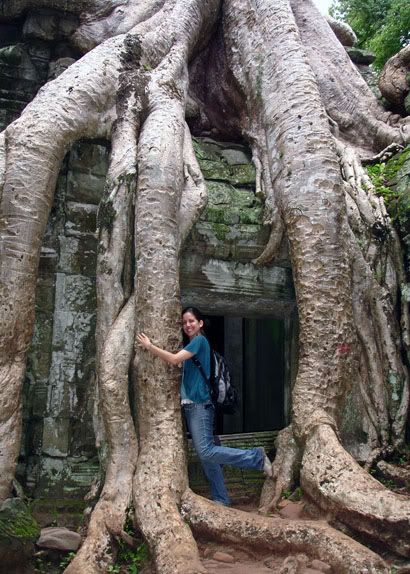
Is that Angelina Jolie? Sadly,no. It's only me (although the resemblence is startling). I've always been a bit of a tree- hugger, but I think this sudden outburst of affection was the due to the realization that I had finally found a place where I could live out my childhood dream of being Indiana Jones. Angkor Thom, Cambodia.

Saturday, August 12, 2006

Here's to you, Ms. 70 Years Old, Bright Purple-Haired, Kimono-Wearing Koto Player...

Photobucket - Video and Image Hosting

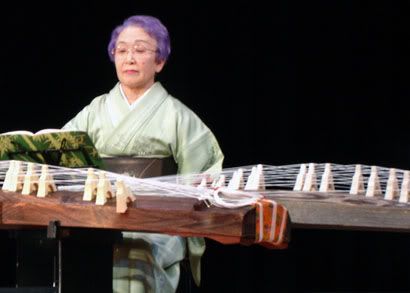
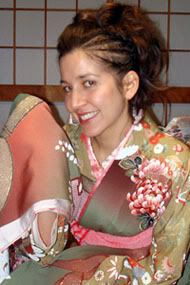
A local obaachan (old woman) jammin' on her koto during a community arts festival. Is that Kool-aid grape colored hair? You better believe it! And she ain't the only one. Obaachans all over Japan dye their hair ridiculously bright and flashy colors, such as the classic Candy Apple Red or the slightly more eccentric electric blue. Straight out of Osaka, this cooky-colored-kami-craze has taken even the inaka by storm!(Kami means hair, inaka means countryside)

To be quite honest, that shade of purple it is the perfect compliment for your kimono! So keep on rockin' out to those classic Koto hits like Sakura, Kimigayo and...sakura! And don't forget the traditional favorite "Purple Haze"! Play that koto, girl! We here at Mboogiedown:Japan salute you!

Thursday, August 03, 2006

The Flower Procession: Gion Matsuri

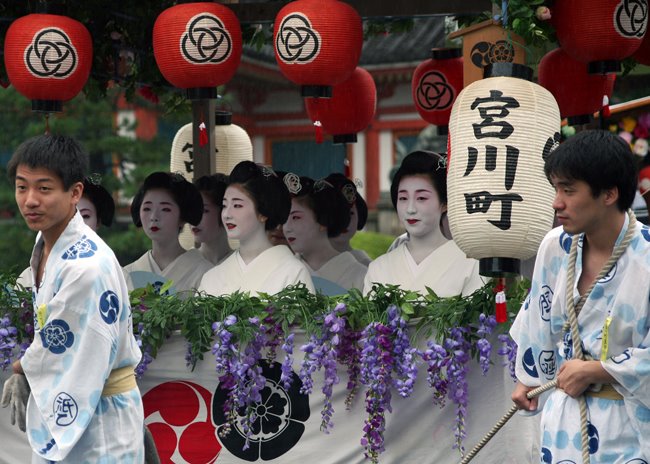
Maiko from Miyagawa-cho being pulled through Kyoto by young men from their neighborhood.
I'm sure you're all sick of seeing pictures from Gion Matsuri, but I just can't help myself! I'll try to write more later...Until then just enjoy the view from here (^_<)

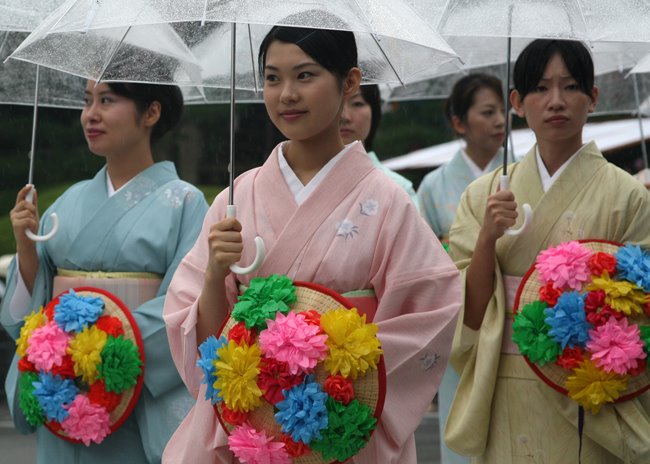
Young women carrying their hanagasa, straw hats covered with fake paper flowers, seek shelter beneath their umbrellas.

Kanazuru, a maiko from Miyagawa-cho.

A young White Herron Dancer giggling as she ran for cover from the relentless rain.

A maiko from Gion.

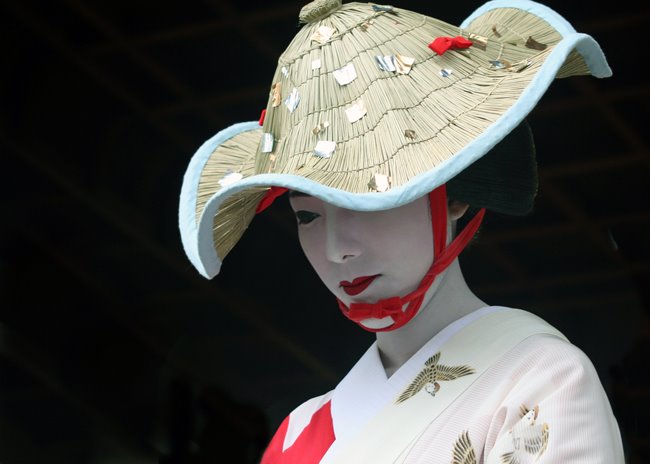
A shrine maiden of Yasaka Jinja tries to keep her hanagasa in place.

Tuesday, August 01, 2006

BLEACH Rocks! (^o^) ♪

Just a little somethin' somthin' to break the monotony of Gion Matsuri: The second opening of BLEACH: D-Technolife, by UVERWORLD. I tried to put up the karaoke-style version, but I'm experiencing techo- Difficulties. Until then, here's my own personal translation:

You've been hurt by unspeakble pain and sadness
Try to carry the burden of the unerasable past
Don't throw away your life!

I held your hand...

Will I lose you someday I wonder...
I want to protect your fading smile, and you.

Even if the resounding voice that calls me withers
Even if its erased by the winds that come with time

I WILL FIND YOU!

You, who's been hurt by unspeakable pain and sadness

Don't say things like "I can't laugh" or "I hate people"

There's meaning in everything that will happens in the future we can't see

You're fine just as you are

There will definately come a time when you realize it.

You and me, True as spoken.

Because someday we'll understand each other.

Saturday, July 29, 2006

Yoiyama Kyomai : Gion Matsuri

Photobucket - Video and Image Hosting
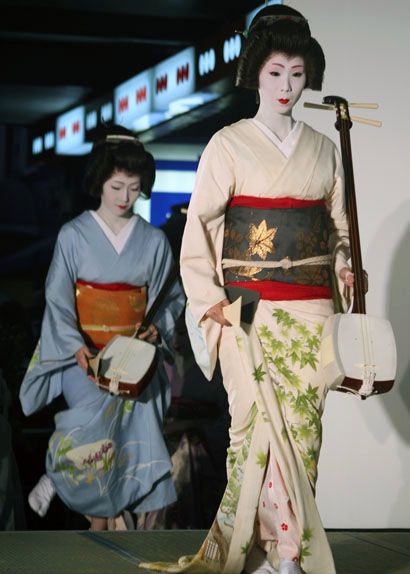
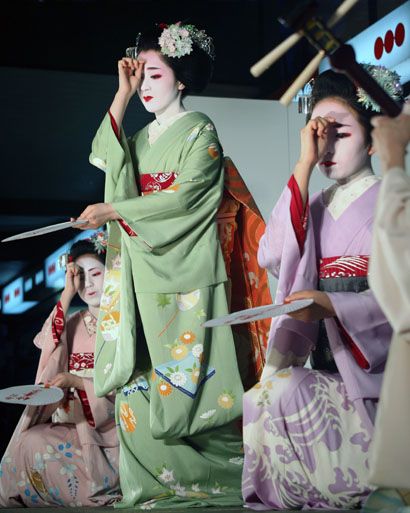
Geiko from Gion glide gracefully across the stage with their shamisens, as the long trains of their kimonos flutter behind them.

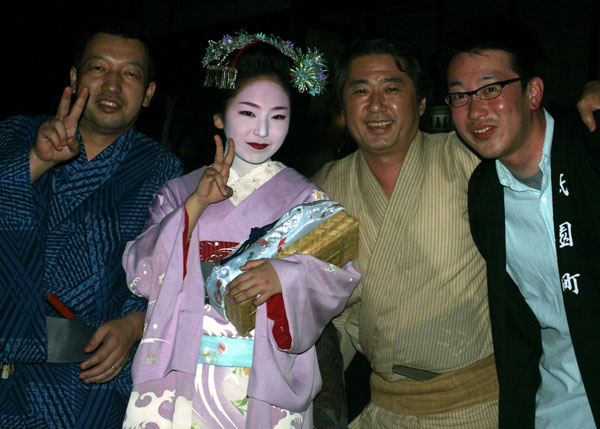
The Geiko took their place on the side of the stage, sitting seiza style, on their knees, and played as 3 maiko danced in the traditional Kyoto style. The maiko in the purple Kimono is Suzuha, who if I am not mistaken, recently appeared on the cover of the Japanese Playboy magazine! She is renowned for her classic beauty among many of Gion's customers.

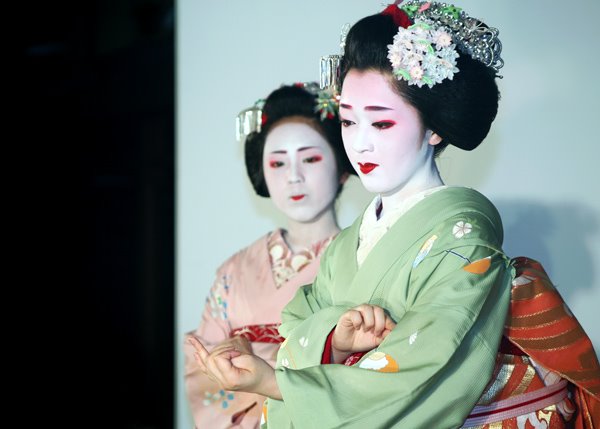
Kotoha, a high ranking maiko (in green) and superb dancer, performed the lead role in the short performance. The young maiko behind her is only in her first year. Her upper lip is not yet painted, and her collar is still predominantly red.

Photobucket - Video and Image Hosting
The extravagance of the flowing layers of colorful silk kimono, the breath-taking contrast of the porcelian-white makeup and delicately painted red lips, and the grace and dignity of the dance set to the haunting music of the shamisen create a scene of ethereal beauty beyond description.

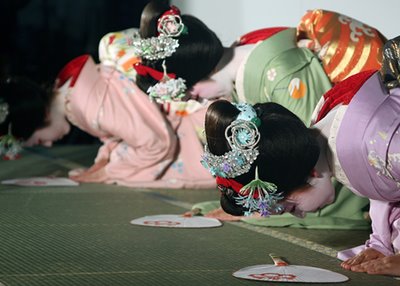
As their dance ends, the maiko bow low to their audience. The maiko wear a very special hairstyle during the month of July specifically for Gion Matsuri.

Sunday, July 23, 2006

Gion Matsuri: Yamahoko Junko 2006


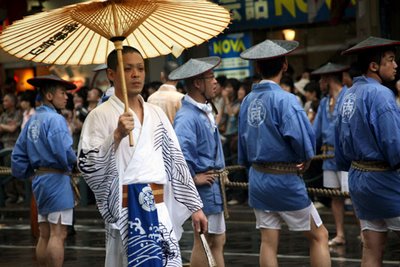
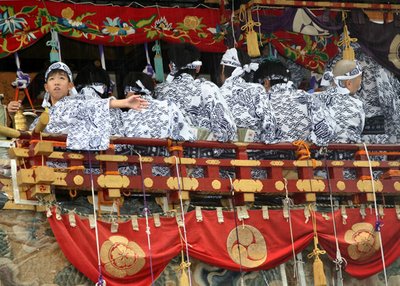
A young man, dressed in his area`s yukata, seeking shelter from the relentless rain that threatened to dampen the festive atmosphere of Gion Matsuri`s most anticipated event: the procession of the gigantic yama and hoko floats. The umbrellaless men behind him wait patiently for their cue to continue pulling their float through the streets. The heavy rain kept spectators to a minimum this year, with only 130,000, almost half last year's record-high of 240,000 people.

Is it still raining? You better your yukata it is!

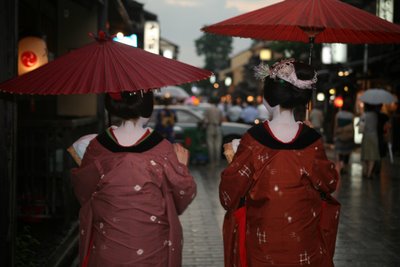
Maiko make their ways through the soggy streets of Gion beneath their beautiful oiled-paper umbrellas.

Friday, July 21, 2006

Gion Matsuri: Yoiyama 2006

Photobucket - Video and Image Hosting
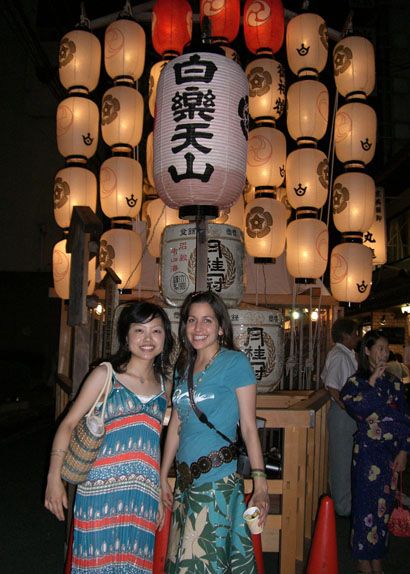
Yuko and I in front of one of the smaller festival floats, haku raku ten yama (White Paradise Mountain) at Gion Matsuri's Yoiyama (the night before the main procession, Yamahoko Junko). Yuko has played a major part in my adventures in Japan since my first day at Kansai Gaidai, when she and a bunch of friends waited for me outside after class and very politely asked if they could be my friend (^-^)/ Look at her! How could I say no? Kawaii! (^-<) *wink*
An elementary student performing the sacred Shirasagi Mai, the White Herron Dance, infront of Yasaka Jinja (Shrine) on Shijo dori (Avenue).

A high ranking maiko taking time out of her busy schedule to teach a younger maiko how to count.

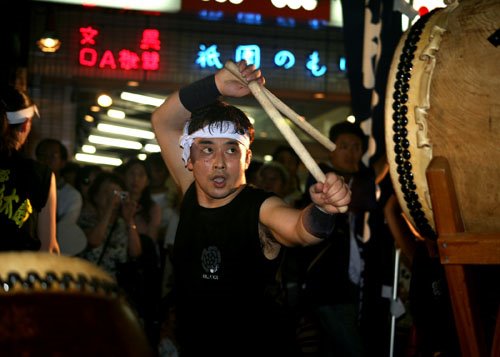
Taiko: It's an art.

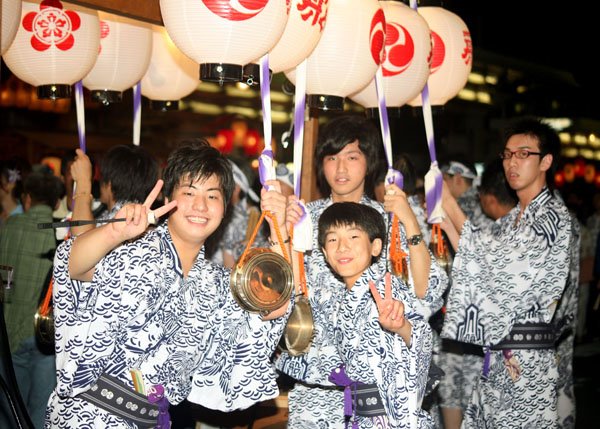
Zettai Shounen! A group of young boys donning their neighborhood yukata making music in the streets.

Suzuha, one of Gion's most beautiful and popular maiko, enjoying Yoiyama with a few friends.Say Peesu! (^-^)v

More Coming Soon!

Saturday, July 15, 2006

Gion Matsuri, Here I Come!

Image hosted by Photobucket.com
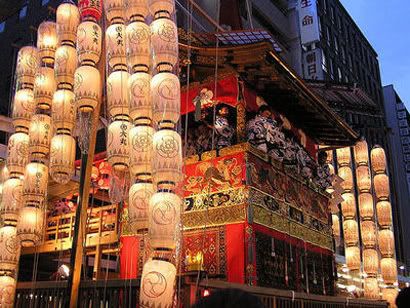
One of the many floats that Gion Matsuri is famous for, softly lit by paper lanters during Yoiyama.

I'm on my way to Kyoto's Gion Matsuri, on of Japan's biggest festivals. Expect me to be MIA until Monday (^o^)< Washoi! If you've never heard of this ancient, month long party in Japan's traditional culture capital, check these out!

Gion Matsuri:Yoiyama
Gion Matsuri: Yamahoko Junko

Don't worry! I haven't quite finished expounding the finer points of anime, as exhibited by BLEACH. All previously scheduled programming will resume with when I return! Have a great Ocean Day Weekend, everyone (^-^)v. Let us join Japan in expressing " our gratitude for the favor of the sea," and the Happy Monday System, too!

Tuesday, July 11, 2006

On My Conversion from Anti-Anime to Anime Addict

Photobucket - Video and Image Hosting
No, I haven`t dyed my hair a las Hilton heiresses. This is much more serious.

I`ve become addicted....to Anime. Well, one anime in particular.

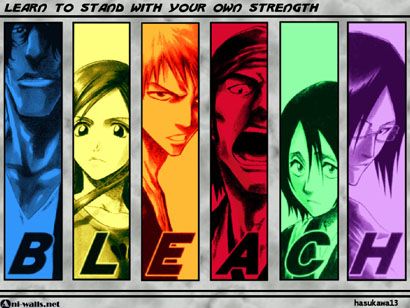
BLEACH.

"So what? No big deal! Anime is anime-zing! " You might say, but to be honest, I was about as Anti-Anime as anyone could be. I vaguely remember watching the classic Akira with my older brother as a junior high schooler, and promptly forgetting it ever existed. I also recall trying to pass the 4 hours of complete and utter bordem afforded by my Saturday detention (part of my punishment for 'inciting a riot and being obligerent to an officer` in my cheerleading uniform) by sketching a wide-eyed, anime-style girl, although I don't know what posessed me to do so. Other than Akira, my Asian exposure was almost nonexistant, and I made little effort to rectify my ignorance on the subject. For one thing I was too busy concentrating on other cultures and forms of art, speaking Spanish, escaping to Mexico, playing softball and any other sport the boys would let me get in on, cheerleading, or partying. Japan was an exotic land of sushi eating samurai and geisha on ketais (cell phones), lost in a neon colored concrete jungle...And it was the last place I ever thought I`d end up.
Photobucket - Video and Image Hosting

I'm not sure why or how, but by the time events had conspired to send me to Japan as a study abroad student (my senior year of university), I had somehow formed a rather unfavorable opinion of anime (despite of my lack of information on the subject) . I was shocked to find that at least half of the gaijin students at Kansai Gaidai had come to Japan with the expressed intent of watching anime they couldn`t see in their home countries. While the other half of us explored the adventure-filled streets of Kyoto and Osaka with our new Japanese tomodachi, they stayed in the dorms watching anime, or dressed up in their Cosplay-best and headed to the nearest gathering of anime otaku (dorks, nerds, freaks).

Japan's culture and customs were basically brand spankin' new to me. I had been transported from a land where cartoons and comics were mostly for small children, to a hardcore manga metropolis where everyone from the ojiisan's (old men) waiting for the next bus, to my university-aged boyfriend, stood in cornerstore conbini's for what seemed like forever, viewing the newest, phonebook-sized releases of their favorite comics. Buisnessmen in gloomy black suits shamelessly scanned page after page of manga on crowded trains, even when they were blatantly pornographic. Sexy depictions of young girls in school uniforms and the shady, smiling, salarymen staring at them seemed to me to be the source of the problematic tsukebe and chikan (perverts) obsessed with anonymously violating women on crowded trains, not to mention the endless score of old men that paid young girls to 'play' with them (enjou kosai).


The original opening for Bleach to one of my favorite Japanese songs: *ASTERIK* by Orange Range.

The connection stuck. Needless to say, I made it through an entire 3 and a half months of study in Japan without ever reading manga or watching anime, not to mention the 3 years since then. In fact I was irritated when, during my breif visit back home for a friends wedding, I found an entire section devoted to Anime at a Borders book store. Shelf after shelf of big-eyed, big-breasted, long-legged school girls, in sailor uniforms, with super-short skirts and clothes molded to every curvey contour of their illustrated bodies.

The seemingly huge success of anime in America shocked me, especially since it seemed to have created and conquered such a huge market in such a short period of time. For the first time, I wondered..."What is it that makes Manga and Anime so special? How are they able to transcend the boundaries of age, nationality, ethnicity, and sex?" Let's face it. People all around the world are obsessed!

Depite the fact that I had always admired the art form, I never considered investigating the substance behind the style.

That is, until now.

Enter BLEACH.

...to be continued

The Joys of Engrish

Photobucket - Video and Image Hosting
A T-shirt in Osaka.

If ever the army of native-speaking ALTs, invited to invade Japan to teach "proper" English, should succeed, thus eliminating the miracle of Engrish in its purest, most unadulturated form, the saddness and sense of responsibility I would feel for taking part in such a tragedy would be nothing something unBERRYBERRYable.

Sunday, July 09, 2006

また七夕: Tanabata Revisited

Photobucket - Video and Image Hosting
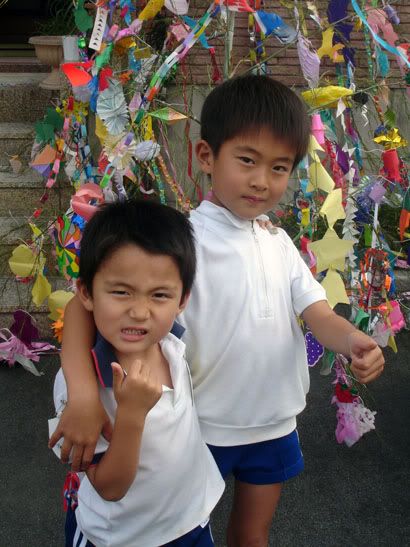
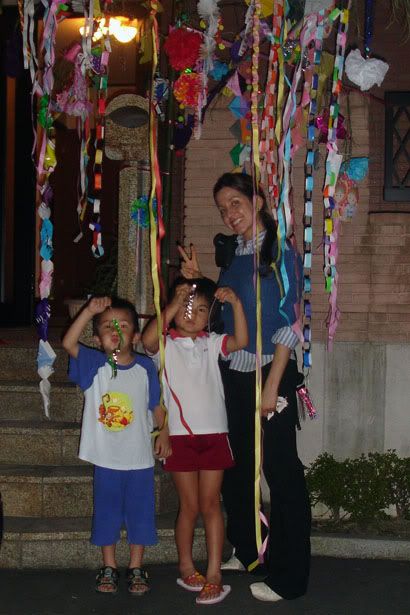
Growing up in a Geisha house makes you tough! Ryu and big bro Kaito beneath the branches of their Tanabata tree. Warning! Due to inherent laziness, this post you are about to read may be recycled from a previous post concerning the same topic. Reader discretion is advised.

Tanabata, Japan's version of the Chinese festival Pinyin, or “The Night of Sevens" (because it falls on the 7th day of the 7th month), celebrates the love between the stellar shepherd boy, Hikoboshi (Vega), and the Weaver Princess, Orihime (Altair). Although the shepherd boy was of lowly birth, the princess’ father, the Emperor of Heaven, worried that Orihime worked so hard weaving cloth for the gods that she had time to do little else, allowed them to be married. They were so in love, however, that they neglected their work and spent all of their time together.

Photobucket - Video and Image Hosting
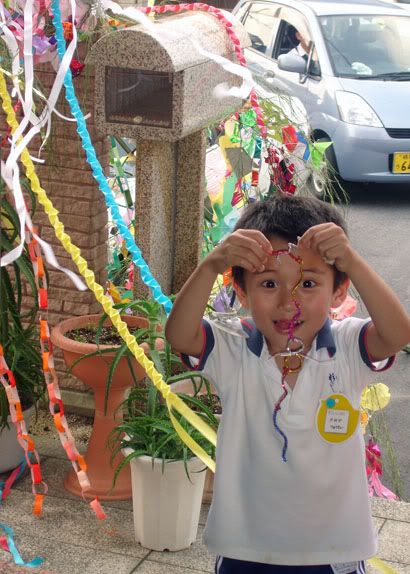
Ryu, holding his hand-made tanabata ornament.

Without the princess to weave their heavenly cloth, the once oshare, stylin' gods were forced to sport the same threads again and again, causing them to loose face and fall in their social standing (not to mention the public opinion polls). Without a herder to care for them, the flocks were scattered and scared. The infuriated emperor forced the love-struck couple to split, relocating them on opposite banks of the River of Heaven (the Milky Way). Watching each other from afar, they tried desperately to focus on their work, but their depression overcame them. At last the emperor took pity on them, and promised to let them meet once a year if they worked as hard as they could. At the chance of being together again, they began to work as hard as before. Ganbaruzo!

Photobucket - Video and Image Hosting
Ryu, Moe and I beneath the tree. Moe has been taking Nihon Buyou, or traditional Japanese dancing lessons, since she was 3. All the girls ( 6 Geisha) in dance.

True to the emperor's word, every year on the 7th night of the 7th month, a magical bridge of magpies forms over the heavenly river, allowing the young lovers meet. It is said that if it rains, the heavenly river overflows, and the young lovers must wait another year for their chance to meet again.

Unfortunately for them, Tanbata falls right in middle of Tsuyu, Japan's rainy season.

On Tanabata Eve I went to the Kamiya house (which just happens to be a modern Okiya, or Geisha house, albeit in good old inaka Ena) for our weekly English playtime. In front of the house, proped up on the porch, was a fresh, green bamboo tree, decorated in a rainbow of intricately folded origami and long, colorful strips of paper wishes. Traditionally people wrote their wishes for the star crossed lovers to be reunited, but nowadays people write their own wishes and hang them on the bamboo tree in hopes that they will be granted. If the rain holds off and the lovers can meet, they believe their wish will come true, but if it rains, they, too, must wait till next year.

Are you wondering if it rained? It's TSUYU! Of course it rained! No wish for you!

Monday, July 03, 2006

Hisamari

Photobucket - Video and Image Hosting
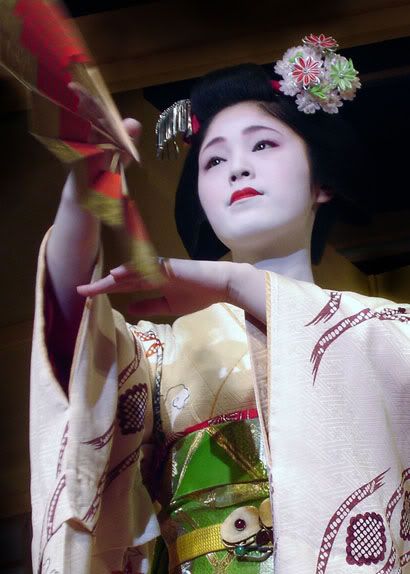
Hisamari, the most beautiful, popular and successful maiko in Pontocho, performing in this spring's Kamogawa Odori.

Souji Time!


Souji is just one of the many time-honored traditions that unite students scattered throughout the islands of Japan. A special time for students to come together to fight grime and gomi (garbage and dust), it is a time of meditation, a chance to reflect on and purify not only their school surroundings, but their internal minds as well.

That's right! In Japan, there are no custodians to clean up after the students~the students "clean up" after themselves! Every day, as the precious freedom of recess draws to an end, "cleaning time" music shoots from speakers strategically placed throughout the school, summoning students to their battle stations. Equipped with all manner of low-tech weapons in the war against grime, the most important of which are mini-brooms and zouki (cleaning rags), students engage in a 20 minute battle to reclaim the cleanliness of their school.

This video is a salute to their fighting spirit...

(Thanks to Luke at Gaijin for Life for sharing! *bows* m(- -)m )

Thursday, June 29, 2006

Sunday, June 25, 2006

Internationalization...

A la Backstreet Boys


A couple crazy kids in China, lip sync'n to the Backstreet Boys. I'm sure most of you out there have already seen this, but since I've only just discovered it I consider it my duty to share it with the world! (Despite the fact that it is not directly related to Japan in anyway, unless it is to remind those of us here in Nihon how far behind the rest of Asia Japan's English education system is. I mean, who needs JETs when you've got the Backstreet Boys)?

ぜひ見てください!本当に面白いのよ!

Friday, June 23, 2006

Tuesday, June 20, 2006

It's Pow Wow Time Again...

Photobucket - Video and Image Hosting
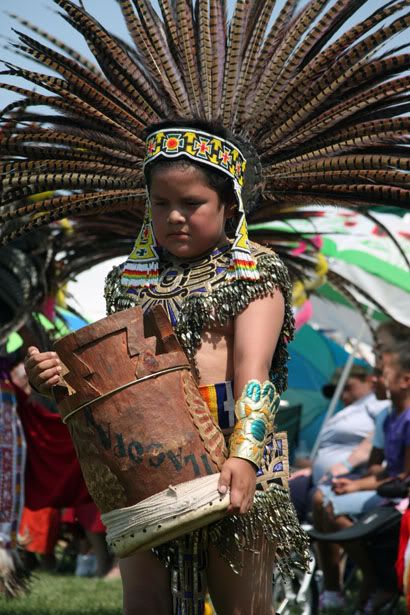
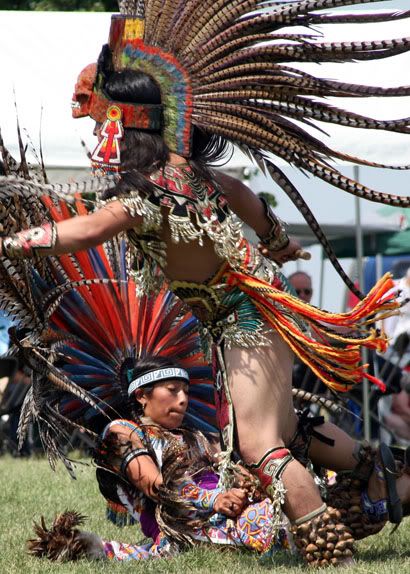
An 8 year old Aztec boy in full regalia at Cleveland's annual Edgewater Pow Wow.

Unfortunately I'm back in Japan, just in time to miss it all. Luckily I was able to make a breif cameo at Cleveland's annual Pow Wow at Edgewater Park before getting back to work after a 10 day stay in my home sweet home of Ohio, known to almost every Japanese person I meet as the Good Morning State (^-^)/.

The last time I had the privledge of attending a Pow Wow was almost 2 years ago at Mohican, before begining my new life as a JET in Japan. You can read more about Pow Wows and see a lot more pictures here and here.

Photobucket - Video and Image Hosting
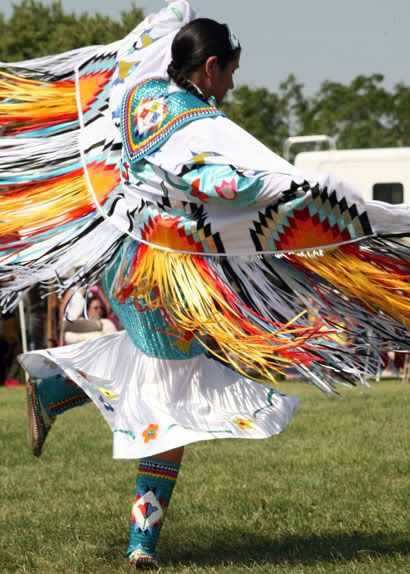
A young girl showing off her wonderfully colorful shawl during the fancy dance competition.

An Aztec teen sporting an impressive headdress at Edgewater's annual Pow Wow.

Photobucket - Video and Image Hosting
A young grass dancer tearing up the arena in some wicked regalia.

Photobucket - Video and Image Hosting
An aztec battle dance.

Photobucket - Video and Image Hosting

Thursday, June 15, 2006

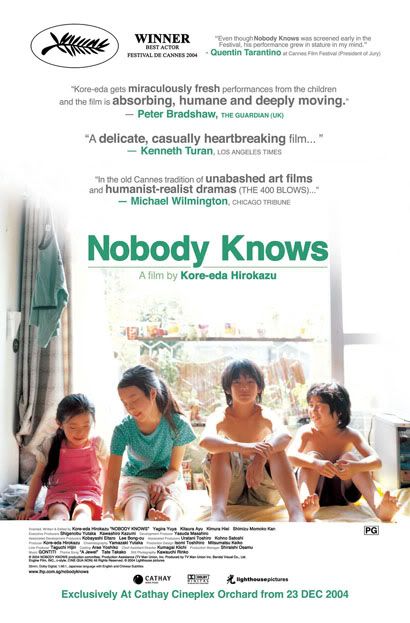
誰も知らない: Nobody Knows

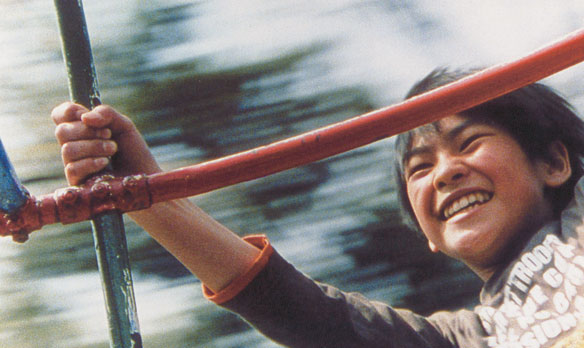
At the age of 14, young Yuya Yagira was named Best Actor at the Cannes Film Festival for his performance in Nobody Knows.

I'm back in the good ol' US of A for my best friend's wedding, which finally gave me a chance to see Daremo Shiranai, or Nobody Knows, a film I have wanted to see since before coming to Japan in 2004.Seems you can take the gaijin out of Japan, but you can't take Japan out of the gaijin (^-^)/

Inspired by the "Affair of the Four Abandoned Children of Nishi-Sugamo," Nobody Knows is based on the true story of 4 children abandoned by their mother in Tokyo in 1988. Each born of a different father, the children's births were never declared, making them legally non-existant. Even in the real world their existance reamined a secret. Never allowed to attend school, only the oldest boy was even permitted to leave their small apartment. Abandoned by their mother, the children lived alone for six months, and were only discovered when one of the young girls, weakend from malnutrition, died in an accident, tragically ending their desperate adventure. Unbelievably, not one inhabitant of the small apartment building was ever aware of the existance of the 3 young children.

For anyone interested in modern Japan, Nobody Knows is an amazing, moving, and heart-breaking work of art, offering a rare and fascinating glimpse into the culture of modern Japan, and a thought-provoking study of human nature.

I have a lot to say about this movie, but no time! Until then, rent it. Watch it. Photobucket - Video and Image Hosting

Saturday, June 03, 2006

Suicide: The Enduring Way of the Samurai?

Random picture of the day: A Pontocho geisha perfroming in Kamogawa Odori. Pontocho is one of Kyoto's 5 hanamachi, or geisha districts. This image has absolutely nothing to do with the following post. (^-^)v

Japan's total fertility rate, an indicator used for international comparisons of birth trends within individual countries, fell for the fifth consecutive year, hitting a record low of 1.25.

At the same time, suicides in Japan topped 30,000 (32,552) for the eigth straight year.

Not a good combination.

Japan's suicide rate is one of the highest in the world-- triple that of Great Britain, and double that of the United States. Suicides started to rise in 1998, when the country was mired in an economic slump. Since then the number of suicides has exceeded 30,000 every year. Males account for more than two-thirds of the total, with health problems and economic woes being cited as the most prevalent causes, respectively.

This year the number of students committing suicide reached 861, up 9.8 percent. University students accounted for more than half of the total, along with 7 elementary school pupils, 66 junior high school students, and 215 high school students .

Japan's cult suicide scene is also growing, with the number of Japanese killing themselves in groups rising steadily in recent years, from 34 in 2003 to 91 last year.

No religious prohibition exists against taking one's own life in Japan, condemning it as a sin or affront to god. Confucianism, in fact, sanctions suicide as a form of protecting one’s honor or protesting injustice. Suicide was once a form of ritual atonement for samurai, a poetic, redemptive act of purpose, considered to be both heroic and beautiful. Today it is a means of escaping failure and saving loved ones from embarrassment or financial loss.