Showing posts with label world heritage. Show all posts

Wednesday, January 10, 2007

New Years: Where Else?

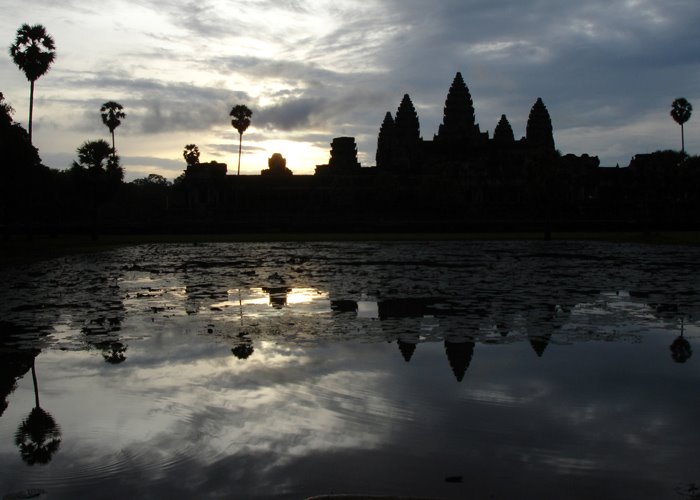
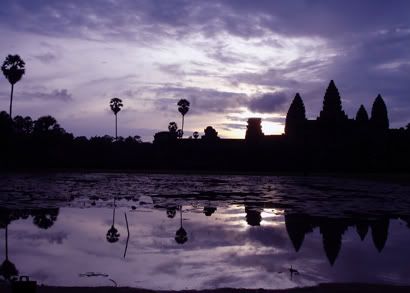
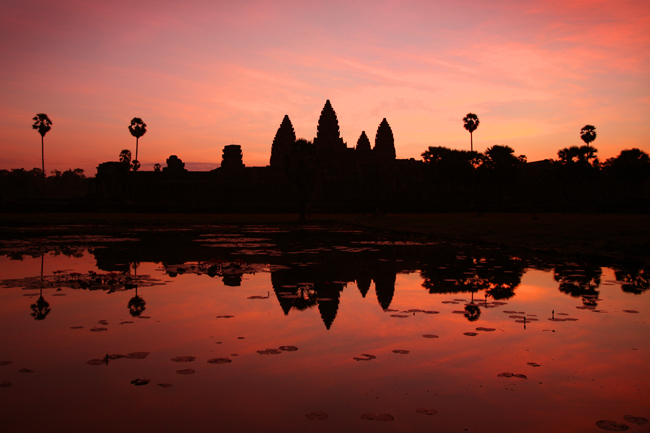
Just before the sun rose over Angkor Wat on the first day of 2007. 明けましておめでとう!今年もようりしくね!

It's only been a few days since I let the colorful cambodian capitol of Phnom Penh, its bustling streets overflowing with life, laughter, poverty, and hope, but the Khmer colored collage of city and countryside is still fresh in my mind. Painted in thick, textured strokes of dry, golden rice fields, shimmering swirls of warm sunlight, and the dark, midnight shaded sihouettes of tall, slender sugar palms against a radiant, ruby and clementine sky, I might as well have been sharing the view with Van Gogh.

I can still taste the restless, rust-colored clouds of dust that swallowed my mighty motodup and I, resurrected from dry, dirt roads by the occasional passover of a precariously packed pick up. Men, women, children, animals, furniture, some standing, some seated, some sitting on top of each other or other cargo, some hanging on for dear life, all smiling at me from beneath their colorful, checkered scarves as they passed. I can still hear the bubbling laughter of children jumping into ponds filled with blue skies and floating water lillies, with only drops of sparkling water covering their richly spiced, chai colored skin like fine, jeweled silks.

Billowing saffron robes draped with modest dignity over deeply bronzed skin dot the landscape of my memories, pausing beneath matching umbrellas to bless an almsgiver.

Shoeless children, with smudged faces and tattered clothing, carry bags too big for their small bodies, collecting whatever might fill the emptiness in their bellies or fetch a few hundred Riel. Heart-breakingly beautiful children, their knotted hair lightened by malnutrition, covered in scabs, bug bites, dirt, and little else, sleeping peacefully in the shallow shelter of a store front. Others stand as if under a spell, holding small bags to their mouth, filling their lungs with poison.

Cambodia.

Sometimes I just don't know what to say.

Perhaps I should start by finishing the last chapter in my travels there: Battambang.

Friday, October 06, 2006

The Land of Eternal Smiles

good bayon2
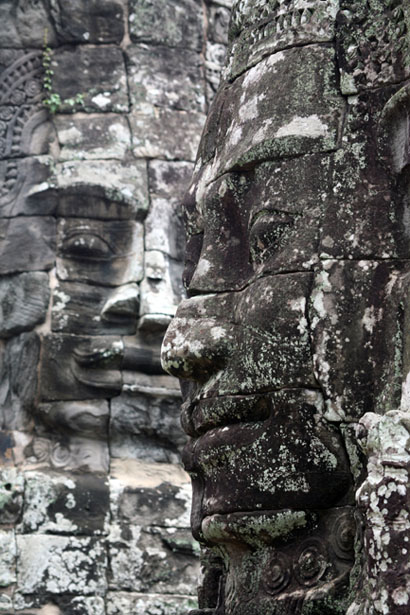
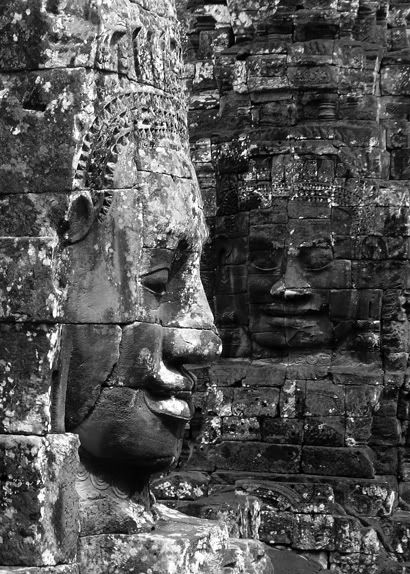
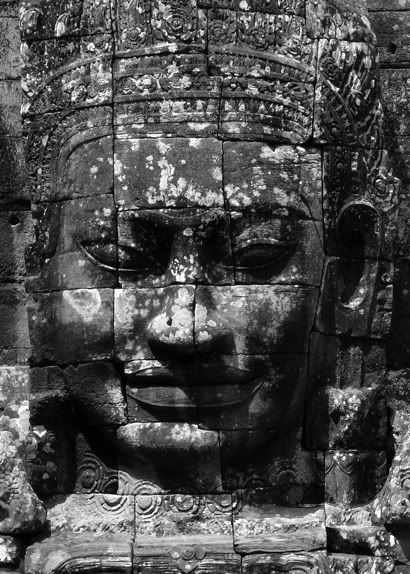
Just 2 of the 216 enigmatic faces keeping watch over the Bayon, Angkor Thom.

A manifestation of King Jayavarman VII`s mystic Buddhist beliefs, the Bayon is a spiritual experience. Built in the 13th century, it was the last state temple to be built at Angkor, and the only one to be built primarily as a Mahayana Buddhist temple. From each of the survivng 54 towers, standing in the center of Angkor Thom, the kingdom's capitol, the enlightened grins of the Boddhisattva Avalokitesvara, one of the most worshipped divinities in Mahayana Buddhism and the kingdom's principal divinity, watches over the temple and out into the surrounding jungle. Carved in the likeness of the King himself (his portrait is known from other sculptures found elsewhere in Cambodia and Thailand), these enigmatically smiling faces portrayed the King as god, symbolizing his omnipresence and omnipotence.

When Chou Ta-Kuan visited Angkor in 1297-98, Bayon's towers were covered in gold, which was stripped by later conquorers. While Angkor Wat was kept from the ravages of the jungle by Buddhist monks, Bayon was forgotten- left to the mercy of nature. Four and a half centuries took their toll...

Experience a little bit of the Bayon for yourself, here.

Wednesday, September 13, 2006

Thursday, August 31, 2006

Sues'day!

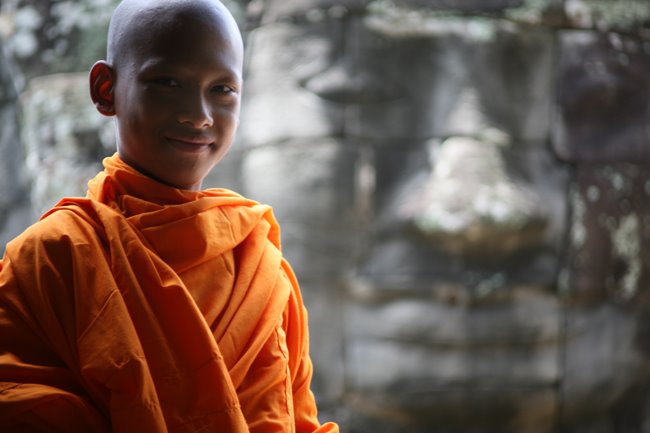
The smile of a young monk (17 years old) reflected in the ancient carvings of the Bayon, Angkor Thom, part of the world heritage Angkor Wat temple complex in Siem Reap, Cambodia. Behind him, one of 216 faces watch over the temple.

Thursday, January 19, 2006

Literature, Lakes and Legends

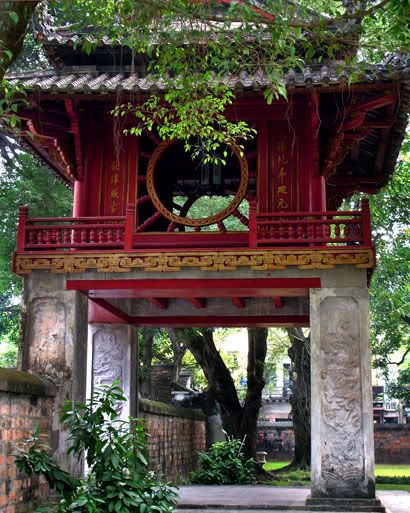
The Temple of Literature

Image hosted by Photobucket.com

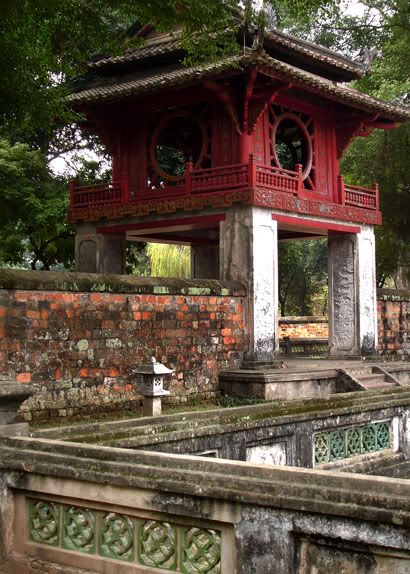
Originally built in 1070 in the Ly dynasty, the temple is a shrine to Confucius and his disciples responsible for spreading his teachings. Six years later, Quoc Tu Giam or School for the sons of the Nation was established for the princes. The school later admitted sons of mandarins and finally commoners were allowed to attend but, only after they passed a rigorous examination at the regional level. Today it is a a place to memorialize the most brilliant scholars of the nation's past.

Image hosted by Photobucket.com

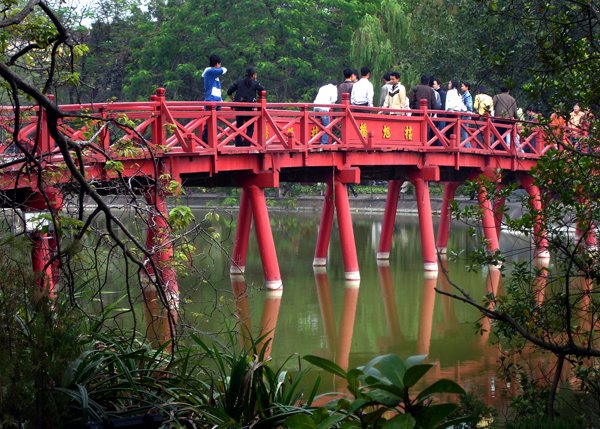
Lake of the Returned Sword

The crimson curve of the Huc, the bridge of the Rising Sun, archs over the emerald waters of Hoan Kiem, the Lake of the Returned Sword,to the Ngoc Son temple.

During the 15th century, the great king Le Thai To (Le Loi) led his armies in battle against Chinese invaders beneath the blade of a powerful sword, bestowed upon him by the gods. After 10 years defending his people, he finally defeated the Chinese and reclaimed Vietnam's independence. With the war over, the king and his courtiers took a leisurely boat ride over the calming waters of the Green lake (as it was known) when suddenly a giant turtle surfaced. The king drew his sword, pointing it at the creature. The turtle immediately took hold of the sword with its mouth and plunged to the depths, returning the sacred blade to its divine owners.

Mourning the loss of such a valuable sword, the king ordered that the lake be drained and the sword recovered, but when it had been emptied, both the turtle and sword were gone. Realizing that the sword had been a gift to help the king defend his country, he renamed the green waters the"Lake of the Returned Sword."

This story is retold in thousands of schoolbooks, and in popular performances at Hanoi's water-puppet theaters. It is believed that giant turtles still live in the lake, although they very rarely surface.

Personally i'd prefer the "watery tart" of King Arthur, but turtles are cool, too.

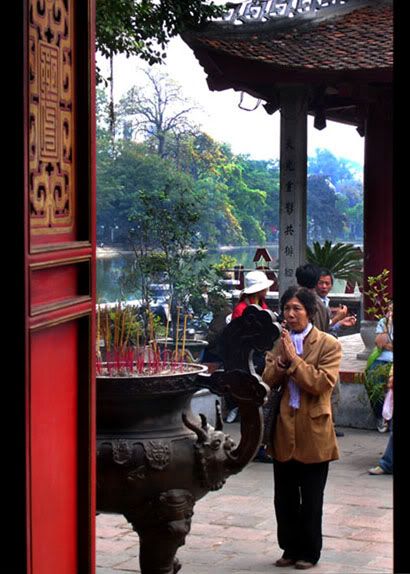
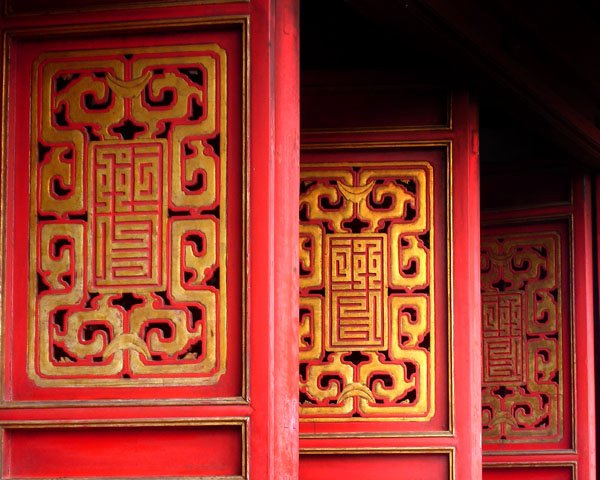
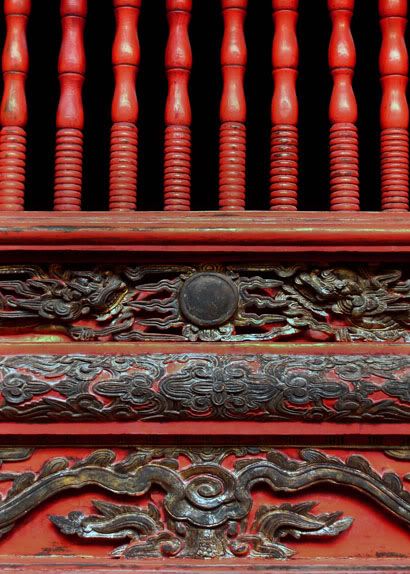
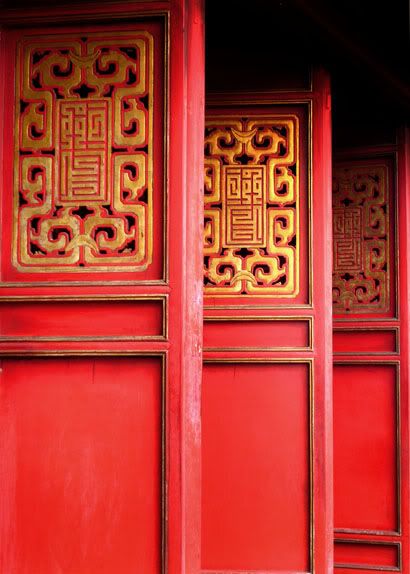
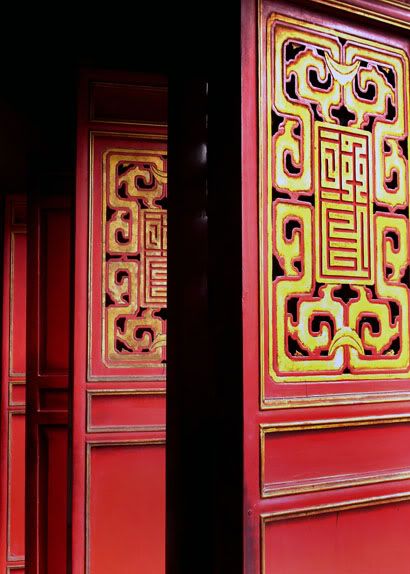
Ngoc Son Temple: A Study in Red

Image hosted by Photobucket.com

A woman praying in the courtyard of Ngoc Son, a shrine dedicated to the patron saint of literature who was often called upon for help by those taking the various tests required to become a mandarin. It is also memorializes a national hero responsible for many victories against the Mongols.


Image hosted by Photobucket.com

Image hosted by Photobucket.com

Image hosted by Photobucket.com

Wednesday, October 19, 2005

Ta Prom: The Jungle Temple

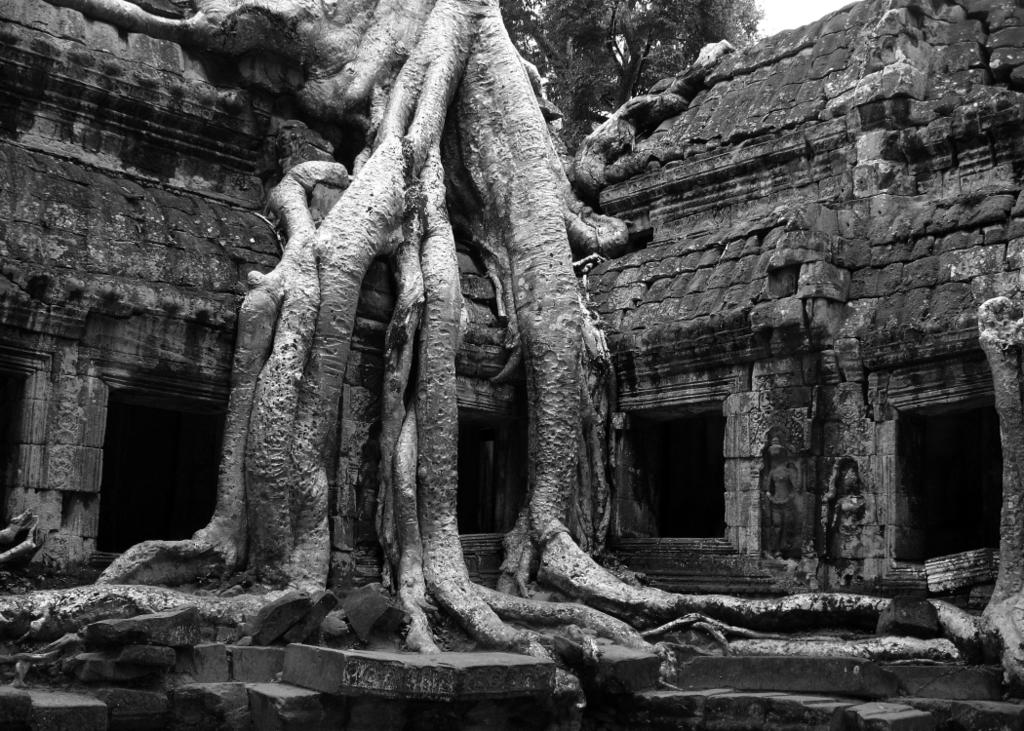
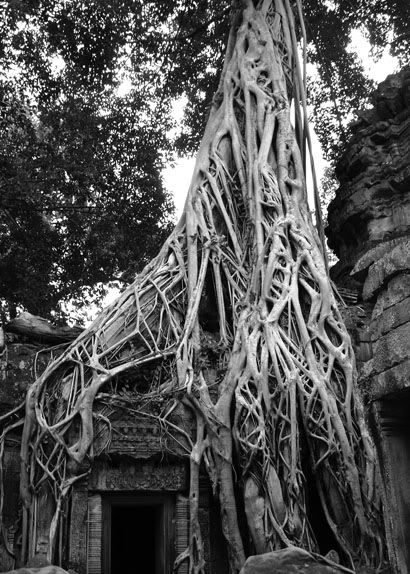
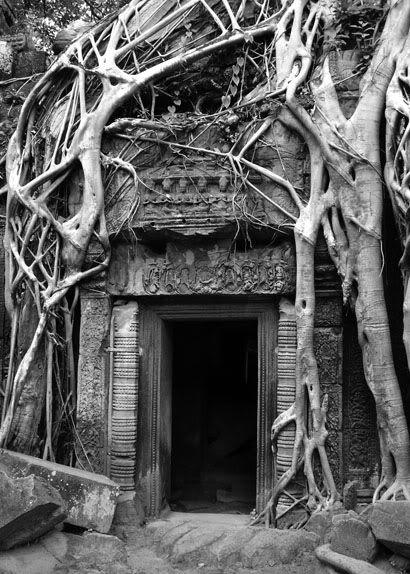
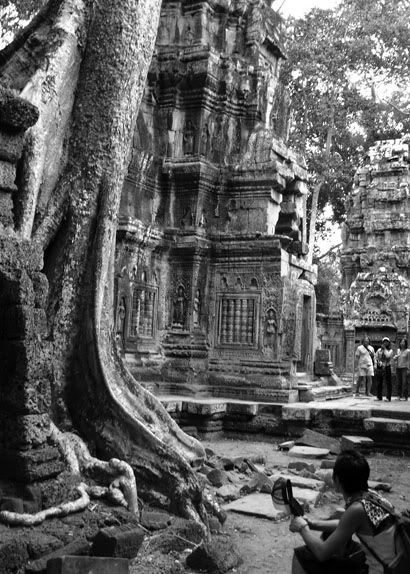
The temple of Ta Prom has been left more or less as it was found, with an overgrowth of jungle and portions tumbled down. It gives you some idea of what the first westerners found when they began exploring the area in the late 19th century.

When I told people I was going to Cambodia, they often asked "Cambodia? Why? What's there?" Once I said Angkor Wat, a light went off in many of their heads. "Oh! That's where they made Tomb Raider! Sweet!" Well, I haven't seen Tomb Raider (Angelina Jolie), and I probably never will. If you have, this may look a bit familliar.

Image hosted by Photobucket.com

Massive webs of Banyon roots cling to sandstone walls, stained by centuries and dancing with intricately carved apsaras. Mounds of moss-rocks, victims of neglect and the the crushing roots of the encroaching jungle, lie defeated, scattered throughout the temple grounds. Droplets of light trickling through the lush green foilage, caught in the mist of monsoon season, creates a mysterious, ethereal air.

Though many signs warn tourists of the danger of exploring most of the tumbling temple grounds, I couldnt help but scatter up mountains of fallen stones into hidden courtyards,stumbling over the tangle of knarled roots slithering down the walls and through the temple passages, and past the warning signs standing gaurd in the darkened doorways of the temple's shadow-veiled interior. I even stumbled into a small chamber acoustically designed so that when I beat upon my chest, the entire temple seemed to shutter from the thunderous echo. I was in full Indaina Jones mode. I could have stayed there forever.

Image hosted by Photobucket.com
Apparently this is the doorway where Angelina Jolie bends down and picks something up. Anyone who's seen the movie, please feel free to elaborate!

Image hosted by Photobucket.com

I was lucky to visit the temple at a time when most tourists are headed elsewhere! These few stand in awe.

Monday, October 17, 2005

Angkor's Apsaras

Image hosted by Photobucket.com
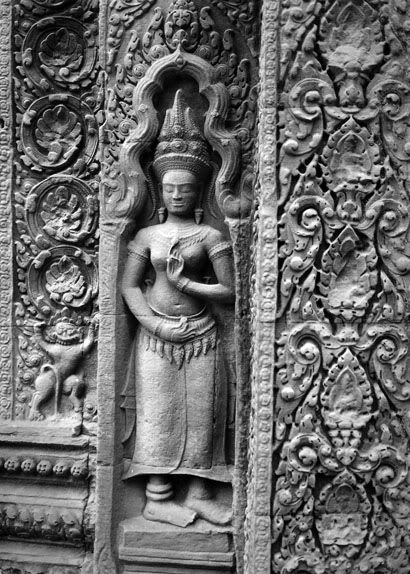
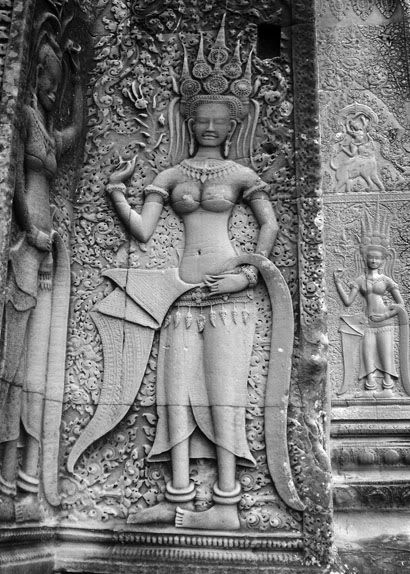
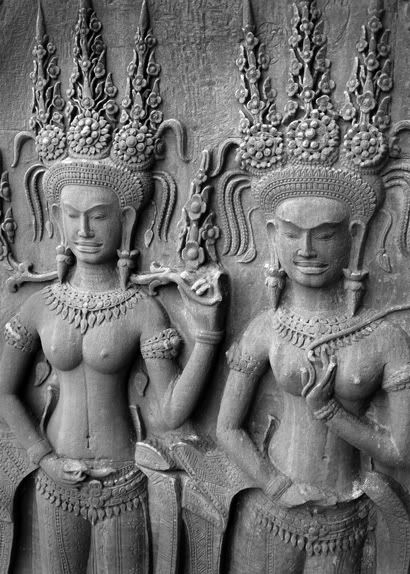
Apsaras are an embodiment of the ideal female beauty in Cambodian culture. Both modern and ancient Khmer artists rendered them elaborately and with great emotional intensity.

Dance in Cambodia is as ancient as the temples of Angkor, whose carved facades seem to dance. A single gallery in Angkor Wat alone features over 1,500 of these dancing nymphs, synonomous with the Cambodian idea of beauty. The word apsara derives, like much of the culture of ancient Angkor, from Indian Hindu influences. Apsaras were lesser goddesses of unimaginable beauty who danced for the entertainment of higher gods.

Image hosted by Photobucket.com

The dancers originally performed topless, and so they are often depicted in has-relief. It was only due to later Chinese influence that they began performing clothed. The dances features over 4,500 body movements known in Khmer as kbach. A pin peat ensemble consisting of oboes, xylophones, gongs and drums provides musical accompaniment along side singers who narrate the stories.

Image hosted by Photobucket.com

The term "apsara dance" today is interchangeable with court classical dance. At the height of the Khmer Empire, it is estimated that there were 3,000 Apsara dancers in the 12th century court of King Jayavarman VII. When Angkor was sacked in at the begining of the 15th century, the Apsara dancers were seized and taken to Thailand. Classical dance survived, and its influence spread throughout the region.

The Khmer Rouge considered dancing to represent the decadent Royalist society itwas determined to stamp out. Its proponents were executed or sent from their city homes to work in a countryside they did not understand. It is estimated that 90 percent of all dancers and musicians were killed during the reign of the Khmer Rouge regime. Along with them died the knowledge of many dance and theatre forms. Thankfully, those who survived have dedicated themselves to preserving this ancient art of Cambodian culture, and passing it on to the next generation.

Sunday, October 02, 2005

The Faces of Bayon

Image hosted by Photobucket.com
When Zhou Daguan visited Angkor in 1297-98, Bayon's towers were covered in gold. While Angkor Wat was kept from the ravages of the jungle by devoted Buddhist monks, Bayon was forgotten, left to the mercy of nature.

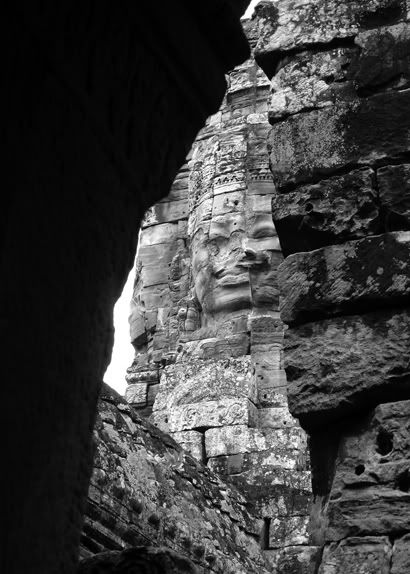
From a distance, it seemed the jungle had taken its revenge on the eerie mass of jumbled rocks known as Bayon. I approached it in awe as hundreds of faces began to emerge from the tangled mass of stone and shadow. 54 towers chaotically assaulted the sky, each in its own plain, creating an intimidating sense of height.

When Chinese ambassador Zhou Daguan visited Angkor before the dawn of the 14th century, the city was dripping with the gold and riches of empire.

Image hosted by Photobucket.com

"At the center of the Kingdom rises a Golden Tower flanked by more than twenty lesser towers and several hundred stone chambers," Zhou wrote.

"On the eastern side is a golden bridge guarded by two lions of gold, one on each side, with eight golden Buddhas spaced along the stone chambers."

The"golden" period of the Khmer Empire was not a peaceful one. Rival powers from present-day Vietnam, Thailand, and Burma struggled with the Khmers for regional domination. Ironically, the Khmers' architectural prowess aided in their demise, as extensive temple construction, combined with frequent military conflicts, eventually drained the empire's resources. As the empire declined, Angkor was sacked several times, the gold and jewels stripped as spoil by invading armies. Bayon was one of the last great achievements of the empire, but fell in 1432 to the Thais, and was soon after forgotten.

The gold and jewels may be gone, but the mystique and grandeur of the Khmer kingdom endures.


A translation of King Jayavarman VII`s mystic Buddhist beliefs, Bayon is a spiritual experience. From each of the survivng towers the enlightened grin of the Boddhisattva Avalokitesvara, one of the most worshipped divinities in Mahayana Buddhism and the kingdom's principal divinity, compassion radiates out in the four cardinal directions. Carved in the likeness of the King himself (his portrait is known from other sculptures found elsewhere in Cambodia and Thailand), these enigmatically smiling faces portray the King as god, symbolizing his omnipresence and omnipotence.

Image hosted by Photobucket.com
The Khmer Smile.

Bodhisattva Avalokitesvara is believed to be the embodiment of compassion. A bodhisattva is motivated by compassion to seek enlightenment for all beings. The 216 faces haunting the heights of Bayon project benevolence outward in all directions, and are believed to bring hope, happiness, peace, and protection to all, especially those living in the Khmer Empire.


As I wandered around in wonder, watched by the eyes of Big Brother, Bayon-style, I couldn't help but feel like I was trapped in an MC Escher drawing. I don't think I could ever have believed such a place existed, even in my dreams, and I certainly never imagined that someday I would see it with my own two eyes.


Saturday, October 01, 2005

The Road To Angkor Thom

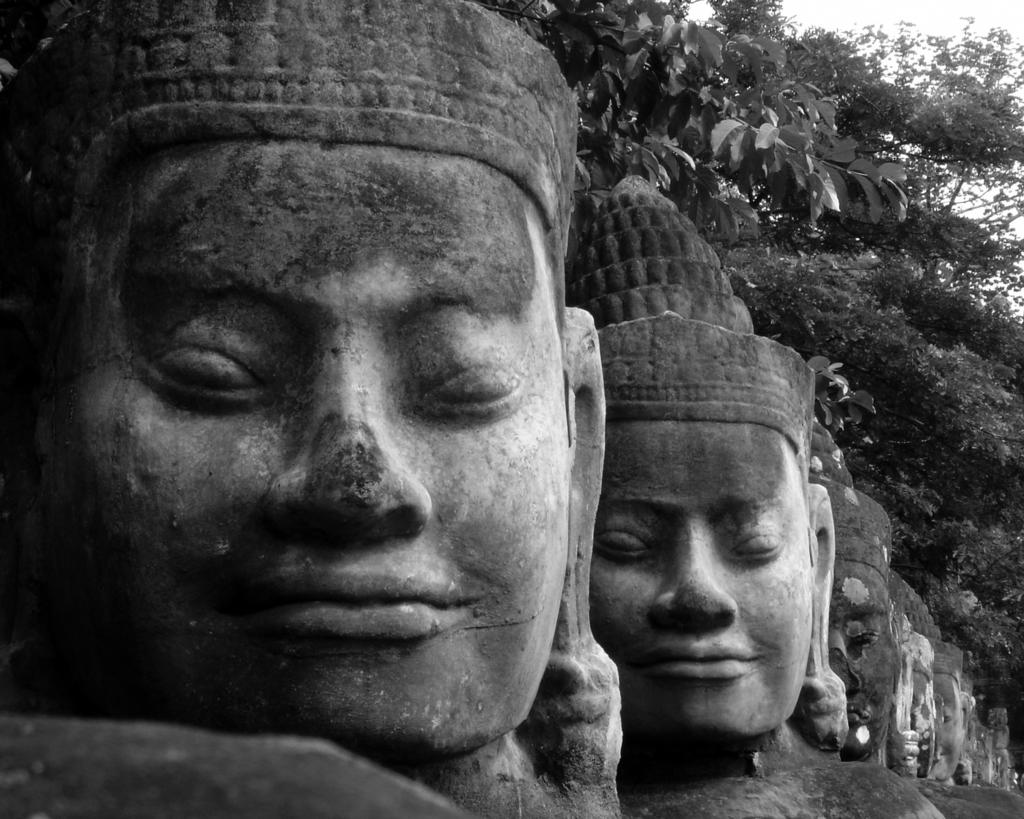
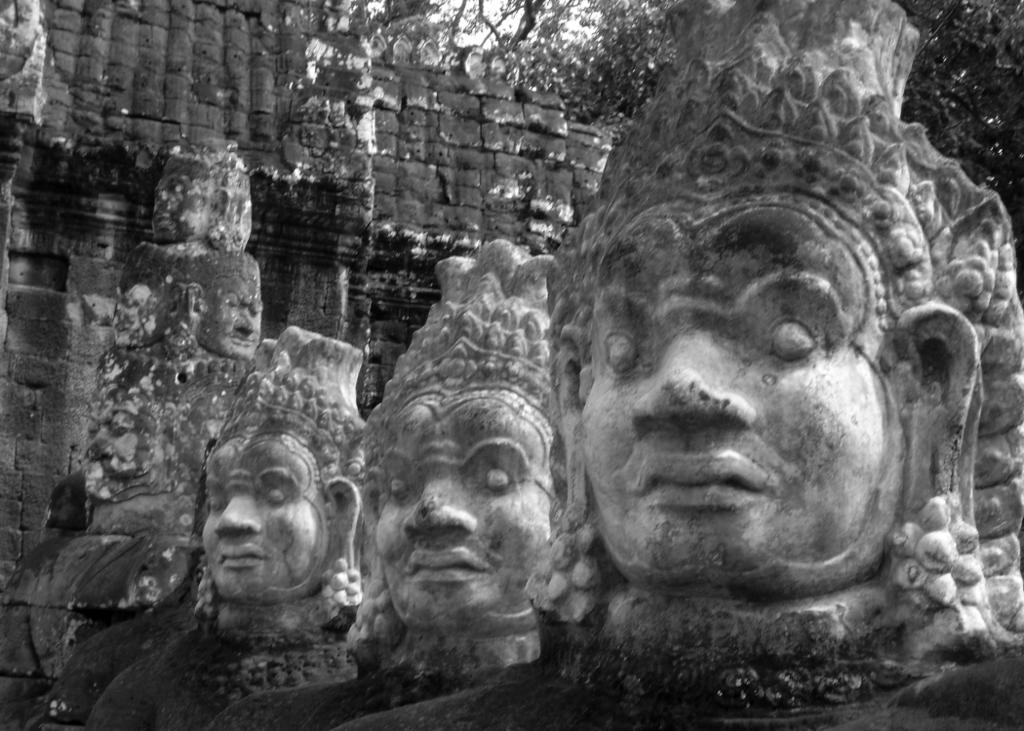
The Enlightened eyes of the 54 devas, or lesser gods, gaurding the gate of Angkor Thom.

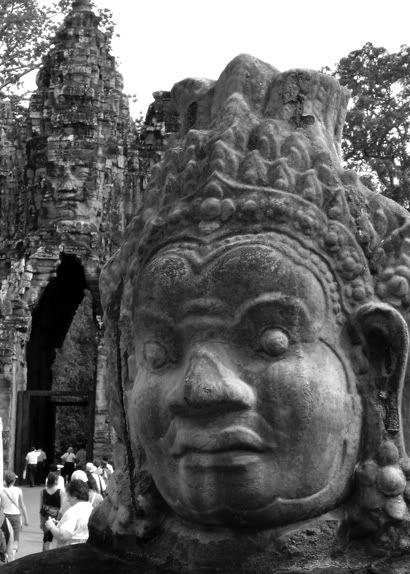
Walking along the narrow road to Angkor Thom, dodging motor bikes and bicycles, a long line of elephants appeared in the shade of the jungle, camouflaged in the shadows of leaves. I watched them as I walked along, until when I finally turned my head I saw a massive stone gate rising up like a mountain, from the peak of which I found a face staring back at me, and two more surveying the jungle in each direction. I came to the foot of a bridge over a large moat, once filled with alligators to detour trespassers like myself. I crossed the causeway, encouraged by the serene smiles of 54 devas on my left, though from my right I felt the heavy stare of 54 demons. Peering down from above, the omniscient eyes of the gatekeeper seemed to watch my every step. I felt as if I were passing through the oracle in the Never Ending Story.

The watchful eyes of Angkor Thom's demons.

Image hosted by Photobucket.com
Niether the gate of Angkor Thom, nor the eyes of its gaurdians, can prepare you for the jewel of the jungle: Bayon.

Friday, September 30, 2005

Home of the Gods


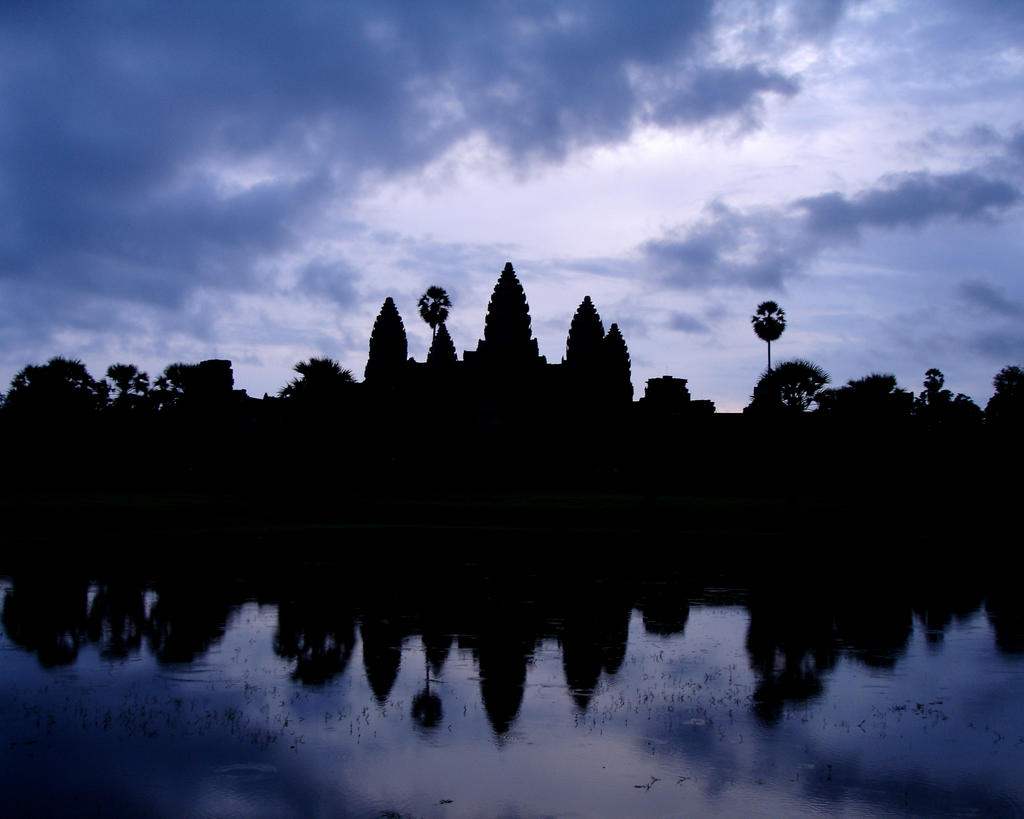
The five peaks of Angkor Wat, reflected in a pool of lilly pads and lotus blossoms, pierce the sky, silohetted by the rising sun. The innermost tower represents Mt. Meru, center of the Hindu universe. Its four surrounding spires symbolize the peaks of the Himalayas.

Thursday, September 29, 2005

On Earth As It Is In Heaven

Image hosted by Photobucket.com

The legendary origins of Angkor Wat (or Capital Temple), according to locals, lie in the story of Preah Ket Melea, son of the king of heaven and a mortal woman. The gods complained that he smelled, and asked his father to send him down to Earth. The king agreed, offering his son the opportunity to have an exact replica of any edifice in heaven erected on Earth with the help of the celestial architect (whom villagers still invoke whenever a building is constructed). A modest man, Preah Ket Melea chose the stable. An ox was released onto the plain of Angkor and the place where it layed down became Heaven on Earth: Angkor Wat.

Wednesday, September 28, 2005

Sunrise Over Angkor Wat

My second day in Cambodia began at 5:30 AM as I jumped from my bed to catch a bus to one of the seven wonders of the world. Charmed by the chanting of the monks nearby, the sun slowly rose out of the darkness, above the five peaks representing Mount Meru, the center of the Hindu universe and home of its gods. I'm back. Hope all of you waiting won't be too disappointed.