Saturday, July 29, 2006

Yoiyama Kyomai : Gion Matsuri

Photobucket - Video and Image Hosting
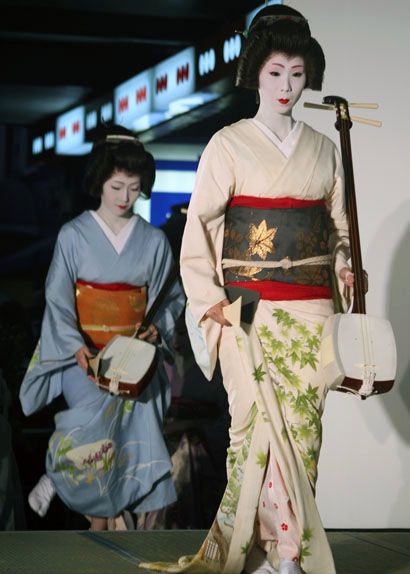
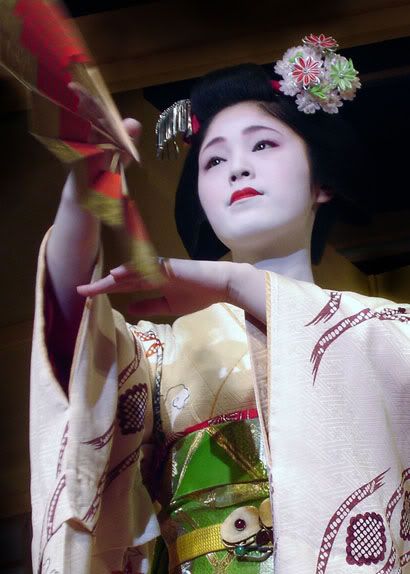
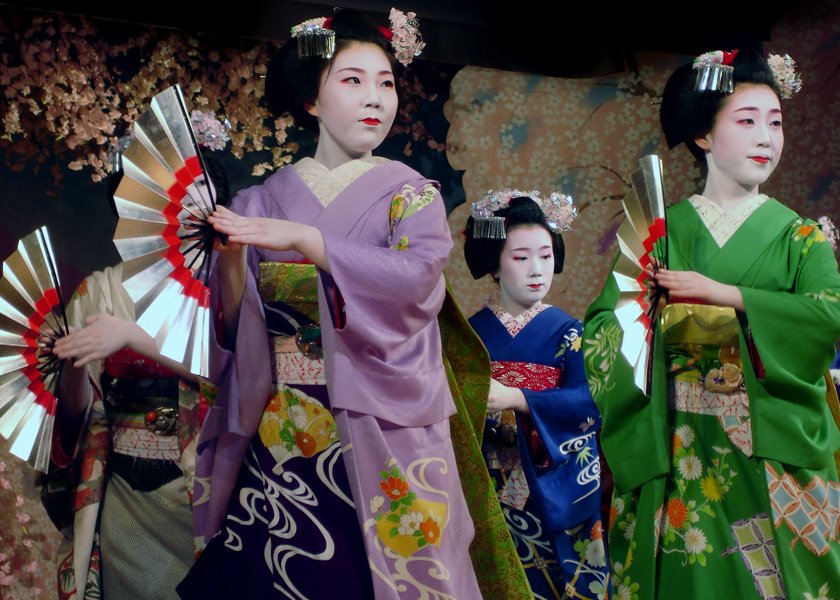
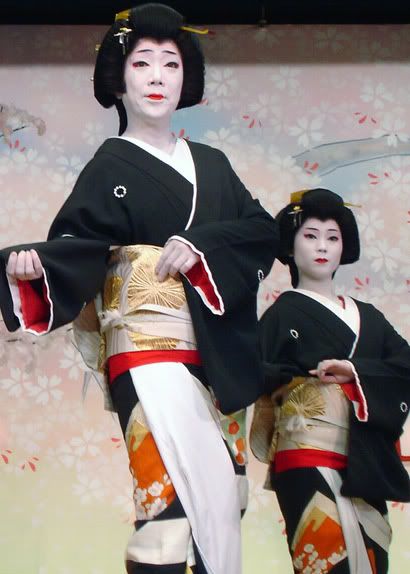
Geiko from Gion glide gracefully across the stage with their shamisens, as the long trains of their kimonos flutter behind them.

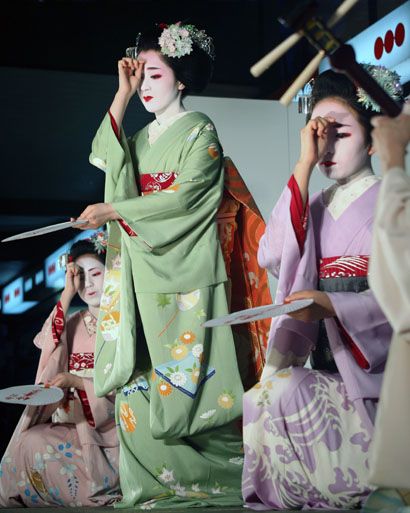
The Geiko took their place on the side of the stage, sitting seiza style, on their knees, and played as 3 maiko danced in the traditional Kyoto style. The maiko in the purple Kimono is Suzuha, who if I am not mistaken, recently appeared on the cover of the Japanese Playboy magazine! She is renowned for her classic beauty among many of Gion's customers.

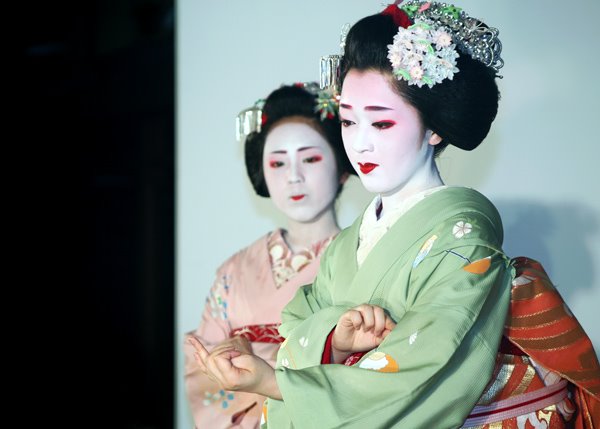
Kotoha, a high ranking maiko (in green) and superb dancer, performed the lead role in the short performance. The young maiko behind her is only in her first year. Her upper lip is not yet painted, and her collar is still predominantly red.

Photobucket - Video and Image Hosting
The extravagance of the flowing layers of colorful silk kimono, the breath-taking contrast of the porcelian-white makeup and delicately painted red lips, and the grace and dignity of the dance set to the haunting music of the shamisen create a scene of ethereal beauty beyond description.

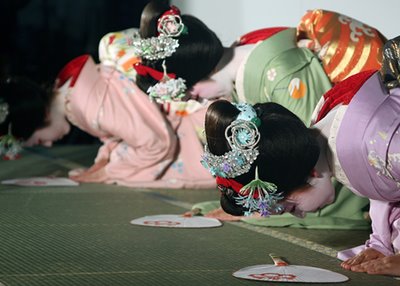
As their dance ends, the maiko bow low to their audience. The maiko wear a very special hairstyle during the month of July specifically for Gion Matsuri.

Sunday, July 23, 2006

Gion Matsuri: Yamahoko Junko 2006


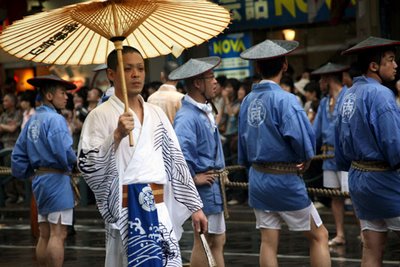
A young man, dressed in his area`s yukata, seeking shelter from the relentless rain that threatened to dampen the festive atmosphere of Gion Matsuri`s most anticipated event: the procession of the gigantic yama and hoko floats. The umbrellaless men behind him wait patiently for their cue to continue pulling their float through the streets. The heavy rain kept spectators to a minimum this year, with only 130,000, almost half last year's record-high of 240,000 people.

Is it still raining? You better your yukata it is!

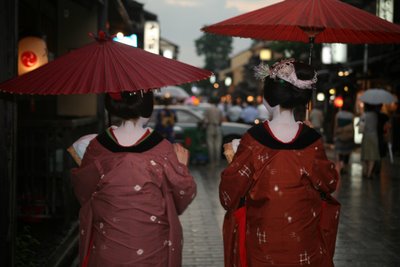
Maiko make their ways through the soggy streets of Gion beneath their beautiful oiled-paper umbrellas.

Friday, July 21, 2006

Gion Matsuri: Yoiyama 2006

Photobucket - Video and Image Hosting
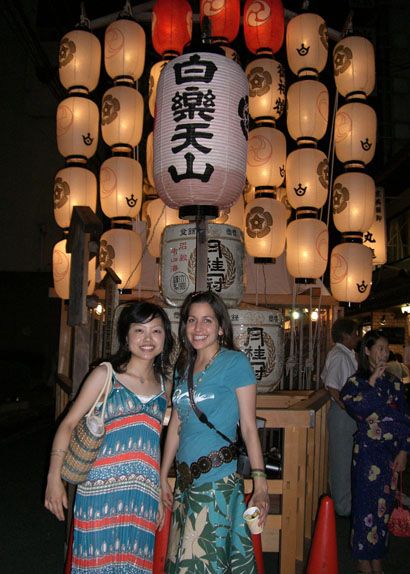
Yuko and I in front of one of the smaller festival floats, haku raku ten yama (White Paradise Mountain) at Gion Matsuri's Yoiyama (the night before the main procession, Yamahoko Junko). Yuko has played a major part in my adventures in Japan since my first day at Kansai Gaidai, when she and a bunch of friends waited for me outside after class and very politely asked if they could be my friend (^-^)/ Look at her! How could I say no? Kawaii! (^-<) *wink*
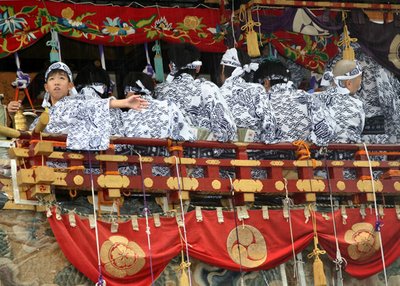
An elementary student performing the sacred Shirasagi Mai, the White Herron Dance, infront of Yasaka Jinja (Shrine) on Shijo dori (Avenue).

A high ranking maiko taking time out of her busy schedule to teach a younger maiko how to count.

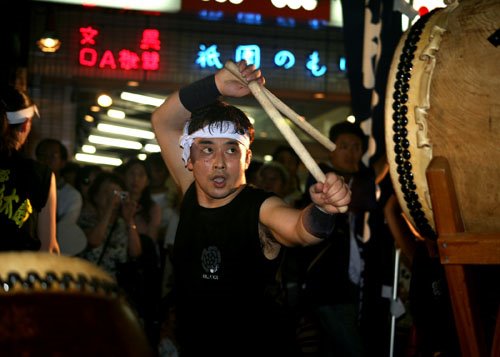
Taiko: It's an art.

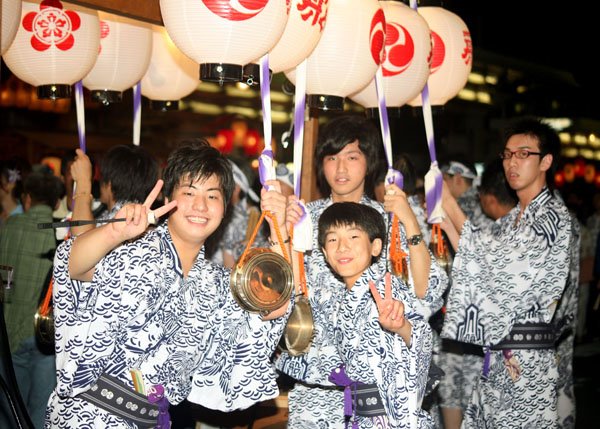
Zettai Shounen! A group of young boys donning their neighborhood yukata making music in the streets.

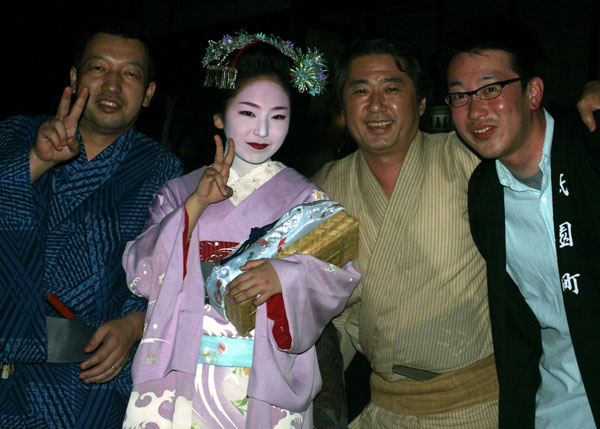
Suzuha, one of Gion's most beautiful and popular maiko, enjoying Yoiyama with a few friends.Say Peesu! (^-^)v

More Coming Soon!

Saturday, July 15, 2006

Gion Matsuri, Here I Come!

Image hosted by Photobucket.com
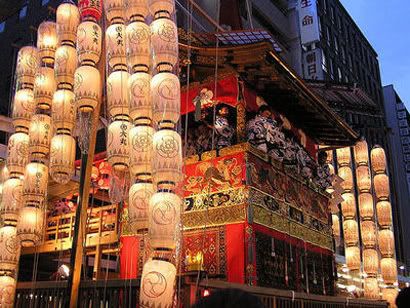
One of the many floats that Gion Matsuri is famous for, softly lit by paper lanters during Yoiyama.

I'm on my way to Kyoto's Gion Matsuri, on of Japan's biggest festivals. Expect me to be MIA until Monday (^o^)< Washoi! If you've never heard of this ancient, month long party in Japan's traditional culture capital, check these out!

Gion Matsuri:Yoiyama
Gion Matsuri: Yamahoko Junko

Don't worry! I haven't quite finished expounding the finer points of anime, as exhibited by BLEACH. All previously scheduled programming will resume with when I return! Have a great Ocean Day Weekend, everyone (^-^)v. Let us join Japan in expressing " our gratitude for the favor of the sea," and the Happy Monday System, too!

Tuesday, July 11, 2006

On My Conversion from Anti-Anime to Anime Addict

Photobucket - Video and Image Hosting
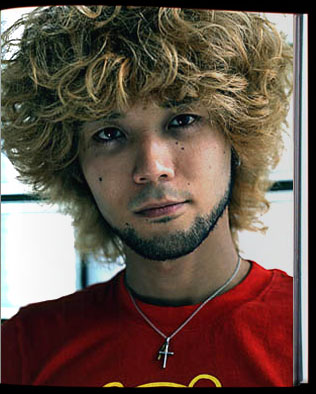
No, I haven`t dyed my hair a las Hilton heiresses. This is much more serious.

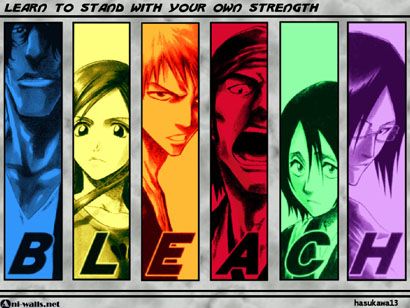
I`ve become addicted....to Anime. Well, one anime in particular.

BLEACH.

"So what? No big deal! Anime is anime-zing! " You might say, but to be honest, I was about as Anti-Anime as anyone could be. I vaguely remember watching the classic Akira with my older brother as a junior high schooler, and promptly forgetting it ever existed. I also recall trying to pass the 4 hours of complete and utter bordem afforded by my Saturday detention (part of my punishment for 'inciting a riot and being obligerent to an officer` in my cheerleading uniform) by sketching a wide-eyed, anime-style girl, although I don't know what posessed me to do so. Other than Akira, my Asian exposure was almost nonexistant, and I made little effort to rectify my ignorance on the subject. For one thing I was too busy concentrating on other cultures and forms of art, speaking Spanish, escaping to Mexico, playing softball and any other sport the boys would let me get in on, cheerleading, or partying. Japan was an exotic land of sushi eating samurai and geisha on ketais (cell phones), lost in a neon colored concrete jungle...And it was the last place I ever thought I`d end up.

Photobucket - Video and Image Hosting

I'm not sure why or how, but by the time events had conspired to send me to Japan as a study abroad student (my senior year of university), I had somehow formed a rather unfavorable opinion of anime (despite of my lack of information on the subject) . I was shocked to find that at least half of the gaijin students at Kansai Gaidai had come to Japan with the expressed intent of watching anime they couldn`t see in their home countries. While the other half of us explored the adventure-filled streets of Kyoto and Osaka with our new Japanese tomodachi, they stayed in the dorms watching anime, or dressed up in their Cosplay-best and headed to the nearest gathering of anime otaku (dorks, nerds, freaks).

Japan's culture and customs were basically brand spankin' new to me. I had been transported from a land where cartoons and comics were mostly for small children, to a hardcore manga metropolis where everyone from the ojiisan's (old men) waiting for the next bus, to my university-aged boyfriend, stood in cornerstore conbini's for what seemed like forever, viewing the newest, phonebook-sized releases of their favorite comics. Buisnessmen in gloomy black suits shamelessly scanned page after page of manga on crowded trains, even when they were blatantly pornographic. Sexy depictions of young girls in school uniforms and the shady, smiling, salarymen staring at them seemed to me to be the source of the problematic tsukebe and chikan (perverts) obsessed with anonymously violating women on crowded trains, not to mention the endless score of old men that paid young girls to 'play' with them (enjou kosai).


The original opening for Bleach to one of my favorite Japanese songs: *ASTERIK* by Orange Range.

The connection stuck. Needless to say, I made it through an entire 3 and a half months of study in Japan without ever reading manga or watching anime, not to mention the 3 years since then. In fact I was irritated when, during my breif visit back home for a friends wedding, I found an entire section devoted to Anime at a Borders book store. Shelf after shelf of big-eyed, big-breasted, long-legged school girls, in sailor uniforms, with super-short skirts and clothes molded to every curvey contour of their illustrated bodies.

The seemingly huge success of anime in America shocked me, especially since it seemed to have created and conquered such a huge market in such a short period of time. For the first time, I wondered..."What is it that makes Manga and Anime so special? How are they able to transcend the boundaries of age, nationality, ethnicity, and sex?" Let's face it. People all around the world are obsessed!

Depite the fact that I had always admired the art form, I never considered investigating the substance behind the style.

That is, until now.

Enter BLEACH.

...to be continued

The Joys of Engrish

Photobucket - Video and Image Hosting
A T-shirt in Osaka.

If ever the army of native-speaking ALTs, invited to invade Japan to teach "proper" English, should succeed, thus eliminating the miracle of Engrish in its purest, most unadulturated form, the saddness and sense of responsibility I would feel for taking part in such a tragedy would be nothing something unBERRYBERRYable.

Sunday, July 09, 2006

また七夕: Tanabata Revisited

Photobucket - Video and Image Hosting
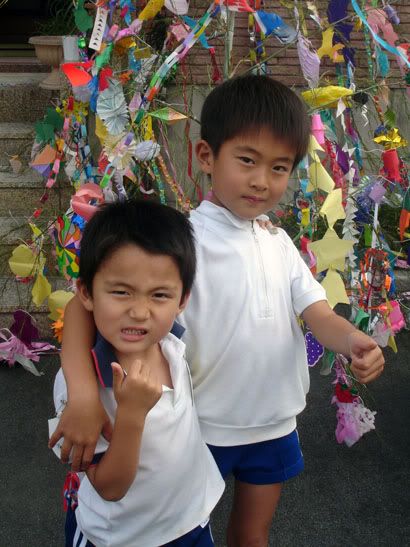
Growing up in a Geisha house makes you tough! Ryu and big bro Kaito beneath the branches of their Tanabata tree. Warning! Due to inherent laziness, this post you are about to read may be recycled from a previous post concerning the same topic. Reader discretion is advised.

Tanabata, Japan's version of the Chinese festival Pinyin, or “The Night of Sevens" (because it falls on the 7th day of the 7th month), celebrates the love between the stellar shepherd boy, Hikoboshi (Vega), and the Weaver Princess, Orihime (Altair). Although the shepherd boy was of lowly birth, the princess’ father, the Emperor of Heaven, worried that Orihime worked so hard weaving cloth for the gods that she had time to do little else, allowed them to be married. They were so in love, however, that they neglected their work and spent all of their time together.

Photobucket - Video and Image Hosting
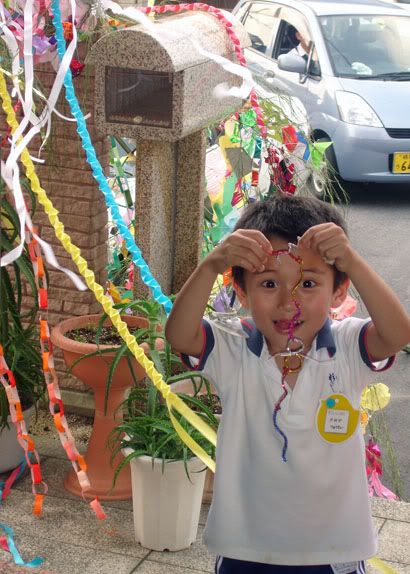
Ryu, holding his hand-made tanabata ornament.

Without the princess to weave their heavenly cloth, the once oshare, stylin' gods were forced to sport the same threads again and again, causing them to loose face and fall in their social standing (not to mention the public opinion polls). Without a herder to care for them, the flocks were scattered and scared. The infuriated emperor forced the love-struck couple to split, relocating them on opposite banks of the River of Heaven (the Milky Way). Watching each other from afar, they tried desperately to focus on their work, but their depression overcame them. At last the emperor took pity on them, and promised to let them meet once a year if they worked as hard as they could. At the chance of being together again, they began to work as hard as before. Ganbaruzo!

Photobucket - Video and Image Hosting
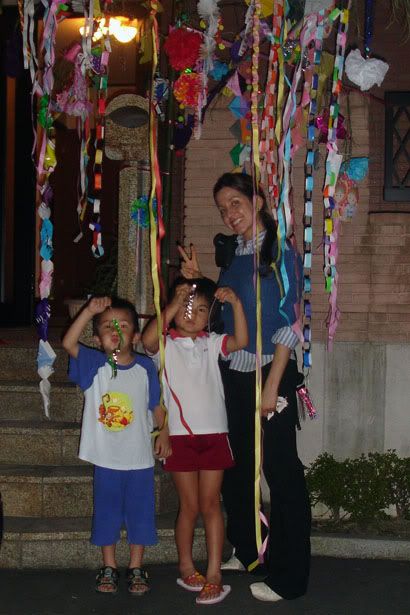
Ryu, Moe and I beneath the tree. Moe has been taking Nihon Buyou, or traditional Japanese dancing lessons, since she was 3. All the girls ( 6 Geisha) in dance.

True to the emperor's word, every year on the 7th night of the 7th month, a magical bridge of magpies forms over the heavenly river, allowing the young lovers meet. It is said that if it rains, the heavenly river overflows, and the young lovers must wait another year for their chance to meet again.

Unfortunately for them, Tanbata falls right in middle of Tsuyu, Japan's rainy season.

On Tanabata Eve I went to the Kamiya house (which just happens to be a modern Okiya, or Geisha house, albeit in good old inaka Ena) for our weekly English playtime. In front of the house, proped up on the porch, was a fresh, green bamboo tree, decorated in a rainbow of intricately folded origami and long, colorful strips of paper wishes. Traditionally people wrote their wishes for the star crossed lovers to be reunited, but nowadays people write their own wishes and hang them on the bamboo tree in hopes that they will be granted. If the rain holds off and the lovers can meet, they believe their wish will come true, but if it rains, they, too, must wait till next year.

Are you wondering if it rained? It's TSUYU! Of course it rained! No wish for you!

Monday, July 03, 2006

Hisamari

Photobucket - Video and Image Hosting
Hisamari, the most beautiful, popular and successful maiko in Pontocho, performing in this spring's Kamogawa Odori.

Souji Time!


Souji is just one of the many time-honored traditions that unite students scattered throughout the islands of Japan. A special time for students to come together to fight grime and gomi (garbage and dust), it is a time of meditation, a chance to reflect on and purify not only their school surroundings, but their internal minds as well.

That's right! In Japan, there are no custodians to clean up after the students~the students "clean up" after themselves! Every day, as the precious freedom of recess draws to an end, "cleaning time" music shoots from speakers strategically placed throughout the school, summoning students to their battle stations. Equipped with all manner of low-tech weapons in the war against grime, the most important of which are mini-brooms and zouki (cleaning rags), students engage in a 20 minute battle to reclaim the cleanliness of their school.

This video is a salute to their fighting spirit...

(Thanks to Luke at Gaijin for Life for sharing! *bows* m(- -)m )

Thursday, June 29, 2006

Sunday, June 25, 2006

Internationalization...

A la Backstreet Boys


A couple crazy kids in China, lip sync'n to the Backstreet Boys. I'm sure most of you out there have already seen this, but since I've only just discovered it I consider it my duty to share it with the world! (Despite the fact that it is not directly related to Japan in anyway, unless it is to remind those of us here in Nihon how far behind the rest of Asia Japan's English education system is. I mean, who needs JETs when you've got the Backstreet Boys)?

ぜひ見てください!本当に面白いのよ!

Friday, June 23, 2006

Tuesday, June 20, 2006

It's Pow Wow Time Again...

Photobucket - Video and Image Hosting
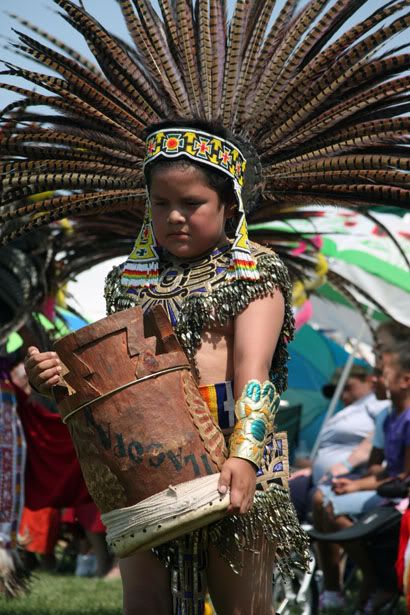
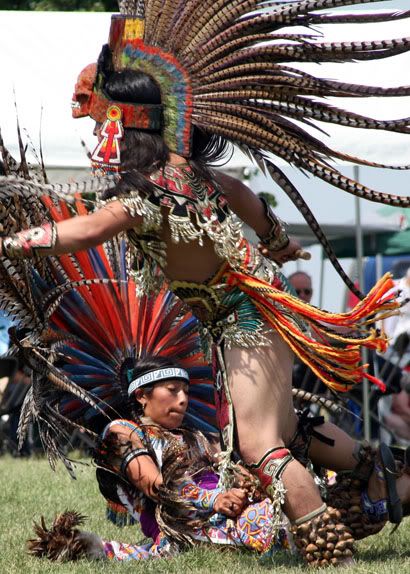
An 8 year old Aztec boy in full regalia at Cleveland's annual Edgewater Pow Wow.

Unfortunately I'm back in Japan, just in time to miss it all. Luckily I was able to make a breif cameo at Cleveland's annual Pow Wow at Edgewater Park before getting back to work after a 10 day stay in my home sweet home of Ohio, known to almost every Japanese person I meet as the Good Morning State (^-^)/.

The last time I had the privledge of attending a Pow Wow was almost 2 years ago at Mohican, before begining my new life as a JET in Japan. You can read more about Pow Wows and see a lot more pictures here and here.

Photobucket - Video and Image Hosting
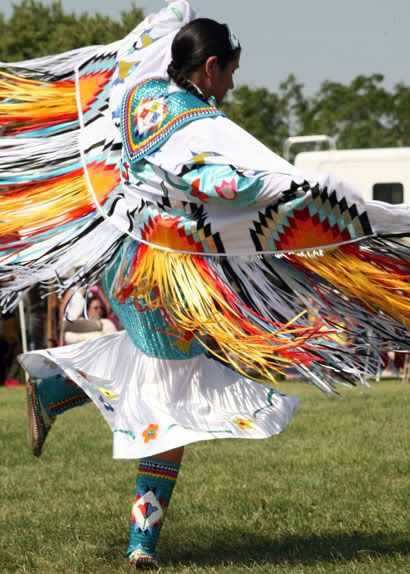
A young girl showing off her wonderfully colorful shawl during the fancy dance competition.

An Aztec teen sporting an impressive headdress at Edgewater's annual Pow Wow.

Photobucket - Video and Image Hosting
A young grass dancer tearing up the arena in some wicked regalia.

Photobucket - Video and Image Hosting
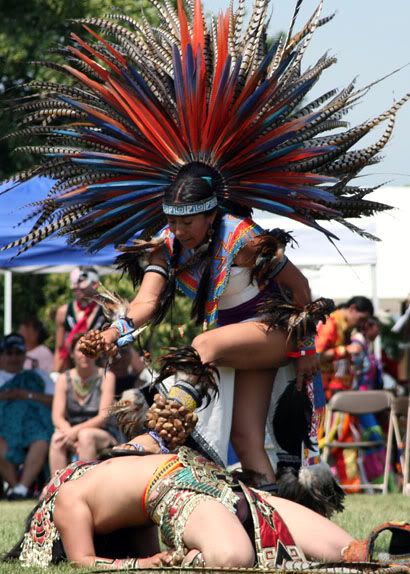
An aztec battle dance.

Photobucket - Video and Image Hosting

Thursday, June 15, 2006

誰も知らない: Nobody Knows

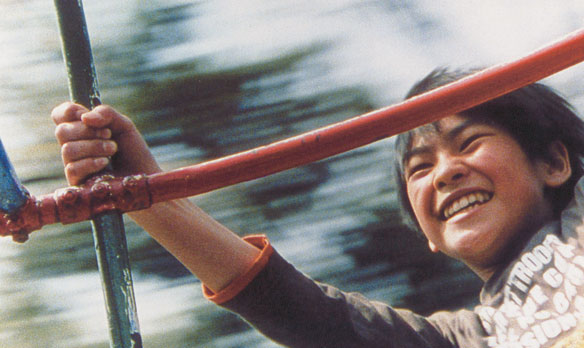
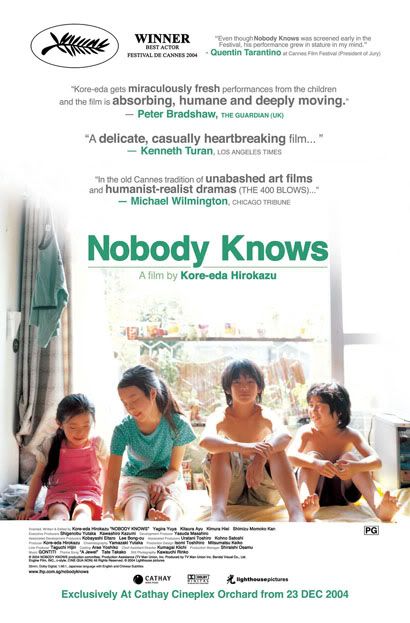
At the age of 14, young Yuya Yagira was named Best Actor at the Cannes Film Festival for his performance in Nobody Knows.

I'm back in the good ol' US of A for my best friend's wedding, which finally gave me a chance to see Daremo Shiranai, or Nobody Knows, a film I have wanted to see since before coming to Japan in 2004.Seems you can take the gaijin out of Japan, but you can't take Japan out of the gaijin (^-^)/

Inspired by the "Affair of the Four Abandoned Children of Nishi-Sugamo," Nobody Knows is based on the true story of 4 children abandoned by their mother in Tokyo in 1988. Each born of a different father, the children's births were never declared, making them legally non-existant. Even in the real world their existance reamined a secret. Never allowed to attend school, only the oldest boy was even permitted to leave their small apartment. Abandoned by their mother, the children lived alone for six months, and were only discovered when one of the young girls, weakend from malnutrition, died in an accident, tragically ending their desperate adventure. Unbelievably, not one inhabitant of the small apartment building was ever aware of the existance of the 3 young children.

For anyone interested in modern Japan, Nobody Knows is an amazing, moving, and heart-breaking work of art, offering a rare and fascinating glimpse into the culture of modern Japan, and a thought-provoking study of human nature.

I have a lot to say about this movie, but no time! Until then, rent it. Watch it. Photobucket - Video and Image Hosting

Saturday, June 03, 2006

Suicide: The Enduring Way of the Samurai?

Random picture of the day: A Pontocho geisha perfroming in Kamogawa Odori. Pontocho is one of Kyoto's 5 hanamachi, or geisha districts. This image has absolutely nothing to do with the following post. (^-^)v

Japan's total fertility rate, an indicator used for international comparisons of birth trends within individual countries, fell for the fifth consecutive year, hitting a record low of 1.25.

At the same time, suicides in Japan topped 30,000 (32,552) for the eigth straight year.

Not a good combination.

Japan's suicide rate is one of the highest in the world-- triple that of Great Britain, and double that of the United States. Suicides started to rise in 1998, when the country was mired in an economic slump. Since then the number of suicides has exceeded 30,000 every year. Males account for more than two-thirds of the total, with health problems and economic woes being cited as the most prevalent causes, respectively.

This year the number of students committing suicide reached 861, up 9.8 percent. University students accounted for more than half of the total, along with 7 elementary school pupils, 66 junior high school students, and 215 high school students .

Japan's cult suicide scene is also growing, with the number of Japanese killing themselves in groups rising steadily in recent years, from 34 in 2003 to 91 last year.

No religious prohibition exists against taking one's own life in Japan, condemning it as a sin or affront to god. Confucianism, in fact, sanctions suicide as a form of protecting one’s honor or protesting injustice. Suicide was once a form of ritual atonement for samurai, a poetic, redemptive act of purpose, considered to be both heroic and beautiful. Today it is a means of escaping failure and saving loved ones from embarrassment or financial loss.

Tuesday, May 30, 2006

Mongolia and the Kama Sutra Scribble

Photobucket - Video and Image Hosting
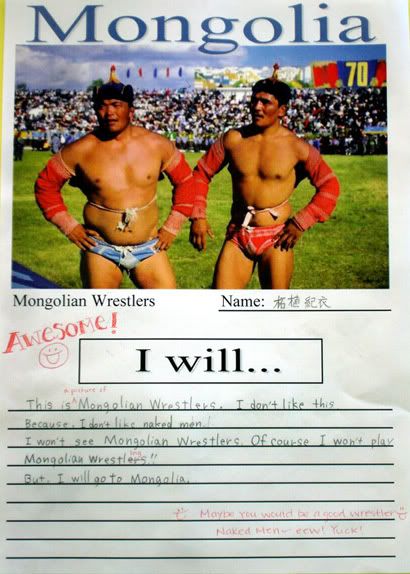
After learning about Mongolian culture last year, I gave my 2nd year students (8th grade in the US) short composition sheets with different images of Mongolia and asked them to describe what they would do there using the future tense. Afterwards we made a big bulletin board outside the English classroom my JTE and I had begged the Kocho Sensei (Principal) for. Usually, in Japan, teachers change rooms while students stay in their homeroom.

I rediscovered this gem today in a pile of old papers.

*****

This is Mongolian Wrestlers. I don't like this.

Because I don't like naked men.

I won't see Mongolian Wrestlers.

Of course I won't play Mongolian Wrestlers

But, I will go to Mongolia.

*****

Shortly thereafter, I discovered this on one of the students desks while we were in the midst of a conversation lesson...


And speaking of naked men...

This comes only a week after one of the sweetest 3rd grade (9th in the US) boys in the whole school invited me to the library during hiru yasumi (recess) to show me the school collection of Disney's books in Engish. Of course it was right about then that the crew that I usually play basketball with came looking for me, and finding me in the library, quickly set to work searching through a shelf of books. I was so impressed that they were giving up their beloved b-ball time to read, until one of them tapped me on the shoulder and pointed to a certain nether region on Michealangelo's famous statue of David in an art encyclopedia.

*****

"Melissa, what's this?"

"Hmm...Yabai." I said, trying to think of a plan of escape. The rest of the crew gathered around, waiting anxiously for my reply.

"Melissa..." he said reassuringly, sensing my fear "Ok, Ok. Doctor's word Ok."

"Doctor's word is Ok?" I asked, still stalling and hoping for a reprieve. " Ok. What is the doctor's word in Japanese?"

"Dansei!" He calmy answered, and then sensing a bit of reverse pedegogy on my part, smiled and tried to translate it into Enlglish himslef.

"Dan nan no de...Man! No no! Man- ZU! Man-zu sei...Sei...Sei..PART! Man's part!"

*****

By now, all the boys in the library were gathered around us in anticipation. We all bust out laughing. The sense of accomplishment on his face was priceless.

Eventually I told them the "doctor's word," which has and promises to lead to even more interesting eikaiwas (english conversations)...

Monday, May 29, 2006

Engrish: Represent!

That is one bad crayfish! I pitty the fool that has to face him in the Olympic! Represent!

Thursday, May 25, 2006

Miyagawa Girls: Kyo Odori

Maiko, or apprentice geisha, of Miyagawa-cho perform during the finale of this year's Kyo Odori: In purple, Fukyoshi, in green, Yasuha, in blue, Fukunao. Note the hint of red in her collar, compared to that of the other maiko -- an indication of her lower rank.

Wednesday, May 24, 2006

Saddam's Last "Dance"


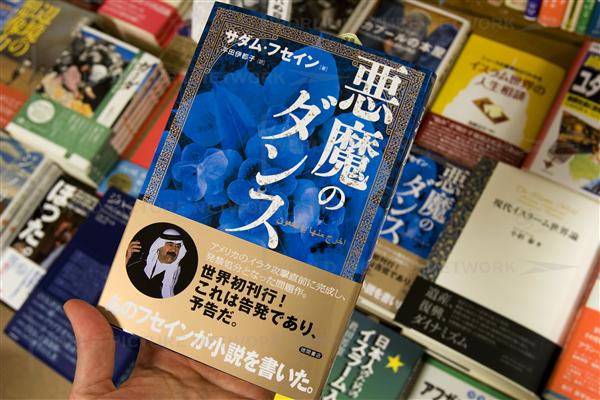
Saddam's new book, Get Out Of Here, Curse You has hit the shelves in Japan's biggest bookstores under the name "Devil's Dance". Saddam supposedly finished his final novel the day before the US invaded Iraq.

Glad to see the translators decided not to follow the popular practice of renaming foreign movies so that they can put the word "love" in the title. I don't think Saddam would be pleased.

And yet, imagine the possibilites...

Tuesday, May 23, 2006

Peonies in Bloom : Geiko of Miyagawa

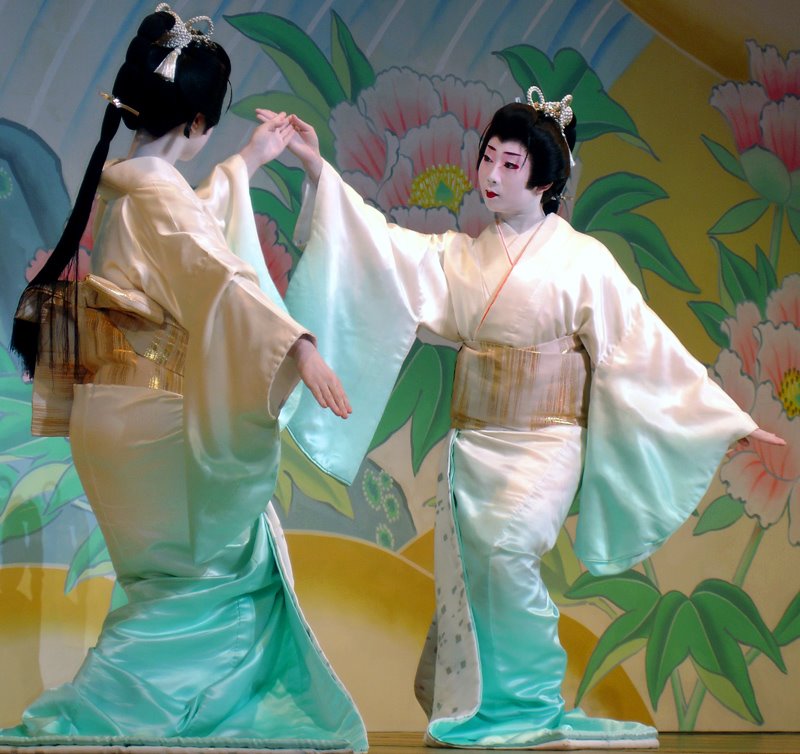
Geiko of Miyagawa-cho, one of Kyoto's five geisha districts, performing during this years Kyo Odori.

Excerpt from the 57th Annual Kyo Odori Program:

The long cold winter gives way at last to the arrival of spring in the ancient capital of Kyoto, and the Kyo Odori is always a welcome and colorful addition to this flower-filled season.

Famous for their beauty, the geisha and maiko of Miyagawa-cho grace the Kyo Odori stage to offer lively, fun, and elegant portrayals of seasonal culture, local flavor, and stories that developed in places throughout Kyoto...

Time always seems short,but we hope that the seven scenes of this year's performance, Seasonal Glories of the Capital, will provide a sense of the tradition and beauty embodied in the local performing arts.

Saturday, May 20, 2006

Can You Feel the Love?

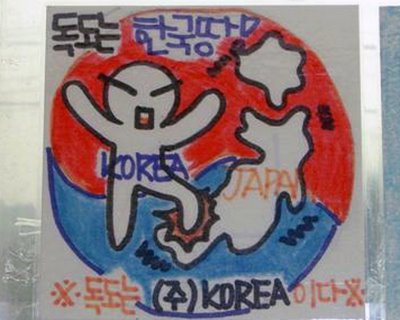
Is "Hating the Korean Wave" a backlash to an Anti-Japanese Media and Educational System in Korea?

Just one of many Children's Anti-Japan drawings found lining the walls of a Korean Subway last summer. Courtesy of Toron Talker.

I remember seeing these pictures on the Toron Talker last summer and being absolutely stunned. At the time I knew even less about the tensions between Japan and the rest of Asia than I do now ( a situation of which I admit I remain almost completely ignorant, but working to understand).

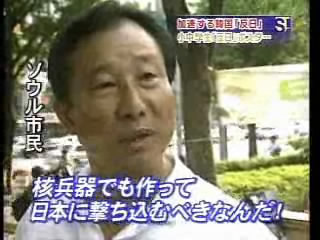
"I think we should make nuclear weapons and fire them at Japan!"A Korean man interviewed by Asahi TV.


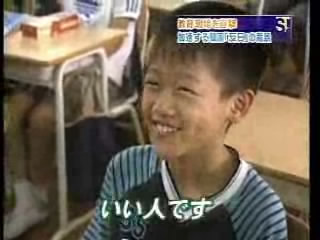
A short time after these children's drawing surfaced, Asahi TV went to the location where they were discovered to investigate, interviewing adults and offering an interesting, if not disturbing, glimpse into a Korean classroom, and the children's views on Kim Jong Il. Korean-based Occidentalism not only reported on the program, but also provided images, translations and a video link on his website. Check it out.

"He's a good person (Kim Jong Il)." A Korean elementary student.

Something to think about:

While the "Hating the Korean Wave" article provides insight into the tensions between the two countries, it is important to remember that less than 1% of the Japanese population had bought it back in Novemeber (360,000 copies sold). In fact, during the 2002 World Cup, Japanese spectators cheered for both Korean and Japanese teams alike, while Koreans often booed when Japan scored a goal.

When I first arrived in Japan back in August of 2004, at least 1 student in every class at each of my 16 schools asked me if I liked Yon-sama (the highly respectful name given to South Korean soap opera idol Bae Yoon Joon by his adoring Japanese fans). At first I didn't know the name, but once the teacher showed me his picture, I recognized him immediately. Star of the enormously famous (in Japan) "Fuyu Sonata," Yon-sama adorned the desktop calendars of many middle aged female teachers. His smiling face had followed me through subway stations and stared down at me from train advertisements. Both he and Choi Ji Woo, the heroine of 'Winter Sonata', can be seen on Japanese TV commercials every day.

Wednesday, May 17, 2006

Manga Propaganda

Originally printed in the New York Times last November, this article sheds light on a suprising and shocking side of modern Japan through one of its most popluar cultural vehicles: Japanese Manga (comics).
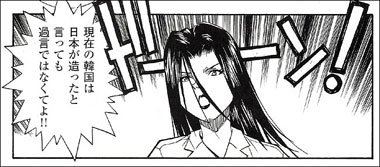

TOKYO - A young Japanese woman in the comic book "Hating the Korean Wave" exclaims, "It's not an exaggeration to say that Japan built the South Korea of today!" In another passage the book states that "there is nothing at all in Korean culture to be proud of."

In their graphic and unflattering drawings of Japan's fellow Asians and in the unapologetic, often offensive contents of their speech bubbles, the books reveal some of the sentiments underlying Japan's worsening relations with the rest of Asia.

They also point to Japan's longstanding unease with the rest of Asia and its own sense of identity, which is akin to Britain's apartness from the Continent. Much of Japan's history in the last century and a half has been guided by the goal of becoming more like the West and less like Asia. Today, China and South Korea's rise to challenge Japan's position as Asia's economic, diplomatic and cultural leader is inspiring renewed xenophobia against them here.

Kanji Nishio, a scholar of German literature, is honorary chairman of the Japanese Society for History Textbook Reform, the nationalist organization that has pushed to have references to the country's wartime atrocities eliminated from junior high school textbooks.

Mr. Nishio is blunt about how Japan should deal with its neighbors, saying nothing has changed since 1885, when one of modern Japan's most influential intellectuals, Yukichi Fukuzawa, said Japan should emulate the advanced nations of the West and leave Asia by dissociating itself from its backward neighbors, especially China and Korea.

"I wonder why they haven't grown up at all," Mr. Nishio said. "They don't change. I wonder why China and Korea haven't learned anything."

Mr. Nishio, who wrote a chapter in the comic book about South Korea, said Japan should try to cut itself off from China and South Korea, as Fukuzawa advocated. "Currently we cannot ignore South Korea and China," Mr. Nishio said. "Economically, it's difficult. But in our hearts, psychologically, we should remain composed and keep that attitude."

The reality that South Korea had emerged as a rival hit many Japanese with full force in 2002, when the countries were co-hosts of soccer's World Cup and South Korea advanced further than Japan. At the same time, the so-called Korean Wave - television dramas, movies and music from South Korea - swept Japan and the rest of Asia, often displacing Japanese pop cultural exports.

The wave, though popular among Japanese women, gave rise to a countermovement, especially on the Internet. Sharin Yamano, the young cartoonist behind "Hating the Korean Wave," began his strip on his own Web site then.

As nationalists and revisionists have come to dominate the public debate in Japan, figures advocating an honest view of history are being silenced, said Yutaka Yoshida, a historian at Hitotsubashi University here. Mr. Yoshida said the growing movement to deny history, like the Rape of Nanjing, was a sort of "religion" for an increasingly insecure nation.

"Lacking confidence, they need a story of healing," Mr. Yoshida said. "Even if we say that story is different from facts, it doesn't mean anything to them."

The Korea book's cartoonist, who is working on a sequel, has turned down interview requests. The book centers on a Japanese teenager, Kaname, who attains a "correct" understanding of Korea. It begins with a chapter on how South Korea's soccer team supposedly cheated to advance in the 2002 Word Cup; later chapters show how Kaname realizes that South Korea owes its current success to Japanese colonialism.

"It is Japan who made it possible for Koreans to join the ranks of major nations, not themselves," Mr. Nishio said of colonial Korea.
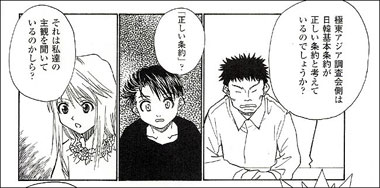
The characters on the left and in the middle are supposed to be Japanese, while the character on the right is not.

But the comic book, perhaps inadvertently, also betrays Japan's conflicted identity, its longstanding feelings of superiority toward Asia and of inferiority toward the West. The Japanese characters in the book are drawn with big eyes, blond hair and Caucasian features; the Koreans are drawn with black hair, narrow eyes and very Asian features.

That peculiar aesthetic, so entrenched in pop culture that most Japanese are unaware of it, has its roots in the Meiji Restoration of the late 19th century, when Japanese leaders decided that the best way to stop Western imperialists from reaching here was to emulate them.

In 1885, Fukuzawa - who is revered to this day as the intellectual father of modern Japan and adorns the 10,000 yen bill (the rough equivalent of a $100 bill) - wrote "Leaving Asia," the essay that many scholars believe provided the intellectual underpinning of Japan's subsequent invasion and colonization of Asian nations.

Fukuzawa bemoaned the fact that Japan's neighbors were hopelessly backward. Writing that "those with bad companions cannot avoid bad reputations," Fukuzawa said Japan should depart from Asia and "cast our lot with the civilized countries of the West." He wrote of Japan's Asian neighbors, "We should deal with them exactly as the Westerners do."

As those sentiments took root, the Japanese began acquiring Caucasian features in popular drawing. The biggest change occurred during the Russo-Japanese War of 1904 to 1905, when drawings of the war showed Japanese standing taller than Russians, with straight noses and other features that made them look more European than their European enemies. " The Japanese had to look more handsome than the enemy," said Mr. Nagayama...

By Norimitsu Onishi (The New York Times)Updated: 2005-11-21

The Morning Commute: Gion

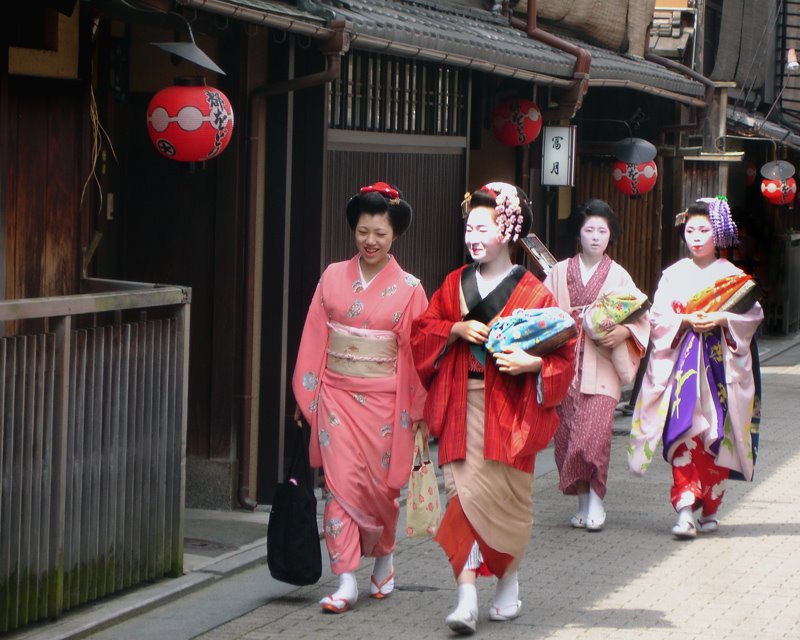
Young maiko wander through the traditional teahouse-lined streets of Gion.

Friday, May 12, 2006

And now for something Completely Different: Gloomy Bear

Photobucket - Video and Image Hosting


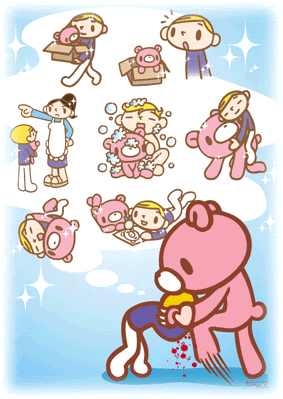
This is the story of a little boy and a cute, cuddly, abandoned, pink bear cub. Captivated by his cuteness, the little boy decided to adopt his new pink pal. He took him home, took care of him, and the two became the best of friends...Until the cute little cub grew up.

The cuteness of stuffed animals, wild and feral in real life, seemed strange to Mori Chack (Chax). "It is only natural for a bear to attack humans. I wanted to express that in a cute manner."

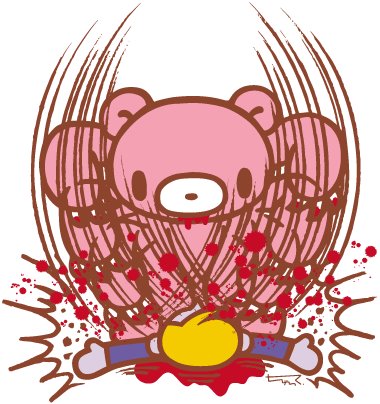
And that's what he's been getting paid to do, since 2002, when he was discovered selling hand-made postcards on the streets of Osaka. Almost overnight, Gloomy Bear, in all his pink, kawaii-style gruesomeness, had clawed his bloody way into the hearts of Japanese youth.

Gloomy, pronounced "gurumi" in Japanese, actually means stuffed, and is the suffix of the word "nuigurumi" (sewed and stuffed) meaning "stuffed animal" in Japanese. Unlike his Disney cousin, Pooh-san, who also enjoys great popularity among kawaii kid consumers, Gloomy can not be tamed by the society he's caged in.

Today, Gloomy Bear can be found sitting pretty, stuffed and fluffed on shelves all over Japan. Bloody key chains, ketai straps, stationary, and almost any other product plastered with this strawberry-sweet killing machine are never hard to find. Come on! You gotta admit -- he is kind of cute -- once you become desensitized to the disturbing, blood-drenched claws and mauling mouth... So let me know if you're in the market! (^-^)/

Tuesday, May 09, 2006

Kamishichiken Geiko

Photobucket - Video and Image Hosting
Katsukiyo and Umewaka, 2 geiko of Kamishichiken district, perform during the Kitano Odori.

A short excerpt from the Kitano Odori programme:

Kamishichiken is the oldest and most distinguished gay quarters (as in merry, not the modern connotation) in Kyoto, and training of geiko is given with the idea of producing an excellent few rather than a large number of mediocre entertainers. Therefore they are required to master many arts, such as shamisen, hand drum, dancing and traditional ballads like kiyomoto, tokiwazu, kouta, and nagauta...

Stay tuned for More to come!

Friday, May 05, 2006

Kodomo no Hi : Children's Day

Photobucket - Video and Image Hosting
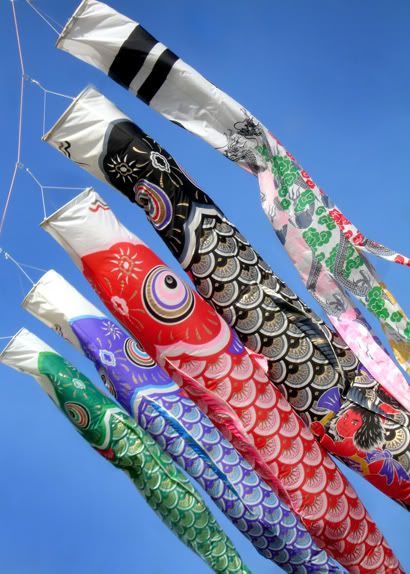
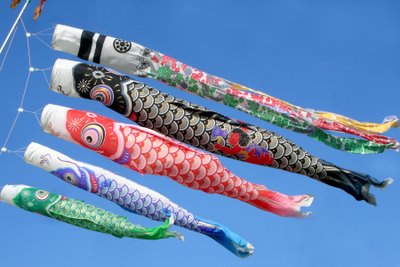
For Kodomo No Hi (Children's Day), families raise colorful carp-shaped "Koinobori" flags, one for each member of the family. The largest and uppermost flag represents the father, followed by the mother, and small carp to represent children.

Children's Day (Kodomo-no-hi or Tango no Sekku) is one of the most popularly celebrated national holidays in Japan. Until recently, Tango no Sekku was the boys' day (also known as Feast of Banners) while the girls' day (Hinamatsuri) was celebrated on March 3. In 1948, the government decreed this day to be a national holiday to celebrate the happiness of all children and to express gratitude towards mothers. It was then renamed Kodomo no Hi.

May 5th marks the beginning of summer on the old lunar calendar and the begining of the 5th month, which according to the Chinese calendar was set aside to be a month for purification. To expel evil spirits and celebrate the future of their sons, families hoist koinobori (cloth carp streamers) from balconies and flagpoles. Gogatsu ningyo (5th Month Dolls) are displayed in homes and store windows with images of Kintarou, usually riding on a large carp, and a traditional Japanese samurai helmet, a Kabuto. Kintarou and the Kabuto are both symbols of a strong and healthy boy. Kintarou (金太郎) is the childhood name of a hero of the Heian period, famous for his strength as a child. It is said that Kintarou mounted on a bear, instead of a horse, and played with animals in the mountain when he was a young boy.

Some children may also take shyobuyu (a bath with floating iris leaves), and eat kashiwa-mochi (a rice cake wrapped in an oak leaf ) and chimaki (a dumpling wrapped in bamboo leaves). Carp, samurai, irises, oak trees, and bamboos all symbolize strength.

Happy Kodomo no Hi!

Monday, May 01, 2006

Colors of Spring

Photobucket - Video and Image Hosting

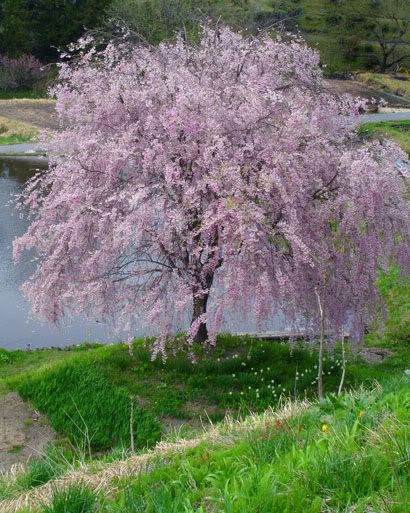
枝垂れ桜 【しだれ桜】(shidare・zakura) A beatiful, weeping cherry tree on the banks of the newly flooded rice paddies, soon to be planted with this years crop. Most of the cherry blossoms have long since fallen to earth, petal by petal like snowflakes in the warm spring wind, gathering in pink puddles beneath the trees. I found this tree in full bloom near Nagano, in Magome、 a small yet remarkably well-preserved Edo period post town on the Nakasendo (中仙道・The Road Through the Mountains), which once connected Shogunate power center Edo (now Tokyo) with the Imperial seat of Kyoto. Magome is also the birthplace of one of Japan's most revered and beloved authors, Shimazeki Toson. (Conveniently located about 20 minutes from my humble abode! (^-^)/)