Showing posts with label kimono. Show all posts

Sunday, June 22, 2008

Reese Witherspoon's Tokyo Tea

Photobucket
Actress Reese Witherspoon enjoys taking part in a traditional Japanese tea ceremony, an activity thought to capture the spirit of healing the mind, body and soul.

Hollywood leading lady Reese Witherspoon was recently in Japan promoting breast cancer awareness as an Avon Global Ambassador. While in Tokyo she had the opportunity to participate in an intimate tea ceremony with breast cancer survivors, dressed in an beautiful powder blue kimono by Midori Yogi, who's family has dressed the Imperial Family for weddings since 1952.

Photobucket
I just wanted to share this beautiful kimono with everyone. I think the wistful color and playful design suited her perfectly.

As an after thought, isin't it slightly disappointing that even members of the Imperial Family can't dress themselves in kimono?

Why does it have to be so difficult? (>.<)


Monday, May 19, 2008

Miyako Odori Kimono and The Art of Gion

Kyoto Rewind: April 1st, 2008

Photobucket
'Uniform' kimono worn by geiko and maiko in the opening prelude, autumn scene, and finale of Gion Kobu's annual spring dance: Miyako Odori.

Before the maiko and geiko of Gion Kobu grace the stage to perform Miyako Odori, the Dance of the Old Capital, overly-anxious guests like me try to curb their enthusiasm by browsing the exhibit of artwork done by the maiko and geiko themselves, including paintings, calligraphy, and flower arrangements. A few of the famous "uniform" kimono the dance is famous for are also on display, highlighting different designs and themes used over the years.

Oil painting of two geiko wearing the Miyako Odori 'uniform' kimono and hanakanzashi (flowered hair ornaments) by the geiko Suzuko.

Photobucket
Kimono design used in the fifth year of Heisei, 1993.

Photobucket
My personal favorite, worn in the fifty-third year of Showa, 1978.

Photobucket
This design must have been the height of kimono chic in Showa's fifty-nineth year, 1984.

Photobucket
I loved this simple silhouette which captures the mystique, innocent playfulness and youthful beauty of a maiko. I wish I knew who painted it!

Photobucket
Another lovely portrait, artist unknown.

Wednesday, May 16, 2007

Kyo Odori

Photo Sharing and Video Hosting at Photobucket
Kikutsuru

An Introduction to Kyo Odori ( from the Kyo Odori Programme)

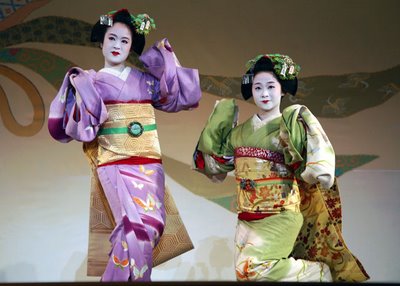
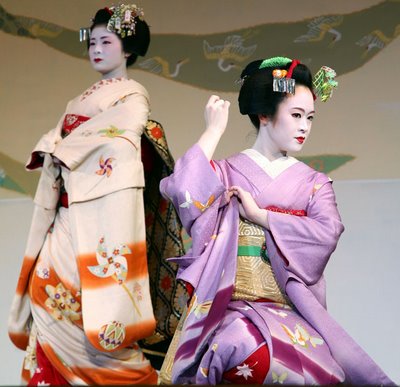
With the arrival of another beautiful spring in the ancient capital, we are again staging the brilliant annual Kyo Odori. The 58th event of the traditional spring dance performance presents the seven scenes of Miyako no Shiki no Mai Ogi (expressing the four seasons in Kyoto through dancer's fans). The Miyagawa-cho Geiko crew provides a tour of many Kyoto attractions, depicting the manners and customs of Kyoto people and performing a powerful and majestic dance inspired by an old legend.


By holding the Kyo Odori performance every year, we at the Miyagawa-cho Kabukai aim to help refine our performing skills even further and develop new talents for traditonal Miyagawa-cho entertainment.

We are convinced that our sustained devotion and passion for traditional dance will enable us to meet your expectations. . .

Fukuaya, Kikutsuru, and Komomo

Photo Sharing and Video Hosting at Photobucket

Kimigiku

Well, I certaintly wasn't disappointed (^_<)

Monday, March 19, 2007

Japan's Past, Japan's Future

Geiko pose with two children of "double" heritage. Seeing this made me wonder... What will happen when Japan's new generation of multi-ethnic daughters grow up with an intrest in traditional culture and the desire to become a geiko? Obviously that is the very least of the questions that face Japan today, as it struggles to come to terms with Japanese citizens that don't quite fit their definition.

Children with one Japanese parent and one non-Japanese parent are refered to as "half" here in Japan, a term most foreigners take acception to. Below is a quote from my fellow JET blogger, Gaijin For Life. His blog is witty, insightful, well-written, and all around much better than mine! Plus he has a super kawaii daughter (^-^). Read it. You won't regret it.

"I am not sure what children of "mixed marriages" are called in other countries, but here in Japan they are called "Half." I suppose that this is an implied reference to such a person's half that is lacking--that portion of them that is not Japanese. As for myself, when I was a kid growing up in Japan I always called them "half-n-halfs" but everyone thought I was talking about coffee. Now that I have a daughter who falls into the category under discussion, I use the term "Double." No one else does, but that must be because they are all under some sort of misconception. My daughter has two citizenships, a double portion of genetic diversity, and will soon speak two languages and carry two passports. That sounds like 1 times 2 to me, not 1 divided by 2."

Monday, December 18, 2006

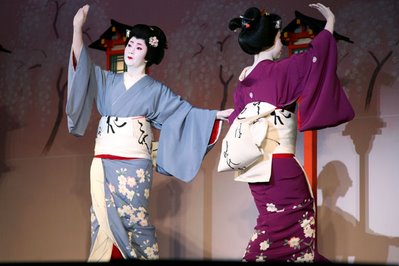
Gion Odori 2006: Acts Two and Three

Photobucket - Video and Image Hosting

Act Two: Okome. Okome is the Japanese word for rice (before it is cooked). The geiko Mariko, dancing as a Shinto priestess for a plentiful harvest of rice in early spring. In January, maiko wear a stalk of rice in their hair to celebrate the new year.

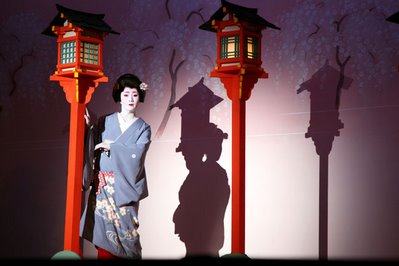
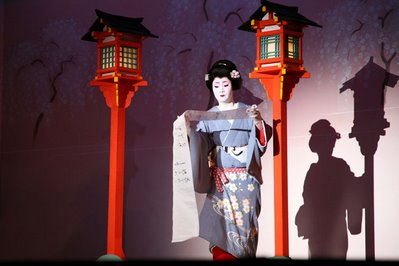
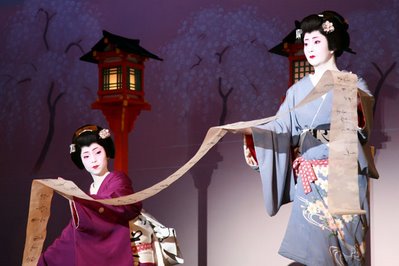
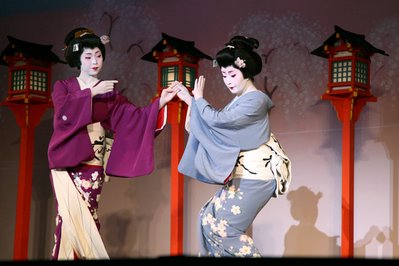
Act Three: Shidarezakura. Shidare zakura (from sakura), or weeping cherry. Before the famous weeping cherries of Maruyama Koen, near Yasaka Shrine, an elder geiko awaits her true love until she is discovered by her younger sister .

Uh oh! She recollectin' ya'll! Reading an unusually long rabureta (love letter) in the absence of her beloved.


I know that correspondence is often recommended to encourage affection, but this is ridiculous sis!

Don't make me...

I love the beautiful bend of their hands, so limber and graceful. It reminds me of the Apsara dance of Cambodia...

Sunday, December 17, 2006

Gion Odori 2006: Maneki

Masayo and Miharu.

The theme of this year's Gion Odori, the fall dance performed by the maiko and geiko of Gion Higashi, was "Seasonal Glories of the Maiko's Hanakanzashi," or flowered hair ornaments.

Masayo and Fumiki.

In December, maiko wear the maneki hanakanzashi. This dance depicted the maiko attending the year-end debut of Kabuki actors at the Minamiza theater. A young maiko overcomes her shyness to ask her favorite actor for his signature "with her big courage".

Photobucket - Video and Image Hosting
Masayo, the highest ranking maiko in Gion Higashi, dancing during the opening act of this year's Gion Odori: Maneki. This years theme was hanakanzashi, the flowered hair ornaments worn by the maiko. Each dance reflected the meaning and seasons in which each hanakanzashi is worn.

During Kaomise (from about Nov.30- Dec. 26) , the names of the performing Kabuki actors are written on long, wooden boards called maneki kanban, and hung outside the theater. Maiko attend the Kaomise (face showing) Kabuki performances, wearing these Maneki hanakanzashi. Two small, blank tags are attatched, and maiko ask their favorite Kabuki actors to sign them afterwards.

Photobucket - Video and Image Hosting
Fukimi and Miharu strike a Maneki Neko, or beckoning cat, pose.

Photobucket - Video and Image Hosting
Fumiki and Umeha.

Photobucket - Video and Image Hosting

Monday, November 20, 2006

Let's Kimono!

Photobucket - Video and Image Hosting

It's not everyday that a gaijin like me gets invited to a Japanese wedding. Excuses, occasions and opportunities to wear kimono are almost as scarce. Thanks to the awesome sensei's at my beautiful mountain school and Colin's conveniently wafu (japanese style) wedding, I was able to do both

Photobucket - Video and Image Hosting

I hadn't honestly considered wearing a kimono because I knew how difficult it would be. Getting your hands on a kimono is no easy task. Buying one is out of the question, as the ensembles can cost tens of thousands of dollars. At $500, renting one, which many young people do for their coming of age ceremonies (seijin shiki) was just as improbable. With just over a week left, I asked my JTE at the beautiful mountain school what I should wear. She acted as if there was no other option. "Kimono! Of course!"

As we sat chatting in the little tea room of the teacher's office, she very casually mentioned Colin's upcoming wedding, and how nice it would be if only I could wear kimono. "That would be good, wouldn't it?" The art teacher smiled, immediately offering to ask his wife, who, as it turnse out, is a master of kisuke, wearing and dressing people in kimono

"And I have many kimonos!" The couselor shot to the edge of her seat, clasping her hands together in excitement. "I can lend you one! I have furisode from seijin shiki, with beautiful, long sleeves It would look so nice on you!"

"Lucky, Melissa!" My JTE smiled at me over our cups of green tea.

Photobucket - Video and Image Hosting

Since I needed to be at the wedding hall in Nagoya (a good one hour train raide from Ena) at 10 AM, I decided to get my hair done the night before. Why, you ask? In Japan, only conbinis (conveinience stores) open before 10AM. For a hair stylist to come in early to do my hair, it would cost about 70$. So basically, it wasn't an option. Even if I had the money, I had to be at the art teacher's house at 7AM to get dressed. There was no time. So I got my hair done at 6:30 PM the night before(everything closes rediculously early too- that was their latest appointment) and slept hunched over my computer desk trying not to ruin it.

Photobucket - Video and Image Hosting

Despite the difficulties involved, wearing such an incredibly beautiful kimono was worth it. I'm so thankful for the never-ending kindness of everyone at the beautiful mountain school, especially the best JTE ever, Kachi Sensei. Arigatou ne!

Monday, November 13, 2006

Pretty in Pink: Miyofuku

Photobucket - Video and Image Hosting

As I stood talking to the old women of Sakuraya, I noticed this young maiko walk past and call at an okiya down the street. After some time had passed, I noticed that she had not yet slipped behind the slit wooden grill of the sliding door, but stood nervously, looking up and down the street. I asked the Okaasan if she was ok, so we walked down to find out. Poor Miyofuku had been locked out of her okiya, and with everyone at rehersals for the fall dance recitals, she didn't know where to go or what do to. Finally Yasuha and Fukuyoshi came by and took her home with them.

Man, I don't know why she didnt just kick off those clogs and climb in through a window! That's what i always used to do when I got locked out (^_<) Hehehe....Just kidding.

Tuesday, June 21, 2005

Tea Time! 宮川町の茶道

Image hosted by Photobucket.com

I just realized that I never posted any of my pictures from Kyo Odori ( 京をど), Miyagawa-cho`s spring dance. Miyagawa is one of Kyoto`s five geisha districts, or flower towns, as the Japanese say (gohanamachi 語花町 : 'go' meaning five, 'hana' meaning flower, and 'machi', meaning town).

Image hosted by Photobucket.com

Before the dance we watched as a high rank maiko and a young apprentice preformed sado ( 茶道 ), or Tea Ceremony. 'The Way of Tea', sado is a highly ritualized method of meditation and reflection that was seen as a means of achieving enlightenment. Every movement is deliberate and meaningful, anchoring the mind in the present to keep it from wandering away from the task at hand.

Image hosted by Photobucket.com

The young girl performing tea ceremony, Fumiko, was the most beautiful maiko I have ever seen, in Gion or elsewhere. Young Kimika, draped in a breathtaking virgin blue kimono, was stunning as well . I couldn't take my eyes off them.

Image hosted by Photobucket.com
As a maiko in her first year of service, Kimika does not yet paint her upper lip.

Friday, January 21, 2005

Seijinshiki: Coming of Age in Japan


Seijinshiki at Yasaka Jinja, Kyoto.

Seijinshiki, the Japanese Coming of Age Ceremony, is a national holiday (and every tourist`s dream,) celebrated every January 10 or 15. Everyone who has turned 20 years old during the past year officially becomes an adult, which means they can vote, smoke, drink, and generally wreak even more havoc than before--only leagally! Along with the bestowal of these new rights come the responsibilities adulthood...Whatever those are!

Coming of Age rituals have been carried out since the seventh century. Genpuku, for boys between the ages of thirteen and sixteen, and mogi, for girls between twelve and sixteen, marked the adolescent`s rebirth as a responsible member of the society, at which time the they were allowed to grow their hair long and formally adopt adult hair and clothing styles.

Today, both young men and women dress up to attend the celebrations held in their hometown and visit shrines. Many young men wear western style suits, but if you`re lucky, you might see one in a formal black kimono with five mon (family crests), hakama, and haori (samarai style!). The girls rock furisode kimono, which literally means, "swinging sleeves." According to popular myth, young women would swing their sleeves to attract young men's attention (sounds better than having to shake your arse).

Brightly colored with auspicous Japanese designs like cherry or plum blossoms, butterflies, maple leaves and rivers, these kimono can cost thousands of dollars (not to mention the hundreds of dollars they spend to get their hair and makeup done). Kimono are so expensive that many people choose to rent them instead. My friend's little sister just rented one for $1000.

Back in the day, pictures taken of women wearing their kimono at Seijinshiki were shown to eligible bachelors hoping to get lucky with an arranged marriage. Ah yes, the good ol' days!

Omikuji: Drawing Lots


New adults in fursiode, drawing their omikuji.

Who needs fortune tellers when you have Omikuji?

Omikuji are written fortunes obtained by drawing lots (sticks) from a container found at Shinto shrines or Buddhist temples. The sticks are then exchanged for long, narrow pieces of paper upon which fortunes ranging from outstanding, to average, to bad a are foretold, covering every aspect of on's life.

During the New Year's holiday festivities many people visit Shirnes and draw omikuji with a sense of playfulness, rather than using them as a means divine their future. Unfavorable omikuji are tied to trees a on temple or shrine grounds in hopes that it will not come true.

Omikuji is said to have been imported from China in ancient times, and was used as a messanger of the gods for everything from business transactions to marriage. Nowadays you can get omikuji from vending machines. Welcome to Japan.

Tuesday, January 18, 2005

Happy New Year Kansai!

Well my first weekend back in Japan turned out to be quite an adventure!


Wakausa Yama Yaki, Nara. Posted by Hello

I happened to come across an amazing photo of Wakakusa Yama Yaki (The Burning of Young Grass Mountain). The stark black silhouette of a 5 storied pagoda seemed to spread its wings and rise from the sea of fire engulfing the gentle slope of the mountain behind it. Fire flowers (the actual translation of the Japanese word for fireworks), shot up from the waves of flame, blooming like cherry blossoms in the dark veil of the night sky.

Luckly along with the picture was a note saying that the festival, which commemorated a battle between Buddhist monks of two rival temples who had set the mountain on fire, was celebrated January 15th of every year! Happy birthday to me!

The next day I was on my way, riding in the lap of the luxurious Shinkansen, Japan’s ultra-fast bullet train. But by the time I got to Nara the sunny blue skies of Ena had faded to paler shade of grey, draped in heavy rain clouds that soaked the earth beneath. There was as much chance of the mountain burning as there was of me spontaneously combusting, so needless to say, I was hopeful.
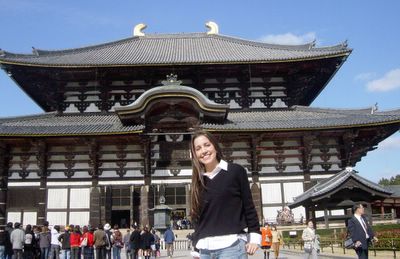

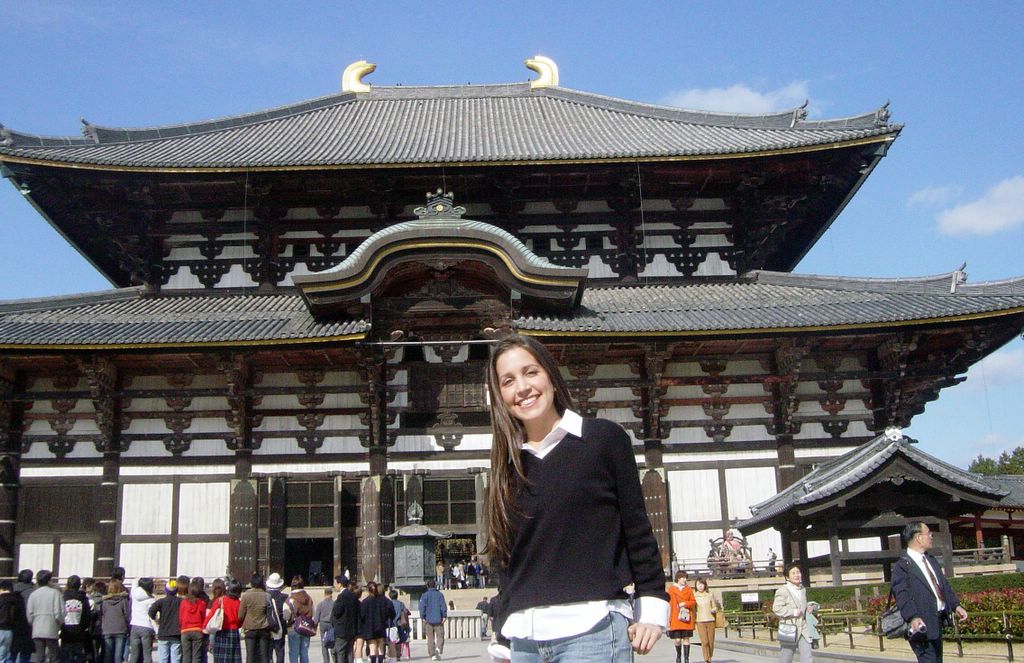
Todaiji, the largest wooden structure on earth, is only a shadow of its former self, 30% the width of the original structure. Fall 2002. Posted by Hello

As I walked toward Todaiji (The Great Eastern Temple), home of the world’s largest cast iron Buddha, I was inevitably stopped by a young rickshaw driver. She casually informed me that this year the festival had been held on January 9th. Ah well. It’s a little early to be celebrating my birthday anyway, so I wasn’t too disappointed. I went to hang out with Buddha for a bit, and figured since I was in Kansai, things could only get better! That’s just the way it works!


Daibutsusan, the Great Buddha of Nara. Posted by Hello

I called Lindz and went to meet her for dinner in Osaka. We noisily slurped down a bowl of miso ramen in a tiny shop conveniently located in her apartment building and run by a bunch of young, American-music-loving kids. I was sucking down noodles to the beat of Michael Jackson, Blink 182 and for a brief moment, Whitney Houston, until thankfully one of the horrified waitresses rushed to the radio and promptly filled the shop with the soothing sounds of something techno.

Lindz said I could crash at her place, so I took the chance to catch up with my long lost partner in crime. Unfortunately, the fact that we are, despite some serious effort, inevitably growing up, she had to work the next day, which made the chance of a joint adventure impossible.

I was ready to head for home the next day when I snapped out of it. There is no way you can go to Kansai and not make brief cameo in Kyoto! I mean, that’s sacrilege!


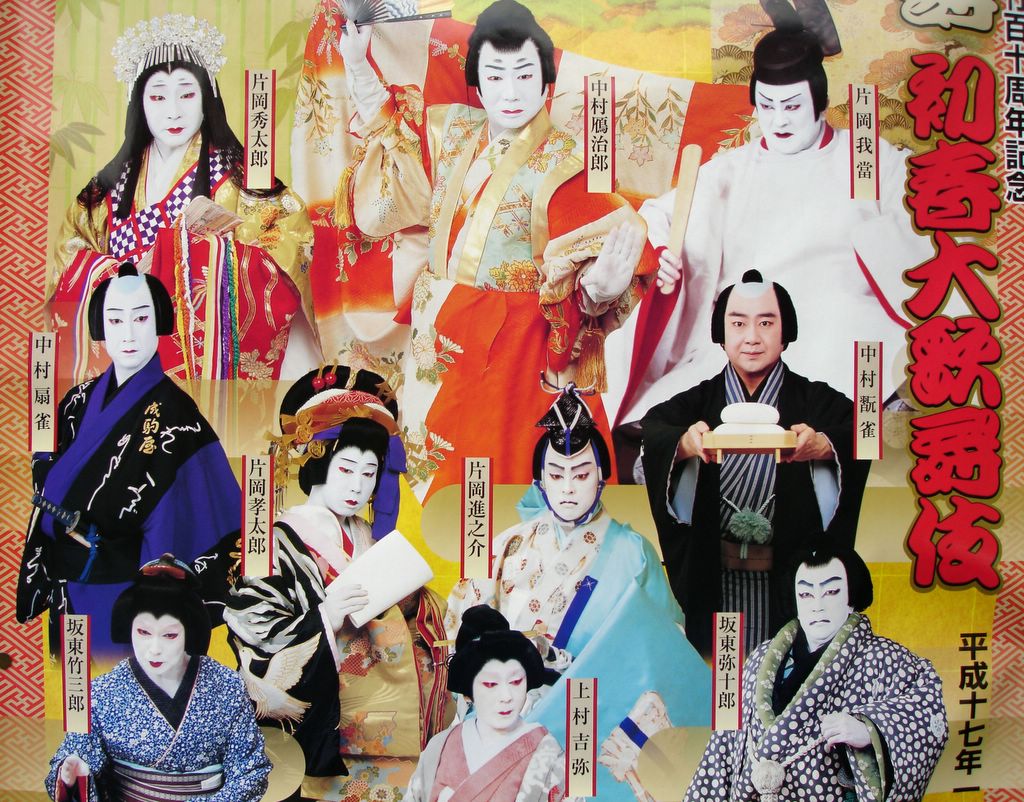
Kabuki, a traditional form of Japanese theatre, in which all roles are acted by men. Posted by Hello

I wandered up the subways stairs, past the famous Minamiza Kabuki theatre and towards Gion. Since it was lunch time and Indian food is a rare commodity in these here parts, I indulged in a little curry and dal in the same place where I had celebrated thanksgiving. It always makes me smile to hear the owner speak Japanese with his undeniably Indian intonation.


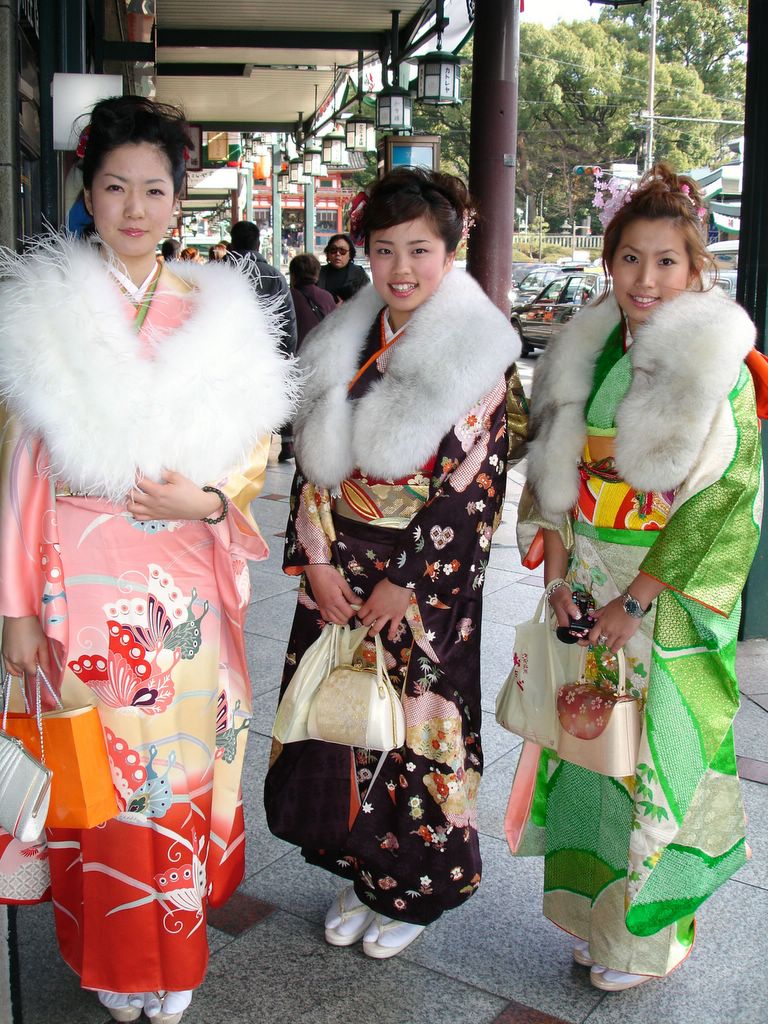
Brand-spankin' new adults I met on thier way from a New Year's visit to Yasaka shrine. Posted by Hello

After meeting my quota of curry in a hurry, I rolled myself out onto the street and turned, as if magnetically drawn, towards Yasaka Jinja. I squinted as what appeared to be three kyoningyo (Kyoto porcelian dolls) dressed in their finest furisode kimono slowly came into view. Seijinshiki and New Years celebrations were still in full swing! I stopped to congratulate them on their coming of age (and take their picture of course), and ran up to the shrine.


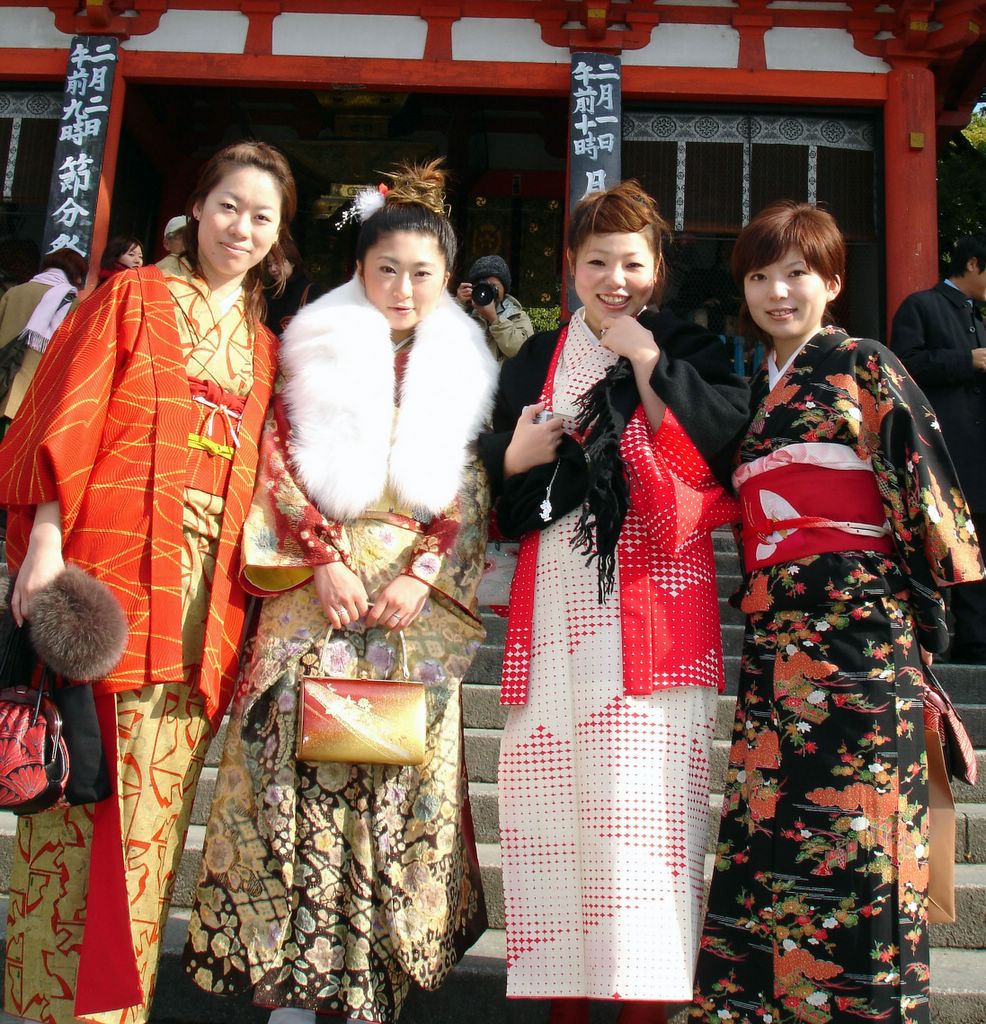
Leaving Yaska shrine, thesr girls couldn't escape without letting me take a picture. But who is that man in the back taking a picture of? Posted by Hello

From there it is only natural for me to head up the twisting, cobblestone roads that lead to Kiyomizudera. I know the path by heart, as if I had grown up wandering the narrow, twisting streets in another life. Along the way I ran into many nisemono maiko, tourists dressed as geisha apprentices to be photographed in the ancient capital, but nothing prepared me for the luck I would find at Kiyomizu.