Showing posts with label traditions. Show all posts

Saturday, May 05, 2007

Kodomo No Hi

Photobucket - Video and Image Hosting
For Kodomo No Hi (Children's Day), families raise colorful carp-shaped "Koinobori" flags, one for each member of the family. The largest carp flag represents the father, followed by the mother and smaller carp to represent children.

For the past month, brilliant, boldly-colored carp flags have flickered in the fresh, baby-blue skies with every breath of spring. In Japan, carp are famous for fighting their way upstream and leaping over waterfalls to get to their spawning areas, making them a symbol of the famous fighting spirit, valiant efforts, and success. Like rainbows fluttering over the slowly flooding rice feilds, koinobori are raised in the hope that young boys in Japan will grow up with the same admirable qualities. Samurai helmets and warrior dolls gaurd the windows of traditional shops and entrances of homes blessed with sons, inspiring boys throught the land of the rising sun to be strong and brave.

May is the month of purple flowers, with irises and wisteria crowning the countryside with kingly purples and violets. The iris, or shoubu, is another famous symbol of Kodomo no Hi. In Japanese, shoubu means both iris and military spirit (although the Chinese characters are different), and because the shape of the leaves resemble swords, they are used to decorate the samurai style Go Gatsu Ningyo (5th Month dolls).

Kashiwa mochi and irises. Image by att.japan

No holiday would be complete without its special treats, and Kodomo no Hi is no exception. Children are treated to kashiwa-mochi, a sweet rice cake filled with even sweeter bean paste and wrapped in an oak leaf. Chimaki, a sticky sweet cake wrapped in bamboo leaves, is also very popular.


Summer is here! Happy Kodomo No Hi (^-^)/

Tuesday, July 26, 2005

Gion Matsuri: Procession of Dieties

Image hosted by Photobucket.com

Ususally the only shot of Yasaka Shrine one can get is with a few ugly buses, taxis and cars streaking thru the foreground, but with Shijo-dori closed to traffic for the procession, the street is filled with happi-clad mikoshi carriers and lined with excited onlookers. Here, three mikoshi, or portable shrines, rest before Yasaka Jinja (shrine) before being carried by the men in white throughout the streets of Gion.

Image hosted by Photobucket.com

There is something strikingly Biblical about these mikoshi...I remember the first time I saw one at the Kurama Himatsuri during my Gaidai days, I immediately thought of the Ark of the Covenant. I am completely aware that there is a very descriptive description (redundant much?) of the Ark in the Bible, and that is it very different from what you see before you here, but the thread that joins all of mankind and its history together is, for me, blatantly aparant in these ancient traditions. You can't tell me that the ornamentation on the roof of the mikoshi doesn't look like a menorah!

Unlike the festival hoko floats, Mikoshi are not pulled, but carried on the shoulders of many men. Not only are they carried through the streets of the city for hours, they are thrown into the air and jostled about to excite the crowd. After bouncing the Mikoshi down Shijo a bit, these men made a turn onto the Hanamikoji, "Wasshoi"-ing their way past the Ichirikiya, the most famous Ochaya ( 'teahouse', where Geisha and maiko entertain) in the history of Japan...

Saturday, July 09, 2005

Tanabata: 七夕

Image hosted by Photobucket.com
Ryu and big bro Kaito beneath the branches of their Tanabata tree.

Tanabata, Japan's version of the Chinese festival Pinyin, or “The Night of Sevens" (because it falls on the 7th day of the 7th month), celebrates the love between the stellar shepherd boy, Hikoboshi (Vega), and the Weaver Princess, Orihime (Altair). Although the shepherd boy was of lowly birth, the princess’ father, the Emperor of Heaven, worried that Orihime worked so hard weaving cloth for the gods that she had time to do little else, allowed them to be married. They were so in love, however, that they neglected their work and spent all of their time together.

Image hosted by Photobucket.com
Ryu, holding his hand-made tanabata ornament.

Without the princess to weave their heavenly cloth, the gods were forced to wear the same thing over and over until they wore out. Without the herder to care for them, the flocks became sick. The emperor became so angry that he forced them to move to opposite banks of the River of Heaven, the Milky Way. They watched each other from afar as they tried to focus on their work, but their depression overcame them and they could do nothing. The king took pity on them, and promised to let them meet once a year if they worked as hard as they could.

Image hosted by Photobucket.com
Ryu, Moe and I beneath the tree. Moe has been taking Nihon Buyou, or traditional Japanese dancing lessons, since she was 3. All the girls ( 6 Geisha) in the house are trained in dance.

At the chance of being together again, they began to work as hard as before. Every year on the 7th night of the 7th month, a magical bridge of magpies forms over the heavenly river, and the young lovers are able to meet. It is said that if it rains, the heavenly river overflows, and they must wait for their chance to meet again the following year.

Unfortunately for them, Tanbata falls right in middle of Tsuyu.


Image hosted by Photobucket.com

Peek-a-boo! The geisha and the kids spent all week making these ornaments!

On Tanabata Eve I went to the Kamiya house (which just happens to be an Okiya, or Geisha house, albeit in good old inaka Ena) for our weekly English playtime. Infront of the house, proped up on the porch, was fresh, green bamboo tree, decorated in a rainbow of intricately folded origami and long, colorful strips of paper. Traditionally people would write their wishes for the star crossed lovers to be reunited, but nowadays people write their own wishes, in hopes that they will be granted. If the rain holds off and the lovers can meet, they believe their wish will come true, but if it rains, they, too, must wait till next year.


Image hosted by Photobucket.com
Growing up in a Geisha house makes you tough!


Are you wondering if it rained? It's TSUYU! Of course it rained! No wish for you!

Friday, January 21, 2005

Omikuji: Drawing Lots


New adults in fursiode, drawing their omikuji.

Who needs fortune tellers when you have Omikuji?

Omikuji are written fortunes obtained by drawing lots (sticks) from a container found at Shinto shrines or Buddhist temples. The sticks are then exchanged for long, narrow pieces of paper upon which fortunes ranging from outstanding, to average, to bad a are foretold, covering every aspect of on's life.

During the New Year's holiday festivities many people visit Shirnes and draw omikuji with a sense of playfulness, rather than using them as a means divine their future. Unfavorable omikuji are tied to trees a on temple or shrine grounds in hopes that it will not come true.

Omikuji is said to have been imported from China in ancient times, and was used as a messanger of the gods for everything from business transactions to marriage. Nowadays you can get omikuji from vending machines. Welcome to Japan.

Tuesday, January 18, 2005

Happy New Year Kansai!

Well my first weekend back in Japan turned out to be quite an adventure!


Wakausa Yama Yaki, Nara. Posted by Hello

I happened to come across an amazing photo of Wakakusa Yama Yaki (The Burning of Young Grass Mountain). The stark black silhouette of a 5 storied pagoda seemed to spread its wings and rise from the sea of fire engulfing the gentle slope of the mountain behind it. Fire flowers (the actual translation of the Japanese word for fireworks), shot up from the waves of flame, blooming like cherry blossoms in the dark veil of the night sky.

Luckly along with the picture was a note saying that the festival, which commemorated a battle between Buddhist monks of two rival temples who had set the mountain on fire, was celebrated January 15th of every year! Happy birthday to me!

The next day I was on my way, riding in the lap of the luxurious Shinkansen, Japan’s ultra-fast bullet train. But by the time I got to Nara the sunny blue skies of Ena had faded to paler shade of grey, draped in heavy rain clouds that soaked the earth beneath. There was as much chance of the mountain burning as there was of me spontaneously combusting, so needless to say, I was hopeful.


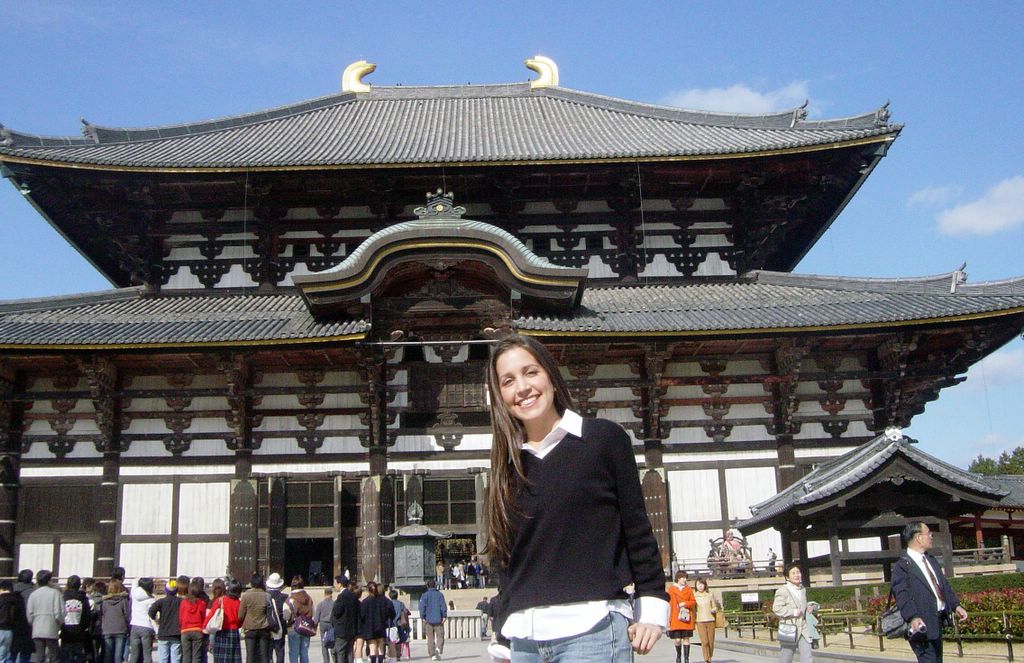
Todaiji, the largest wooden structure on earth, is only a shadow of its former self, 30% the width of the original structure. Fall 2002. Posted by Hello

As I walked toward Todaiji (The Great Eastern Temple), home of the world’s largest cast iron Buddha, I was inevitably stopped by a young rickshaw driver. She casually informed me that this year the festival had been held on January 9th. Ah well. It’s a little early to be celebrating my birthday anyway, so I wasn’t too disappointed. I went to hang out with Buddha for a bit, and figured since I was in Kansai, things could only get better! That’s just the way it works!


Daibutsusan, the Great Buddha of Nara. Posted by Hello

I called Lindz and went to meet her for dinner in Osaka. We noisily slurped down a bowl of miso ramen in a tiny shop conveniently located in her apartment building and run by a bunch of young, American-music-loving kids. I was sucking down noodles to the beat of Michael Jackson, Blink 182 and for a brief moment, Whitney Houston, until thankfully one of the horrified waitresses rushed to the radio and promptly filled the shop with the soothing sounds of something techno.

Lindz said I could crash at her place, so I took the chance to catch up with my long lost partner in crime. Unfortunately, the fact that we are, despite some serious effort, inevitably growing up, she had to work the next day, which made the chance of a joint adventure impossible.

I was ready to head for home the next day when I snapped out of it. There is no way you can go to Kansai and not make brief cameo in Kyoto! I mean, that’s sacrilege!


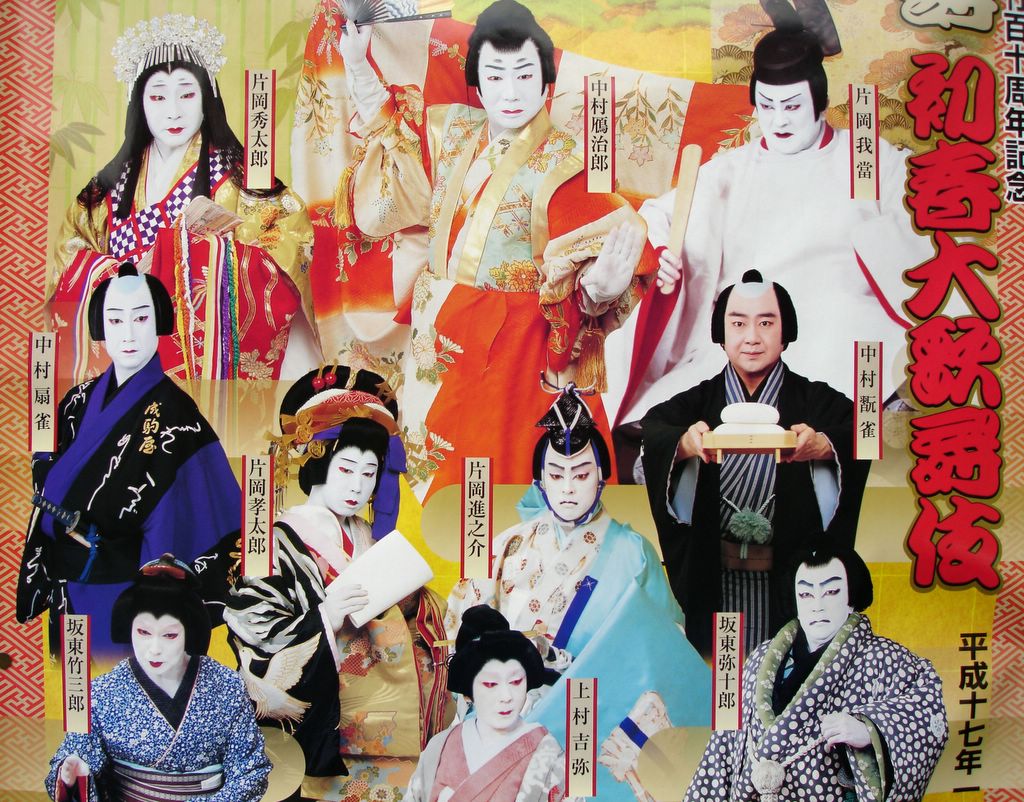
Kabuki, a traditional form of Japanese theatre, in which all roles are acted by men. Posted by Hello

I wandered up the subways stairs, past the famous Minamiza Kabuki theatre and towards Gion. Since it was lunch time and Indian food is a rare commodity in these here parts, I indulged in a little curry and dal in the same place where I had celebrated thanksgiving. It always makes me smile to hear the owner speak Japanese with his undeniably Indian intonation.


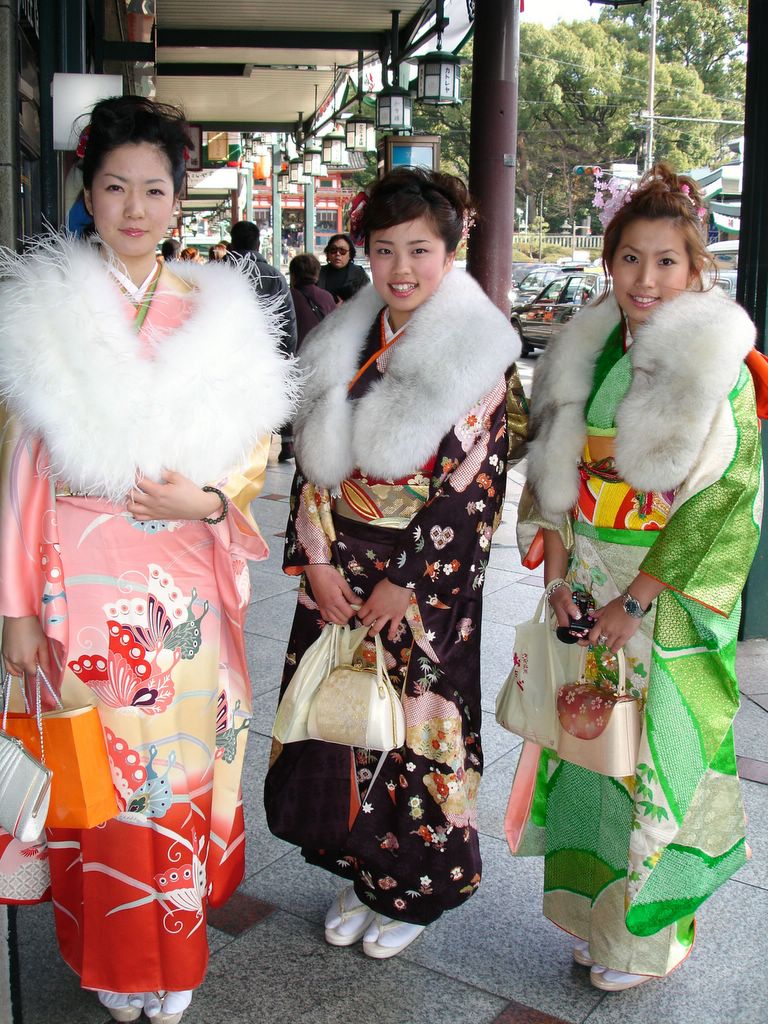
Brand-spankin' new adults I met on thier way from a New Year's visit to Yasaka shrine. Posted by Hello

After meeting my quota of curry in a hurry, I rolled myself out onto the street and turned, as if magnetically drawn, towards Yasaka Jinja. I squinted as what appeared to be three kyoningyo (Kyoto porcelian dolls) dressed in their finest furisode kimono slowly came into view. Seijinshiki and New Years celebrations were still in full swing! I stopped to congratulate them on their coming of age (and take their picture of course), and ran up to the shrine.


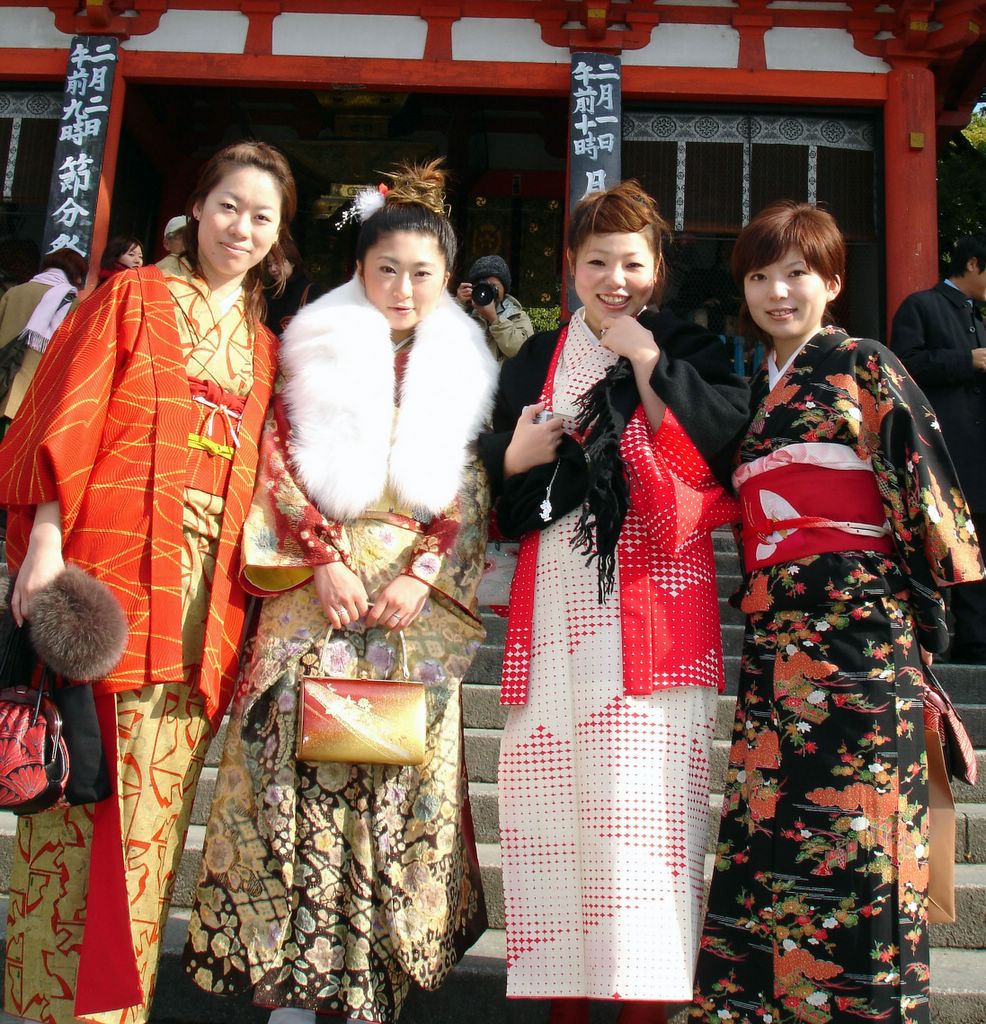
Leaving Yaska shrine, thesr girls couldn't escape without letting me take a picture. But who is that man in the back taking a picture of? Posted by Hello

From there it is only natural for me to head up the twisting, cobblestone roads that lead to Kiyomizudera. I know the path by heart, as if I had grown up wandering the narrow, twisting streets in another life. Along the way I ran into many nisemono maiko, tourists dressed as geisha apprentices to be photographed in the ancient capital, but nothing prepared me for the luck I would find at Kiyomizu.