Showing posts with label nara. Show all posts

Thursday, May 15, 2008

Tōdaiji and the Great Buddha of Nara

Spring Rewind: March 31, 2008

Photobucket
More tricksy deer work the crowded approach to Todaiji's great gate. Watch out girls, they bite!

Photobucket
A young boy shares his shika senbei with one of many sacred deer lounging along the tourist-infested main approach to the temple.

Photobucket
An artist sketches one of two nio, or "benevolent kings", enshrined in Todaiji's main gate, which is named after them (the nio-mon). Nio gaurd the entrance to most Buddhist temples in Japan in pairs, one with it's mouth open, the other, closed. Together, they represent Alpha and Omega, birth and death, the begining and the end. Created in 1203 AD, Nara's nio are the most famous in all of Japan, standing 26 feet tall.

Tourists stop for a sakura-framed souvenier photograph along the corridor leading to the temple's thoroughfare.

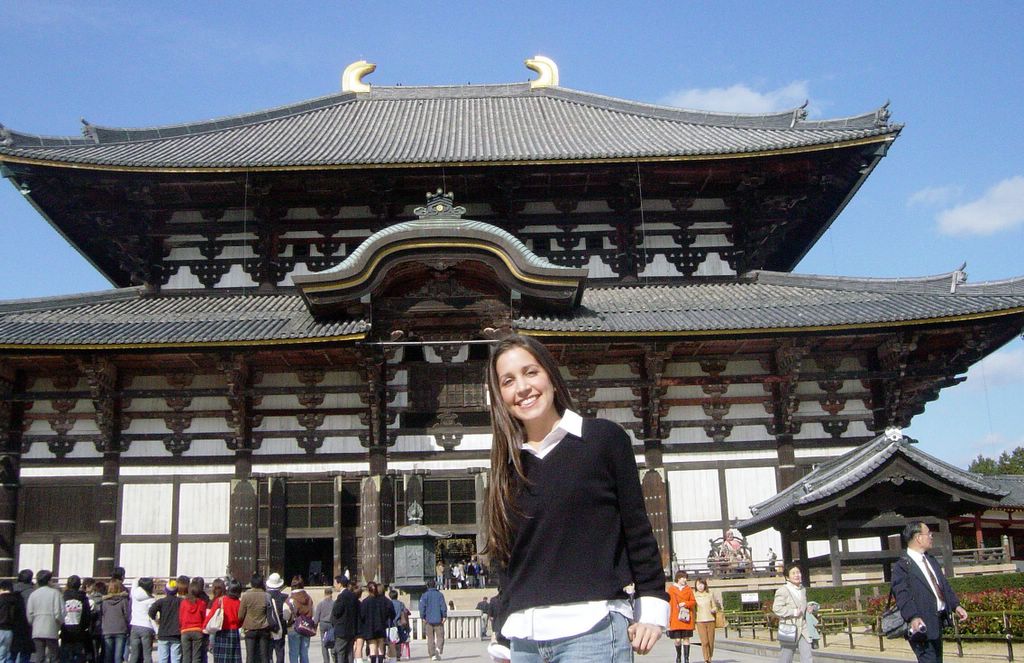
Todaiji towers over visitors, dwarfing everything in sight. Certified as a UNESCO World Heritage site, Todaiji is one of Japan's most famous and historically significant temples. Despite the fact that the present reconstruction of the building, undertaken in 1692, is only two-thirds of the original size, Todaiji remains the largest wooden structure on earth, housing the world's largest cast iron Buddha at 57 meters wide, 50 meters deep, and 48 meters tall.

Sakura, silhouettes and stormy skies surround the home of Daibutsu-san, the Great Buddha of Nara. When the original construction had concluded in in 798, it was recorded that 50,000 carpenters, 370,000 metal workers, and 2.18 million laborers worked on its construction and furnishings, nearly bringing the nation to the brink of bankruptcy.

Photobucket
The Great Buddha of Nara is the world's largest cast iron Buddha, sitting at a staggering 14.98 meters and weighing 500 metric tonnes.

Photobucket
Framed by the temple's decorative woodwork and massive timber pillars.

Photobucket
The Great Buddha's left hand raised in the abhaya mudra, imparting fearlessness and reassurance.

Photobucket
Another temple gaudian, in full battle gear, glares ominously down at visitors.

Photobucket
A couple joins the crowd in snapping a few shots on their cell phones.

Photobucket
Like the buddha, this boddhisatva's left hand mudra offers reassurance. It's right hand depicts the Varada mudra, lowered with the palm facing outward, the gesture of bestowing blessings or of giving charity.

Tuesday, May 13, 2008

The "En" in Nara : 縁

Spring Rewind: March 31, 2008

Photobucket
Abbey and I beneath the weeping cherries and watchful eye of Himuro Shrine's Shishi. A shishi, which can be translated as "lion", often refers to a mythical creature with magical power to repel evil spirits..

Abbey's first day in Kyoto had been gray and rainy, but the next morning found us seated outside Starbucks, one of the many guilty pleasure we indulge in outside of Ena, enjoying sunshine mixed soy chai. As usual, we weren't exactly sure where the day would lead us, but since we were so close to the station, I suggested we head for Nara. Abbey had never been there, and in the interest of packing as much Kansai punch into her three day Kyoto foray as possible, she agreed.

A family struggles to satisfy the impatient hunger of Nara's tourist-chasing deer.

Within an hour we were walking the deer-infested streets of Nara, dodging their senbei-sniffing noses and side-stepping the plentiful pellets of deer droppings splattered on the surface of the sidewalk. One thing you'll never find in Japan is the desperate hordes of destitute, poverty-stricken children or tourist dependent adults begging and badgering you for money. Instead, they have sacred deer, free from harm, free to roam, and free from the burden of finding food for themselves. Tourists excitedly buy shika senbei, or deer rice crackers, to feed to the ravenous hordes.

Once the deer started to surround me, I made a break for it, hoping to escape unscathed.

I have been to Nara at least five times, but I had never tried or wanted to try feeding those freakin' deer. I knew better. But during my last trip to Japan, I was persuaded by a friend to give it a try. "It's not like they bite!" He laughed at my feigned excitement. Little did he know...


That's me getting attacked from both ends. The deer in front over-bit, planting a lovely slop of saliva on my fingers, while his buddy bit my bum from behind. I may look like I was pleasantly suprised, but I assure you that it felt anything but pleasant.


It's a hold up! Having unloaded all of his shika sembei on an unsuspecting victim (me), my friend escaped unscathed instead. To tell the truth, I'm suprised. Those deer don't look particularly pleased.

Photobucket
Elementary school children try to capture the craziness of Nara's infamous deer with their ketai, or cell phone, camera.

Photobucket
The five story pagoda of Kofukuji.

As we wandered through public parks and temple grounds, absent-mindedly admiring the anceint architecture and ethereal cherry blossoms, we stumbled upon a young American man traveling with his father who had seen us in Starbucks the day before. An exchange student spending a gap year studying in a Japanese High School, he had recognized me from my blog (something that, strangely enough, only happens in Kyoto). Before they knew it, we had high-jacked their peaceful father-son afternoon, insisting that they join us for our slow and study trek in the general direction of Todaiji, the Great Eastern Temple.

The great weeping cherry shading Himuro Shrine's gate.

Along the way we noticed a modest shrine on the main road overflowing with cherry blossoms in full bloom. They spilled over the brilliant tangerine torii, or spiritual gate, covering the graveled pathway like Anne's White Way of Delight. Sunshine spilled like watery jewels, dripping through the leaves, filtered by the velvety petals into clouds of playful light.

Our new friends flooded in sakura-filtered sunlight. (Snaps to Abbey for the shot).

Photobucket
Towering tendrils of blossom-burdened branches tumbling down....

Unfortunately, most shrines are not barrier-free.

More about Todaiji tomorrow....

Tuesday, January 18, 2005

Happy New Year Kansai!

Well my first weekend back in Japan turned out to be quite an adventure!


Wakausa Yama Yaki, Nara. Posted by Hello

I happened to come across an amazing photo of Wakakusa Yama Yaki (The Burning of Young Grass Mountain). The stark black silhouette of a 5 storied pagoda seemed to spread its wings and rise from the sea of fire engulfing the gentle slope of the mountain behind it. Fire flowers (the actual translation of the Japanese word for fireworks), shot up from the waves of flame, blooming like cherry blossoms in the dark veil of the night sky.

Luckly along with the picture was a note saying that the festival, which commemorated a battle between Buddhist monks of two rival temples who had set the mountain on fire, was celebrated January 15th of every year! Happy birthday to me!

The next day I was on my way, riding in the lap of the luxurious Shinkansen, Japan’s ultra-fast bullet train. But by the time I got to Nara the sunny blue skies of Ena had faded to paler shade of grey, draped in heavy rain clouds that soaked the earth beneath. There was as much chance of the mountain burning as there was of me spontaneously combusting, so needless to say, I was hopeful.


Todaiji, the largest wooden structure on earth, is only a shadow of its former self, 30% the width of the original structure. Fall 2002. Posted by Hello

As I walked toward Todaiji (The Great Eastern Temple), home of the world’s largest cast iron Buddha, I was inevitably stopped by a young rickshaw driver. She casually informed me that this year the festival had been held on January 9th. Ah well. It’s a little early to be celebrating my birthday anyway, so I wasn’t too disappointed. I went to hang out with Buddha for a bit, and figured since I was in Kansai, things could only get better! That’s just the way it works!


Daibutsusan, the Great Buddha of Nara. Posted by Hello

I called Lindz and went to meet her for dinner in Osaka. We noisily slurped down a bowl of miso ramen in a tiny shop conveniently located in her apartment building and run by a bunch of young, American-music-loving kids. I was sucking down noodles to the beat of Michael Jackson, Blink 182 and for a brief moment, Whitney Houston, until thankfully one of the horrified waitresses rushed to the radio and promptly filled the shop with the soothing sounds of something techno.

Lindz said I could crash at her place, so I took the chance to catch up with my long lost partner in crime. Unfortunately, the fact that we are, despite some serious effort, inevitably growing up, she had to work the next day, which made the chance of a joint adventure impossible.

I was ready to head for home the next day when I snapped out of it. There is no way you can go to Kansai and not make brief cameo in Kyoto! I mean, that’s sacrilege!


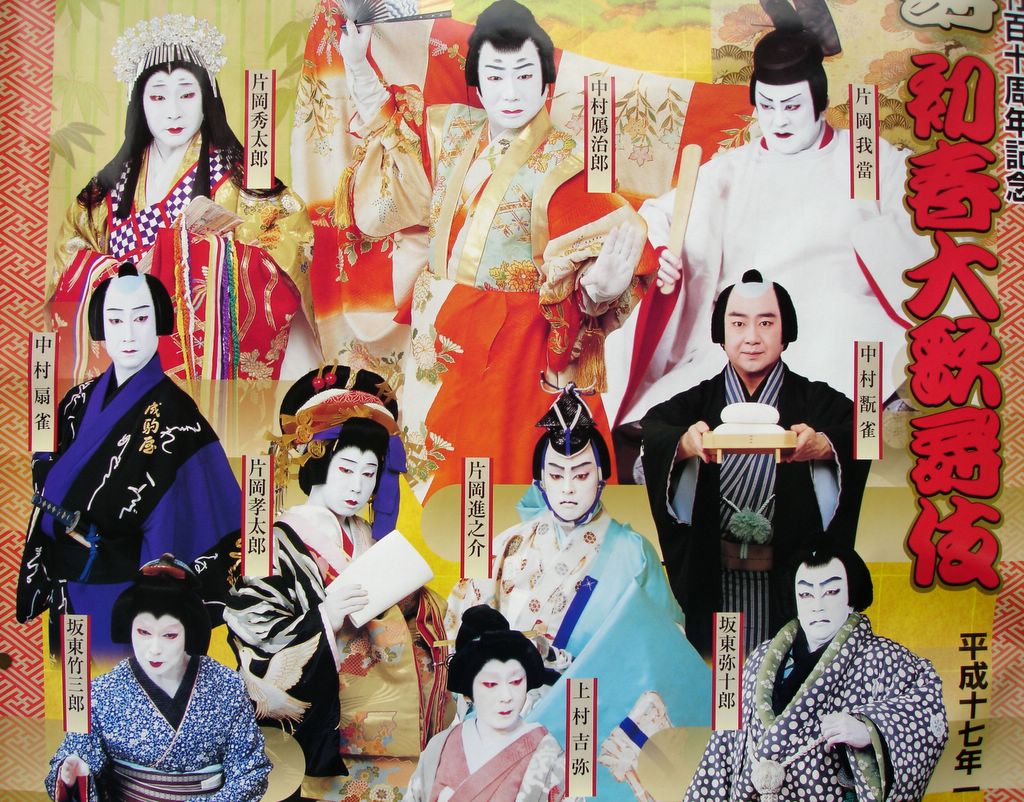
Kabuki, a traditional form of Japanese theatre, in which all roles are acted by men. Posted by Hello

I wandered up the subways stairs, past the famous Minamiza Kabuki theatre and towards Gion. Since it was lunch time and Indian food is a rare commodity in these here parts, I indulged in a little curry and dal in the same place where I had celebrated thanksgiving. It always makes me smile to hear the owner speak Japanese with his undeniably Indian intonation.


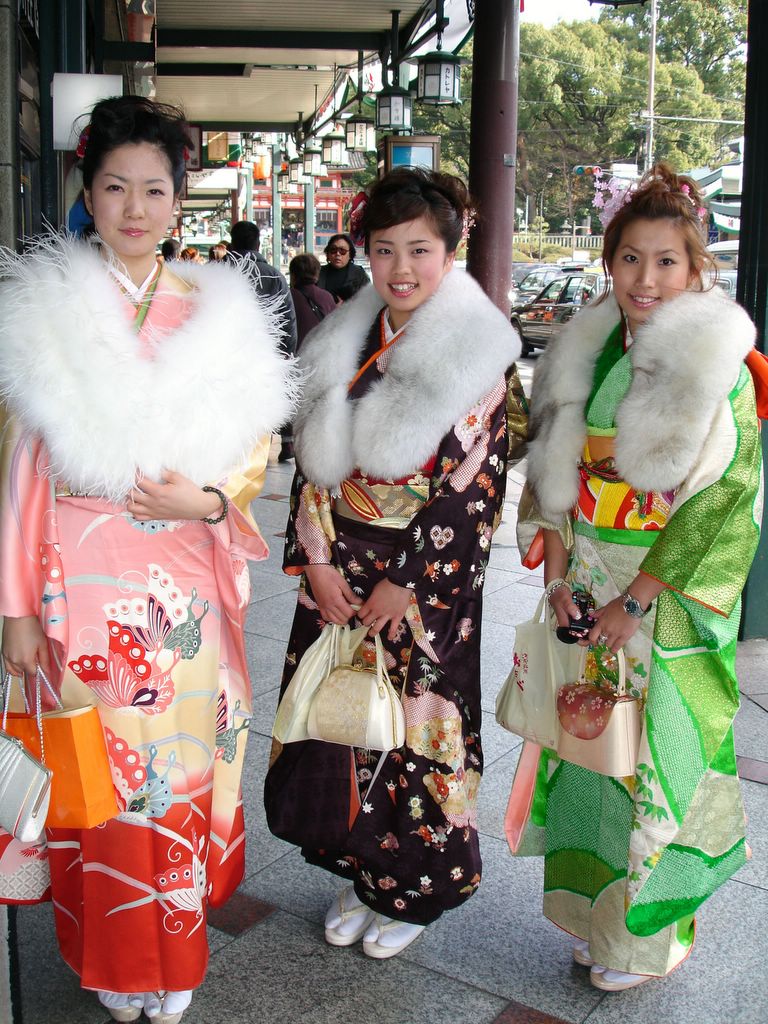
Brand-spankin' new adults I met on thier way from a New Year's visit to Yasaka shrine. Posted by Hello

After meeting my quota of curry in a hurry, I rolled myself out onto the street and turned, as if magnetically drawn, towards Yasaka Jinja. I squinted as what appeared to be three kyoningyo (Kyoto porcelian dolls) dressed in their finest furisode kimono slowly came into view. Seijinshiki and New Years celebrations were still in full swing! I stopped to congratulate them on their coming of age (and take their picture of course), and ran up to the shrine.


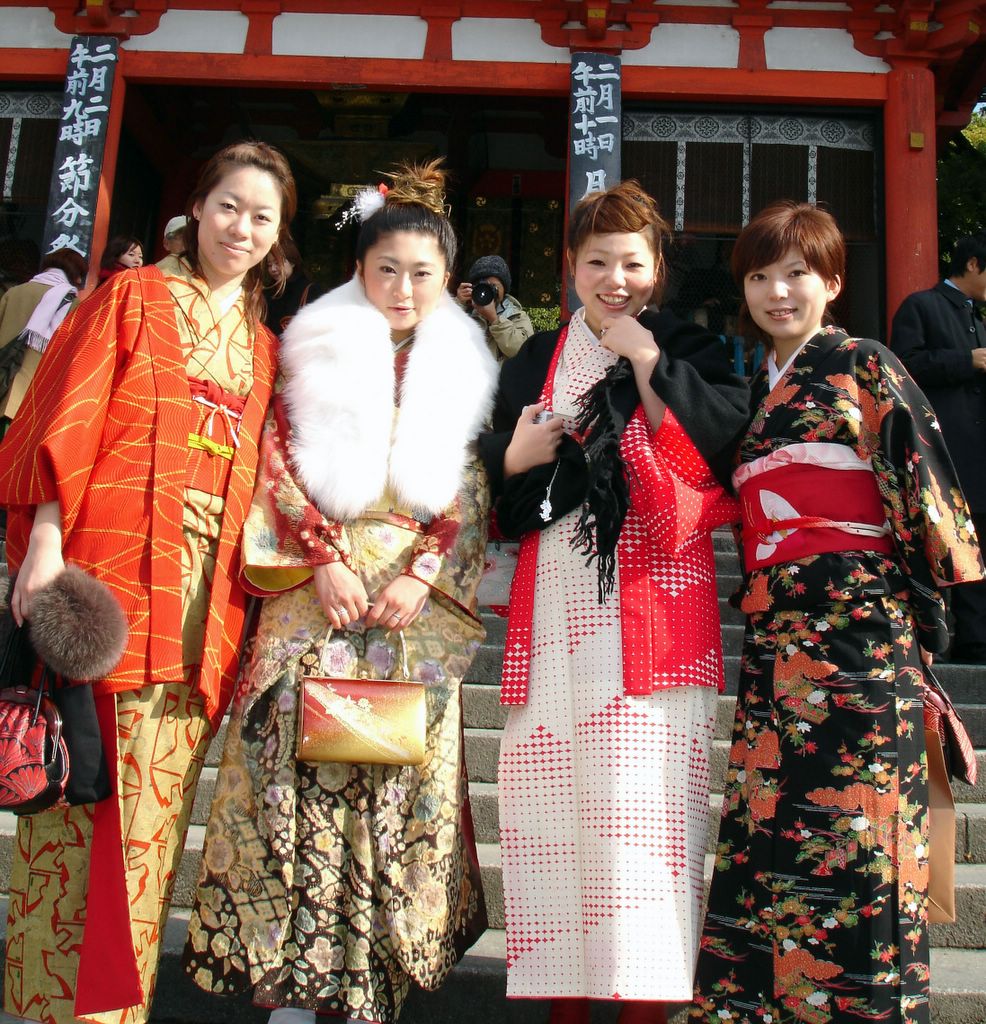
Leaving Yaska shrine, thesr girls couldn't escape without letting me take a picture. But who is that man in the back taking a picture of? Posted by Hello

From there it is only natural for me to head up the twisting, cobblestone roads that lead to Kiyomizudera. I know the path by heart, as if I had grown up wandering the narrow, twisting streets in another life. Along the way I ran into many nisemono maiko, tourists dressed as geisha apprentices to be photographed in the ancient capital, but nothing prepared me for the luck I would find at Kiyomizu.