Showing posts with label fall. Show all posts

Sunday, December 17, 2006

Gion Odori 2006: Maneki

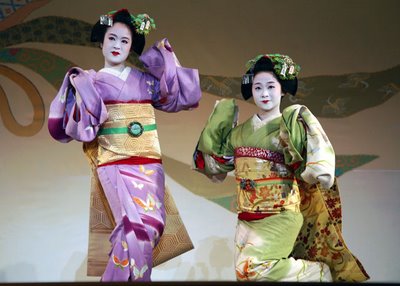
Masayo and Miharu.

The theme of this year's Gion Odori, the fall dance performed by the maiko and geiko of Gion Higashi, was "Seasonal Glories of the Maiko's Hanakanzashi," or flowered hair ornaments.

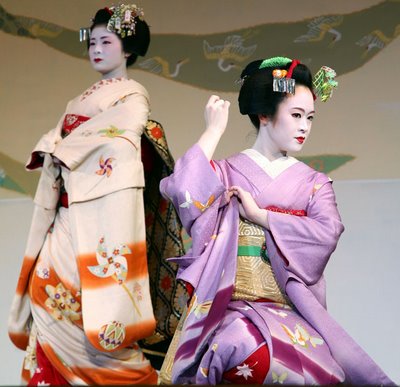
Masayo and Fumiki.

In December, maiko wear the maneki hanakanzashi. This dance depicted the maiko attending the year-end debut of Kabuki actors at the Minamiza theater. A young maiko overcomes her shyness to ask her favorite actor for his signature "with her big courage".

Photobucket - Video and Image Hosting
Masayo, the highest ranking maiko in Gion Higashi, dancing during the opening act of this year's Gion Odori: Maneki. This years theme was hanakanzashi, the flowered hair ornaments worn by the maiko. Each dance reflected the meaning and seasons in which each hanakanzashi is worn.

During Kaomise (from about Nov.30- Dec. 26) , the names of the performing Kabuki actors are written on long, wooden boards called maneki kanban, and hung outside the theater. Maiko attend the Kaomise (face showing) Kabuki performances, wearing these Maneki hanakanzashi. Two small, blank tags are attatched, and maiko ask their favorite Kabuki actors to sign them afterwards.

Photobucket - Video and Image Hosting
Fukimi and Miharu strike a Maneki Neko, or beckoning cat, pose.

Photobucket - Video and Image Hosting
Fumiki and Umeha.

Photobucket - Video and Image Hosting

Tuesday, December 05, 2006

Picture of the Day and a Letter from the Edge....

Photobucket - Video and Image Hosting
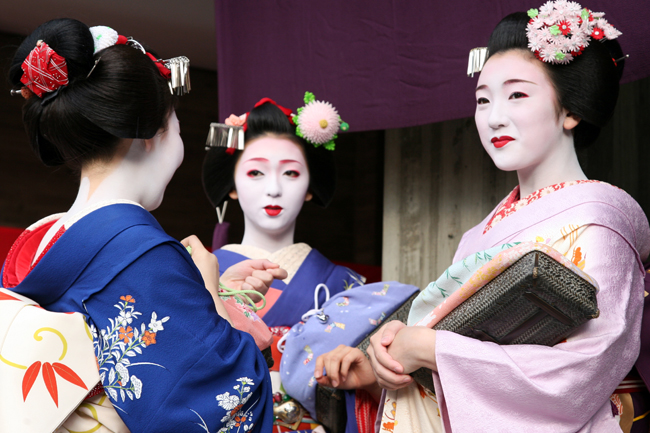
The stunningly beautiful Kikutsuryu of Miyagawa-cho, greeting customers before the autumn dance recital.

*****
And in totally unrelated news....
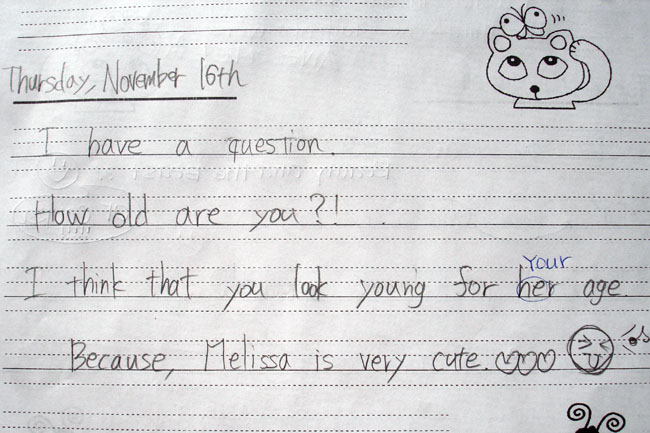
I love my students!

Have I mentioned that lately? (^-^) This is from an first year student at my Ghetto school (9th grade). Lately the ichinensei have been writing me all kinds of letters, probably because they're still excited about learning and being able to write in English, unlike most of their jaded, juken-obsessed sempai (upper classmen. Juken is the life-altering high school exam the entire Japanese junior high education system is built around. Note: These letters are not assignments, the students choose to write to me on their own). God bless them, every one!


*****
We now returned to the regularly scheduled programming...

Breath-taking beauty...

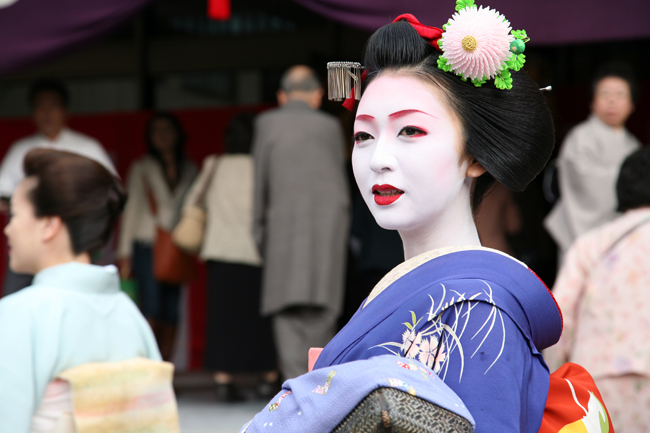
Fukunao laughs as she gives a thumbs up to her big sister, Mioharu. You can see the subtle difference in their regalia that allude to their rank. , as a senior maiko, Mioharu wears a pure white collar, while Fukunao's is still predominantly red. Their kanazashi, or flowered hair ornaments, also reveal their rank: Mioharu wears a single, mono-colored Chrysanthemum blossom, while Fukunao wears a cluster of small, multi-colored blossoms.

Fukuyoshi, Kikutsuryu and Fukunao hanging out before the autumn dance recital. Notice Fukuyoshi's hairstyle (left edge).The red, triangular shaped cloth in her hair is called a Chirimen Tegarami, and is the sign that she has had her mizuage. In the modern day hanamachi, mizuage now happens around her 18th birthday, or three years after the start of her training and is simply a coming of age ceremony in which her hairstyle, and certain details of her ensemble, change. Mizuage, as it is described in "Memoirs of a Geisha", no longer takes place.

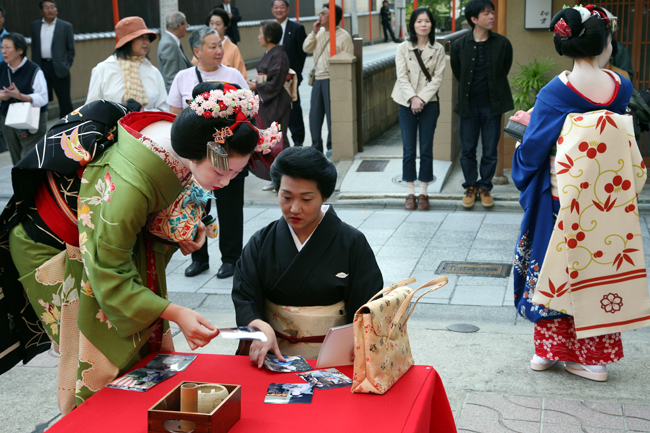
Young Miehina, a maiko from Miyagawcho, looks at pictures of herself and her friends that photographers have brought for them before the final performance of the autumn dance. Her Okaasan, in the black kimono, is not only the mother of her Okiya, but her maternal mother as well (This is quite rare). Patrons begin to arrive at the theater, as passers-by stop to gaze at the exotic scene of maiko and geiko greeting customers in the street. Note: No gaijin. Just me (^-^)/


And a special thank you to Yukio Katsumi, a wonderful woman I've had the pleasure of bumping into on more than one occasion in Kyoto. Her husband and her are geiko afficionados as well, and have taught me a lot about Kyoto and the 'Flower and Willow World'. They also snapped this picture of me...taking pictures! Ookini Yukio!

Friday, December 01, 2006

Autumn in Ena  恵那の秋

Fallen leaves
Come flying from elsewhere
Autumn is ending.
~Matsuo Basho

Along this road
Goes no one,
This autumn eve.

~Basho

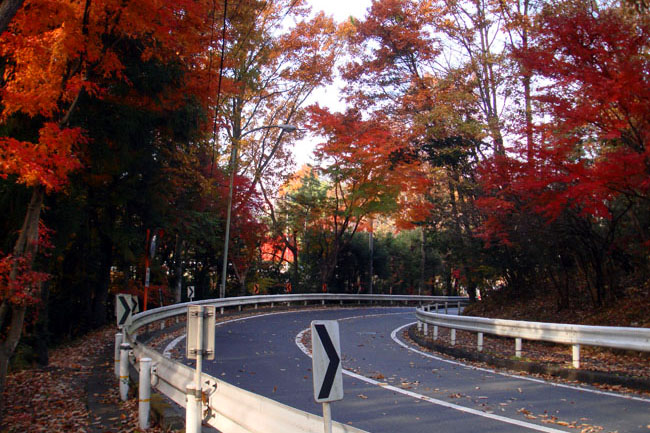
The road to my beautiful mountain school.

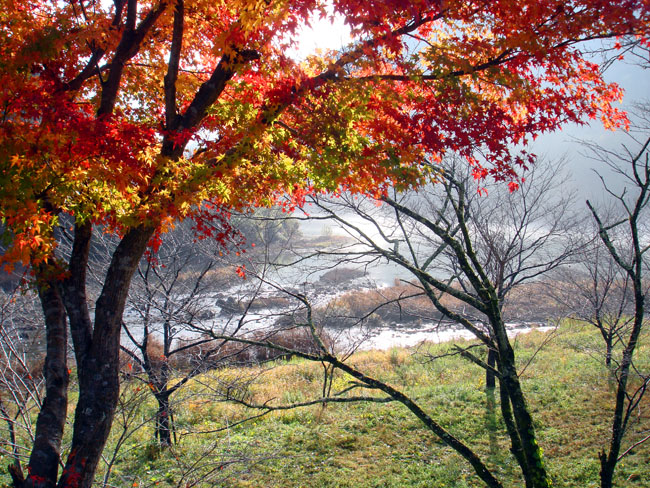
The view from the Beautiful Mountain school (^-^)/

Friday, November 17, 2006

Ena Update: Fall has Arrived!

Beautiful! Lovery!
Dusk in the mountain top town of Akechi, a newly acquired tributary of Empire Ena.

I am much more than a geisha chaser. I am an Assistant English teacher. Behold, the fruits of my labor!

Kana is a third year junior high school student, which is the equivalent of 9th grade in the US. If you can't read it, click on the image and a larger version will pop up. (^-^)

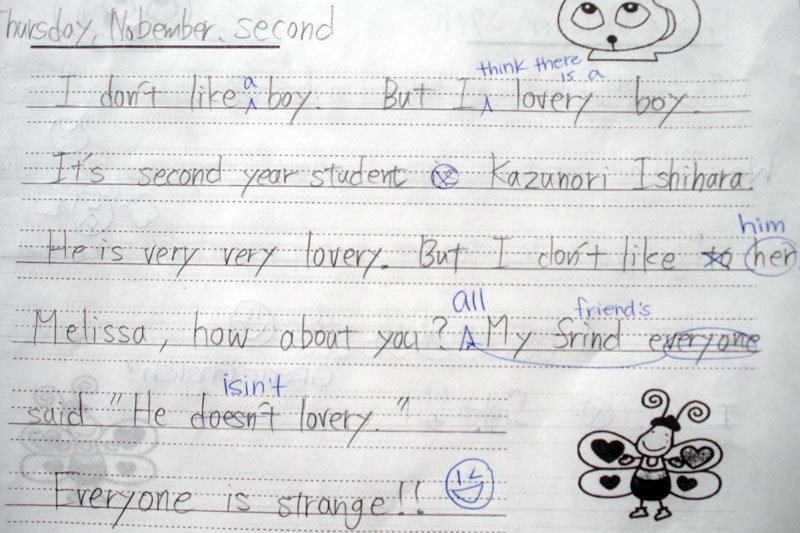
KAWAII! How cute is this? Written by a second year (8th grade) student who does not like a lovery boy named Kazunori (^_<)

These are just a few of the smile-inducing journal letters my Beautiful Mountain School students write me every week. Although it is optional, most of them try to write at least once a week, and many even write three times a week. I'm always excited to see a huge stack of letters waiting in my mailbox when I visit, and spend more time writing back then I do preparing for class (>o<). I've learned so much about my kids through these little letters, and they've learned a lot about writing! The improvement we've seen is incredible, both in their vocabulary and sentence structure (although is obviously still far from perfect). Having the opportunity to write about anything they want, without the pressure of being graded, keeps the students motivated and keeps me up to date on everything about them, especially since I don't get to visit as much as I used to. This connection to my students, and the relationships that it has fostered, is what makes being an ALT worth all the hours of absolute, brain-numbing boredom.

Tuesday, November 14, 2006

Misoekai: Miyagawa's Fall Dance

Photobucket - Video and Image Hosting
Kimitomo 君友 peeks out demurely from behind her gold-speckled fan. The extravagant silks, colorful kimonos, flowery hair ornaments and hauntingly beautiful make up are only part of a maiko's beauty, and impressive as they are, the true allure lies in her child-like innocence.

Photobucket - Video and Image Hosting

Photobucket - Video and Image Hosting

Photobucket - Video and Image Hosting
As a geiko, Kimina 君奈 no longer relies on the flashy kimonos or ornate hair ornaments. She has attained a level of skill that speaks for itself with every graceful movement.

Photobucket - Video and Image Hosting

Photobucket - Video and Image Hosting
Harumi 春美

Photobucket - Video and Image Hosting
Kikuryuu 菊柳 perfroming a traditional dance in which awamochi vendors take turns pounding rice cakes as they perform various acts. Awamochi is a type of rice cake that was popular during the Edo Era and is still made today.

Photobucket - Video and Image Hosting

Wednesday, November 08, 2006

Meeting the Maiko of Miyagawa

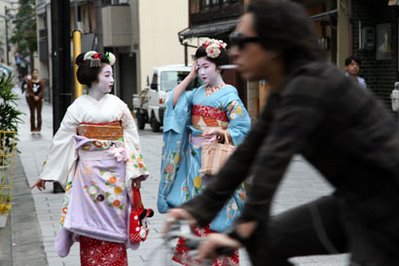
Kimika and Satoai. Check out Kimika's Minnie Mouse purse (^-^) The epitome of traditional Japanese style.

Goro goro goro goro... The unmistakeable sound of a wooden door sliding open. Whenever I find myself strolling through a hanamachi (flower town, where geiko live and entertain), my senses are heightened and alert. Even simple sounds that usually blend into the indistiguishable hum of everday life in Japan, become melodious, distinct, and full of meaning.

Kobo kobo kobo kobo... Before I could even turn around I heard the soft, giggling voices of two girls and the clop of their tall, hollowed wooden sandals (called Okobo, because of the sound they make) stepping out onto the cement. As I looked over my shoulder, two beautifully dressed maiko came to a stop at busy corner, trying to decide which way to go. The cars and bicyclists, oblivious or uninterested, passed them by without so much as a second glance, but I couldn't take my eyes off them. Behind them a young minarai (apprentice maiko) stood in the street, respectfully seeing her big sisters off. I recognized Kimika (on the left) who has the reputation of being one of the most beautiful maiko in Miyagawa-cho, and was recently featured in Kateigoho Magazine. I watched them turn the corner and disappear, and even after found myself straining to hear the kobo kobo sound of their footsteps fading away. When I came to, I noticed a cute little Japanese woman smiling at me, sweeping the pavement infront of her machiya (townhouse).

"Konnichiwa," I smiled back with a little bow.

"Kawaii, ne? Nihon no maiko-san..." (Cute, aren't they? Japan's maiko)?

"So cute! Beautiful! They're like living works of art. Their hair, their kimono, their make-up, and the way they move... Like a dream!"

"Yes, but it's very difficult, you know. They come from very far away and study very hard. And how about you? You've come quite a way haven't you? Where are you from?"

"America. The State of Ohio. Ohaiyo!" I smiled cheesily and waved my hands in typical school girl fashion (Ohaiyo means 'good morning/ hello' in Japanese).

"Oh, really? Ohio." She said as she laughed at me. "You know, my big sister went to America before. Oh, if she was home I bet she'd love to talk to you. Are you a student? Are you studying abroad? How amazing that you can speak Japanese so well! It's amazing!"

"Actually, I'm an English teacher in Gifu prefecture," I giggled. I get the student thing a lot (I'm not complaining)! "And my Japanese is horrible! I don't study at all...But Thank you for saying so." We stood in the street talking for quite awhile, and eventually she mention that she was 80 years old. 80 years old?! The woman did not look at day over 60, and a young sixty at that. Now that is amazing. It got me thinking, just how old was her big sister?

Yasuha and Fukuyoshi.

As we stood in the street, maiko continued to hurry by. Incapable of hiding my excitement, I fumbled akwardly to get my camera untangled from my neck and bag before they hurried past us. "Oh, that's good!" She said. "We'll take a picture!"

"What? No, no, that's Ok! They're busy and..."

Before I could refuse she was already calling to Yasuha, by name. To my suprise, Yasuha greeted her with a big smile, a bow and bubbley "Konnichiwa Okaasaan!" The little old woman asked her if she could take our picture, directed Yasuha to stand in front of a teahouse across the street, and pushed me over to her as she grabbed my camera out of my hands.
Yasuha and I (^-^)v

I apologized and thanked Yasuha about 3 times in one breath, even as I tried to smile for the picture. "Hai cheeezu!" She called out. "Ah! That one was no good. One more! Hai Cheezu! Ok!"

I started to apologize and thank Yasuha all over again, but she smiled, bowed to me, said "Ookini" (thank you in Kyoto dialect).

Photobucket - Video and Image Hosting

As Yasuha walked up the street, a little old woman leaning on her cane came around the corner. Yasuha greeted her and bowed, stopping in her steps and turning to face the old woman as she slowly hobbled on by. "Oh! Here she is! This is my big sister. Big sister! This cute little sister is from America! It's amazing. She can speak English and Japanese!"

The big sister, who turned out to be 84, slowly made her way to me with a beautiful smile spread across her softly wrinkled face. She asked me where I was from and if I was a student, and then we began to talk about her trips to America at least 40 years ago. She had been to L.A., San Fransisco, Las Vegas and the Grand Canyon. "It was amazing. I had never seen so many fruits. Such beautiful fruit!"

"Really?" I asked "Was the fruit delicious?"

"Oh, I don't know...I never got to eat any. I was with a customer. You know we can't eat when we're with a customer like that. But I remember thinking, "What beautiful fruit!" I had never seen anything like that before!"


The maiko were still making there way back and forth, calling at okiyas and hurrying to get to the recital practice. All of them greeted this wonderful little woman with deep bows of respect and sweet sounding "Konnichiwa Okaasaan!" and then would smile at me a give a little bow. She often asked them to stop for me to take a picture, or tried to talk to them long enough until I seemed satisfied with the shot I had. "Did you get it?" She asked when they would clop clop away down the little alley just next to her home.


We talked for quite awhile before she called for her little sister to bring something out for me. She emerged, hiding her smile behind a classic Gion Matsuri uchiwa (Japanese style fan) with the name of Miyagawa's most acclaimed dancer written elegantly beside the crest of the hanamachi. She place a "Sakura-ya" sticker (name card, like geiko use) near the base of the smooth wooden handle. "This is my place. Sakura-ya." I thanked her profusely before she slipped into the sliding door of her home, content with the events of the day and the experience they had brought me. It wasn't even noon yet.

Miyoharu and Fukuhina outside their okiya. Conveniently placed, ubiquitous vending machines.

Friday, November 03, 2006

Miehinna

Photobucket - Video and Image Hosting
Miehinna, a beautiful young maiko from Miyagawa-cho.

I had an amazing adventure in Kyoto last weekend. I promise to tell you all about it and get the rest of my pictures up soon! Gomen ne m(- -)m

Final Touches: Jidai Matsuri

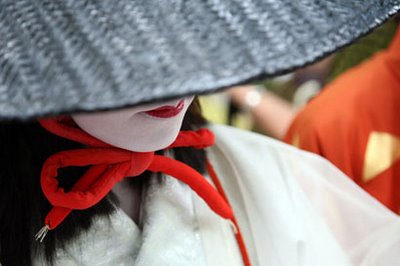
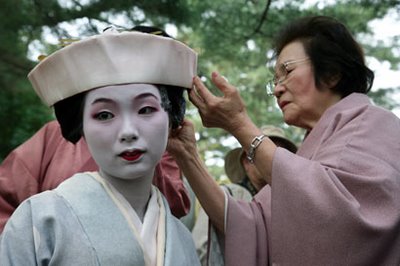
A Ritsumeikan University student participating in Kyoto's Festival of Ages has her uchikatsugi tied into place before the commencement of the procession. An uchikatsugi is a long veiled straw hat once worn by noble women to protect their anonymity.

Monday, October 30, 2006

Women of the Ages: Jidai Matsuri

Jidai Matsuri, Kyoto`s Festival of Ages, started as a way to revitalize Kyoto after Japan's capitol moved to Tokyo. It has now grown to include over two thousand participants (Kyoto residents, including Maiko and Geiko) dressed in authentic period costumes from throughout Japan`s history valued at over $25 million.
Izumo-no-Okuni (1600), the mother of Kabuki, was once a maiden in the service of the Izumo Shrine, one of Japan’s holiest Shinto shrines. She later became famous for her dancing, and legend holds that her troup`s first performance took place in the dry bed of the Kamo River. These dances were very popular (I have been told the originall characters used to write kabuki meant song, dance and prostitution), so popular that the Tokugawa shogunate banned women from the stage. From then on, all roles have been placed by men. Today Kabuki is written with characters meaning song, dance and skill.

Photobucket - Video and Image Hosting

Lady Shizuka (played by Masayo, a high ranking maiko from Gion Higashi), a famed Kyoto dancer of the late 12th century,was the lover of the hero Minamoto-no-Yoshitsune, a brilliant Genji general in the Gempei War (1180-1185). His success, however, earned him the distrust of his half-brother, Yoritomo, the leader of the Genji (vs. the Heike). In 1185, Yoritomo forced his half-brother to flee and live like an outlaw.

Four years later, facing capture and certain execution, Yoshitsune committed suicide. Shizuka, pregnant with his child, was captured by Yoritomo. Reportedly, she danced for him and so charmed him that Yoritomo spared her life and that of her unborn child only if it was a girl. Unfortunately, a son was born and soon killed to prevent him from seeking vengeance for his father's death later in life.

Sunday, October 29, 2006

Edo Style: Red White and Stripes

Photobucket - Video and Image Hosting
A beautiful smile and some stylin' threads at Jidai Matsuri, Kyoto's Festival of Ages.

Friday, October 27, 2006

Jidai Matsuri 2006: Heian Style

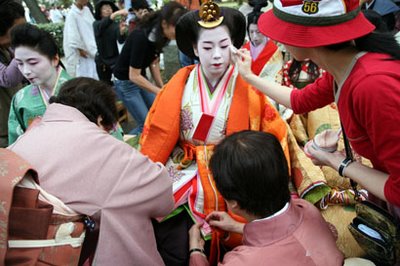
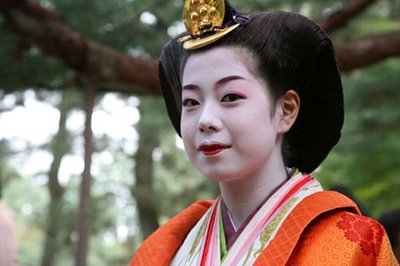
A Heian period princess, dressed in the 12 layered kimono popular with the imperial court in that era, patiently waits as the final touches are applied to her make up and kimono before participating in Kyoto's Jidai Matsuri: The Festival of Ages.

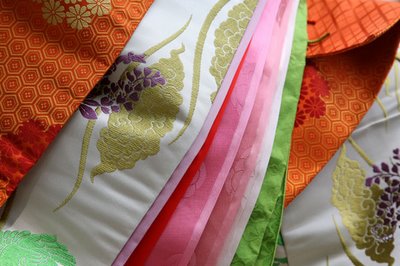
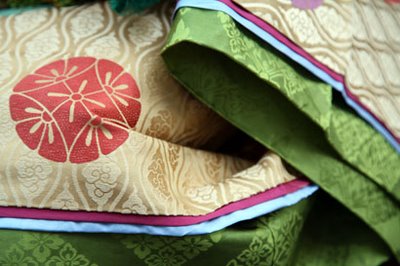
During the Heian period (794-1192), the subtle matching of different colored robes was considered a great skill, an expression of artistic sensibility that revealed the character of the wearer. In a woman, this skill was more highly valued than her ethical or moral character, and even held more sway than the physical features she was born with. The Heian society was “on the whole governed by style rather than by moral principles”.

Colors and patterns of the "juni-hitoe" (12 layers- a rather arbitrary number, as some women wore as many as 20) reflected many things, including: rank, seasons, directions, virtues, and elements of the earth as they related to spirits of nature. The multiple layers also helped in staying warm in winter. Eventually, sumptuary laws of the Edo Period standardized the number of layers to five.
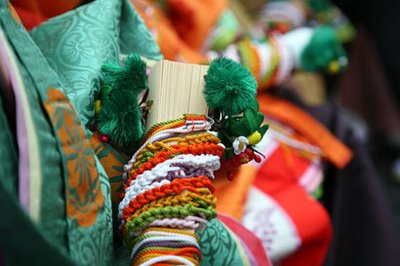
Fans carried by ladies of the Heain Imperial court.

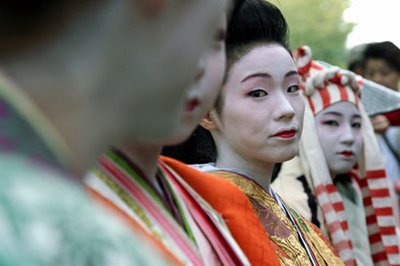
Over 2,000 Kyoto residents take part in the great procession of the Festival. Many maiko and geisha also make an appearance, dressed as some of the most famous women of Japanese history.

The costumes used in the festival are authentic, created according to the techniques used during the period, and are valued at over $25 million.