Showing posts with label summer. Show all posts

Sunday, September 23, 2007

Gion's Hassaku "Uniform": 祇園の八朔の正装

Photo Sharing and Video Hosting at Photobucket
Kosen emerges from a narrow, covered alleyway as she returns to her okiya.

Photo Sharing and Video Hosting at Photobucket
Kotoha and Yasuha headed back to their okiya after a long morning of visits beneath the brutal summer sun.

Photo Sharing and Video Hosting at Photobucket
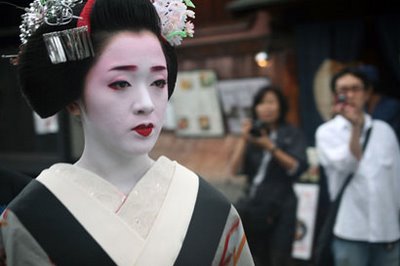
Kosen and Koyuki slip through a noren, carefully stepping into the street with her black laquered okobo. Kosen wears the typical susuki kanzashi ( Japanese Pampas Grass hair ornament).

Photo Sharing and Video Hosting at Photobucket

While many maiko wear kanzashi (hair ornaments) based on summer grasses, Mameteru wears a rare asagao, or Morning Glory, perfectly complimenting the flowery theme of her kimono.

Photo Sharing and Video Hosting at Photobucket
Teruyuki also wears the asagao, but as a senior maiko her hair is ornamented with only a single, large blossom.

Kotoha wears another rare kanzashi.

Photo Sharing and Video Hosting at Photobucket
Mameteru lifts a festive noren as she leaves a teahouse.

Because it is a very formal occasion, maiko leave three tapered prongs of skin bare on their painted white necks, as opposed to the usual two. This is called sanbonashi, or "three legs". Lower ranking maiko wear their hair in the wareshinobu style, characterized by the mage, or top knot, woven through with a peice of silk and topped with a special ornament called a kanko dome.

Senior maiko wear the Yakko Shimada hairstyle.

The difference is easily observable, as seen above.

The shimmering silver kanzsahi sparkle in the sunlight.

Sunday, August 19, 2007

Hanagasa Gyoretsu: Pontocho

Photo Sharing and Video Hosting at Photobucket
The maiko Hisano looks calm and composed before joining the geiko of Pontocho in offering a dance to the dieties of Yasaka Shrine.

With a rare view of their own hair pulled back in a sleek, simple pony tale, the geiko of Pontocho ride through Kyoto in a flowered float during the Hanagasa Kyoretsu, the Procession of Flowered Hats.

Photo Sharing and Video Hosting at Photobucket
Dressed as miko, or shrine maidens, Hisano performs "Kabuki Odori" with her fellow geiko.

Photo Sharing and Video Hosting at Photobucket

Friday, October 20, 2006

Kyoto: Where My Heart Belongs

Almost Famous: Kotoha, A young, high rank maiko named Kotoha makes her to the big party at the Ichiriki teahouse after the main procession of Yamahoko Junko last July.

I'm headed to Kyoto for Jidai Matsuri: The Festival of Ages. I haven't been to Kyoto since July(way too long) but here are some of the photos I took during the summer and never got around to sharing. Enjoy!

A young, first year maiko on her way to an appointment during Gion Matsuri. Geiko still use traditional, oiled paper umbrella in the rain and snow. This was my first time actually seeing a maiko or geiko use one. Breath-taking. This is also the first image taken with my new camera (^-^)/ I'm still learning how to use it. Non-stop pouring rain + fast moving maiko = a great learning experience! The blur helps conveys the hustle and bustle of the crowded street, the young maiko rushing through the crowd to her appointment, and the dreary, dripping rain. It looks ethereal, like a scene from a dream, which is exactly the way I felt when I shot it.
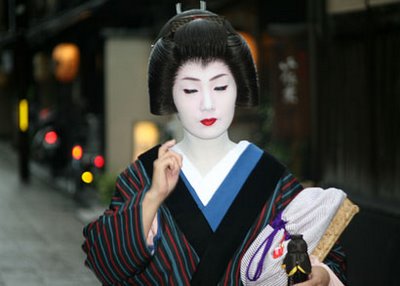
Eyes Wide Closed: Gion. A geiko making her daily communte through the streets of Gion. Geiko wear wigs called katsura, with almost no ornamentation (compared to maiko, who style their own hair, which is adorned with many kanzashi, or flowered ornaments). Of course she blinked the exact moment I pressed the shutter, but what a perfect face.

A young geiko waiting outside the Ichiriki Teahouse in Gion with her client. Customers pay about $200 dollars an hour for the privledge of spending time with geiko (kyoto dialect for geisha), but having money is not the only requirement. Customers must have a relationship with an ochaya, a place where geiko entertain, in order to make an appointment, and being introduced to an ochaya is no simple task. The refined manners of Kyoto dictate that charging a customer at the end of the night is a no-no. With bills often running past 5,000$ a night, Ochaya must have a relationship based on trust, so that they can rest assured that the bills that they send to their customers once a month will be paid.
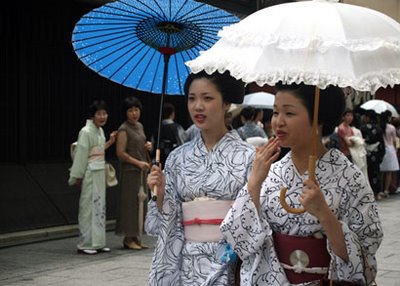
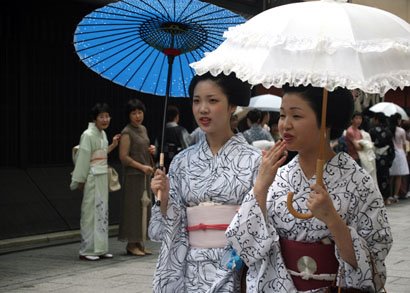
Two maiko make their way through the busy streets of Gion, sheltered from the sweltering summer sun by their umbrellas. Daytime casual: No white makeup, no heavy silk kimono. Just cotton yukata and lip gloss (^-^). I've never seen a maiko with a western umbrella before (right). Interesting. Also love the way the two older women watched them pass with awe, reverence and pride.

It is a Japanese custom for women to cover their mouths when smiling,laughing, and even sometimes, speaking. This young maiko was laughing as she talked with her friend, which is as she talked with her friend, which is why her hand is raised just so.
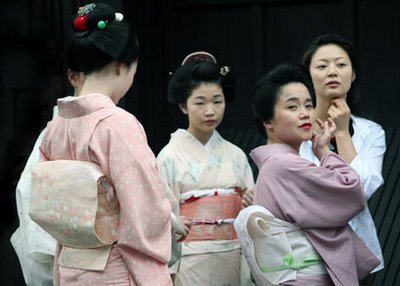
An older "sister", an accomplished and high ranking geiko, accompanying a few younger maiko, or apprentice geisha, to a tea ceremony held at the famous Ichiriki Teahouse. The way the older women on the right hold themselves, and the sensual way they touch themselves, even in such a casual way....

Saturday, July 29, 2006

Yoiyama Kyomai : Gion Matsuri

Photobucket - Video and Image Hosting
Geiko from Gion glide gracefully across the stage with their shamisens, as the long trains of their kimonos flutter behind them.

The Geiko took their place on the side of the stage, sitting seiza style, on their knees, and played as 3 maiko danced in the traditional Kyoto style. The maiko in the purple Kimono is Suzuha, who if I am not mistaken, recently appeared on the cover of the Japanese Playboy magazine! She is renowned for her classic beauty among many of Gion's customers.

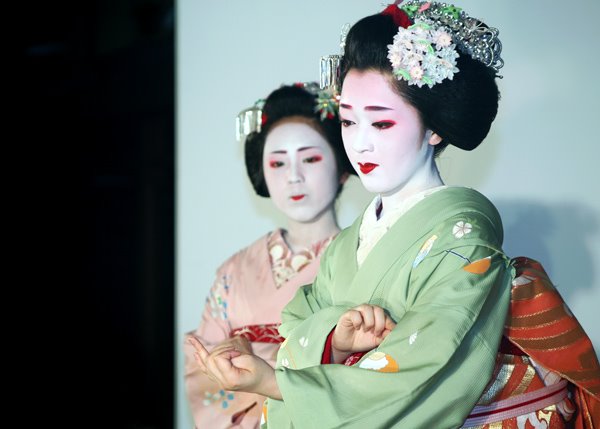
Kotoha, a high ranking maiko (in green) and superb dancer, performed the lead role in the short performance. The young maiko behind her is only in her first year. Her upper lip is not yet painted, and her collar is still predominantly red.

Photobucket - Video and Image Hosting
The extravagance of the flowing layers of colorful silk kimono, the breath-taking contrast of the porcelian-white makeup and delicately painted red lips, and the grace and dignity of the dance set to the haunting music of the shamisen create a scene of ethereal beauty beyond description.

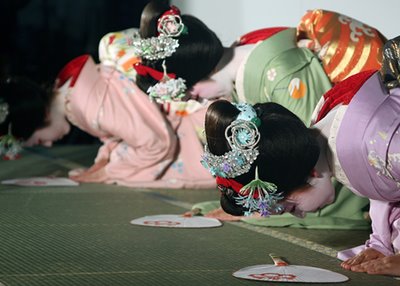
As their dance ends, the maiko bow low to their audience. The maiko wear a very special hairstyle during the month of July specifically for Gion Matsuri.
Sunday, July 23, 2006

Gion Matsuri: Yamahoko Junko 2006


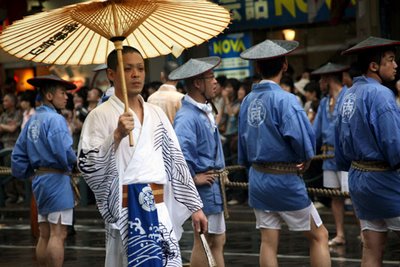
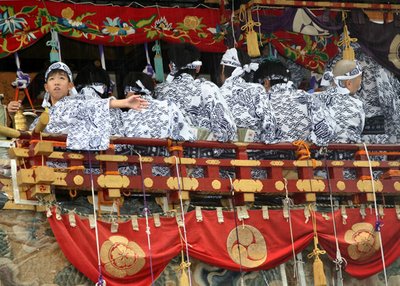
A young man, dressed in his area`s yukata, seeking shelter from the relentless rain that threatened to dampen the festive atmosphere of Gion Matsuri`s most anticipated event: the procession of the gigantic yama and hoko floats. The umbrellaless men behind him wait patiently for their cue to continue pulling their float through the streets. The heavy rain kept spectators to a minimum this year, with only 130,000, almost half last year's record-high of 240,000 people.

Is it still raining? You better your yukata it is!
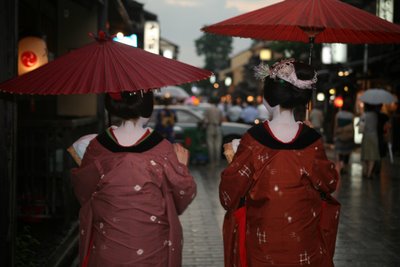
Maiko make their ways through the soggy streets of Gion beneath their beautiful oiled-paper umbrellas.

Thursday, August 25, 2005

Summer in Gion Kobu

Image hosted by Photobucket.com
A young maiko in her summer yukata, strolling the Hanamikoji, the most famous road in Gion, with her friends and family.

Image hosted by Photobucket.com
Her hair is dressed in the traditional wareshinobu style, which is said to accentuate the "loveliness" of the Maiko. This hairstyle is easily recognizable due to the two strips of red silk ribbon that has been woven through the mage (the mass of hair, or "bun" on the crown) visible from the front and the back. For three years after her debut, a maiko will wear this hairstyle.

Image hosted by Photobucket.com
A Geiko of Gion, on her way to the Ichirikiya (Japan's most famous teahouse), talking to a high ranking maiko in casual kimono. Geiko wear an elaborate wig known as a katusra, while maiko have their own hair styled once a week.

Image hosted by Photobucket.com
Pausing to chat with a patron of the Gion's expensive entertainment. Notice the elaborate top knot of the Geiko's wing, as well as her wooden clogs, which, unlike the okobo that maiko wear, are cut out in the center.

Image hosted by Photobucket.com
Red lanterns dangle from the lattice windows and walls of Tea houses. These lanterns display the outline of an array of six circles, skewered by a line. This is the famous tsunagi-dango (literally, 'linked dumplings'), and the crest of the Gion Kobu district. This design reputedly originated in an attempt to build solidarity among the six Gion areas during the Edo Period, when permission was granted to open entertainment establishments. Each area is represented by one dango (dumpling).

Image hosted by Photobucket.com

Image hosted by Photobucket.com
Kyoto's town houses have many distinctive features, such as red-ochre lattice windows, vertical-slit windows and spikes. One of the more peculiar is the inu-yarai that skirts many a house. Inu-yarai, or dog repellers, first appeared in the 17th-18th century. Their purpose was to protect houses from mud spattering up from the road, among other things (like dogs peeing on them)! They are usually made of bamboo or curved sticks, assembled in a frame that slopes out from the wall at an angle, a few feet above the ground, down toward the road. Scenes of slender strips of bamboo leading out in elegant curves from clean walls can be seen outside restaurants in Gion and on town houses in Nakagyo Ward.

A Summer Stroll in Ponto Cho

Image hosted by Photobucket.com
Hisano, a beautiful young maiko from Ponto-cho in her casual daytime yukata, sheilded from the scolding summer sun by a Japanese paper umbrella.

Image hosted by Photobucket.com
Hisano strolls along the narrow alley known as Pontocho, the second largest traditional entertainment district in Kyoto, after Gion. Running 500 meters (0.3 miles), it is bordered on the east by the Kamo river and the Takase-gawa canal to the west.

Image hosted by Photobucket.com
A clear sign the summer has come. More than 80 of Pontocho's restaurants, bars, and other establishments set up wooden balconies on stilts over the canal on the west bank of the Kamo River, between Nijo Street and Gojo Street.

Image hosted by Photobucket.com
The famous Kamo River has been the backdrop of the Geisha and Maiko of Kyoto since the mid 17th century, when the first tea houses of Gion and Pontocho sprang up. Summer is the perfect chance to enjoy dinner by the cool, clear waters of the Kamagawa.

Image hosted by Photobucket.com
The mountains fade into blue as your eye follows the path of the river downstream, until its hard tell where the mountains end and the clouds begin

Image hosted by Photobucket.com
Pontocho's mon (crest) adorns the bright red lanterns that line the narrow alleyway, bringing a soft glow to magical evenings among the old buildings, illuminating ephemeral glimpses of geiko and maiko as they disappear into the night. The chidori is a small bird known as a plover, often spotted along the banks of the Kamogawa.

Monday, August 15, 2005

Obon: Dancing with the Dead

Image hosted by Photobucket.com
The festival ground in Nakanoho, a small mountain village with terraced rice paddies and a tiny population. On Saturday night the site of the old junior high (back when there were enough residents to necessitate one) was transformed into the original Japanese disco, minus the disco and plus the many yukata-clad dancers cirlcing a red and white striped yagura, as singers yodeled traditional songs to the beat of a taiko. It is widely believed that as they dace beneath the lanterns, the spirits of their ancetors are dancing along with them.

Obon, the annual Buddhist ritual of welcoming ancestral spirits back to the world of the living, is one of the three major Japanese holidays. Usually celebrated August 13 thru the 17th, many employees are given mandatory paid leave to return to their ancestral abodes to pray for the repose of their forefathers, visit their graves, and guide their spirits back home with fire, lanterns, and prominent displays of the family crest.

Image hosted by Photobucket.com

Two of my elementary school students in their brand-spankin' new, stylin' yukatas, complete with huge glowing hoop earrings.

Of course these days Obon is often seen as an excuse to celebrate the cool nights and lazy days of summer, show off the latest yukata fashions, and see old friends. "This festival is just summer, no god." My friend explained to me as we drove along the narrow winding roads that lead up from the Kiso River into the mountain cleft of Nakanoho.

Image hosted by Photobucket.com
More of my super cute elemenary kids in yukata.

The truth is that Obon finds its Buddhist roots in the Ura-Bon-Sutra, which recounts the legend of Moku-ren, a Buddhist monk distressed over a vision of his mother suffering in hell. Desperate to rescue her from the Hunger Devil, the Buddha suggests he ask the local monks to make generous offerings of food, thus easing her pain for seven generations. Mokuren was so relieved that he had alleviated his dead mother's suffering that he danced. The tale represents the need to change resentments and regrets about our parents and ancestors into appreciation for what they did to make our present life possible.

Image hosted by Photobucket.com
The Ena Kyo Odori Crew dance around the Yagura, a boat shaped pavillion where the singers and musicians lead each dance with traditional festival music.

The event also reflects an older, pre-Buddhist, Japanese belief that the spirits of dead come home each year to visit their families. In early times, on the first evening of the festival, fires were lit in people's yards and on nearby hills to guide the souls home. The next evening a neighborhood dance (odori) was performed, using tunes and steps drawn from community tradition, handed down thru the generations. On the third day the families sent the souls of their relatives back to the spirit world by lighting the way with roadside torches or floating lanterns, which drifted down the river or out to sea on the tide. It also embodies the Japanese custom of venerating their ancestors, honoring departed parents for the "debt that can never be repaid."

Image hosted by Photobucket.com
Nishi Junior High girls in their stylin' yukata!

Image hosted by Photobucket.com
This year the rain put a quick stop to all the dancing, but last year, fresh off the airplane and sporting yukata, I quickly made friends with the odori sensei!

Image hosted by Photobucket.com
My friend Keiko and I, in the yukata she gave me, and her little dog too!