Showing posts with label Kodomo no hi. Show all posts

Saturday, May 05, 2007

Kodomo No Hi

Photobucket - Video and Image Hosting
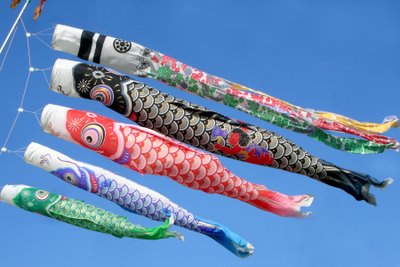
For Kodomo No Hi (Children's Day), families raise colorful carp-shaped "Koinobori" flags, one for each member of the family. The largest carp flag represents the father, followed by the mother and smaller carp to represent children.

For the past month, brilliant, boldly-colored carp flags have flickered in the fresh, baby-blue skies with every breath of spring. In Japan, carp are famous for fighting their way upstream and leaping over waterfalls to get to their spawning areas, making them a symbol of the famous fighting spirit, valiant efforts, and success. Like rainbows fluttering over the slowly flooding rice feilds, koinobori are raised in the hope that young boys in Japan will grow up with the same admirable qualities. Samurai helmets and warrior dolls gaurd the windows of traditional shops and entrances of homes blessed with sons, inspiring boys throught the land of the rising sun to be strong and brave.

May is the month of purple flowers, with irises and wisteria crowning the countryside with kingly purples and violets. The iris, or shoubu, is another famous symbol of Kodomo no Hi. In Japanese, shoubu means both iris and military spirit (although the Chinese characters are different), and because the shape of the leaves resemble swords, they are used to decorate the samurai style Go Gatsu Ningyo (5th Month dolls).

Kashiwa mochi and irises. Image by att.japan

No holiday would be complete without its special treats, and Kodomo no Hi is no exception. Children are treated to kashiwa-mochi, a sweet rice cake filled with even sweeter bean paste and wrapped in an oak leaf. Chimaki, a sticky sweet cake wrapped in bamboo leaves, is also very popular.


Summer is here! Happy Kodomo No Hi (^-^)/

Friday, May 05, 2006

Kodomo no Hi : Children's Day

Photobucket - Video and Image Hosting
For Kodomo No Hi (Children's Day), families raise colorful carp-shaped "Koinobori" flags, one for each member of the family. The largest and uppermost flag represents the father, followed by the mother, and small carp to represent children.

Children's Day (Kodomo-no-hi or Tango no Sekku) is one of the most popularly celebrated national holidays in Japan. Until recently, Tango no Sekku was the boys' day (also known as Feast of Banners) while the girls' day (Hinamatsuri) was celebrated on March 3. In 1948, the government decreed this day to be a national holiday to celebrate the happiness of all children and to express gratitude towards mothers. It was then renamed Kodomo no Hi.

May 5th marks the beginning of summer on the old lunar calendar and the begining of the 5th month, which according to the Chinese calendar was set aside to be a month for purification. To expel evil spirits and celebrate the future of their sons, families hoist koinobori (cloth carp streamers) from balconies and flagpoles. Gogatsu ningyo (5th Month Dolls) are displayed in homes and store windows with images of Kintarou, usually riding on a large carp, and a traditional Japanese samurai helmet, a Kabuto. Kintarou and the Kabuto are both symbols of a strong and healthy boy. Kintarou (金太郎) is the childhood name of a hero of the Heian period, famous for his strength as a child. It is said that Kintarou mounted on a bear, instead of a horse, and played with animals in the mountain when he was a young boy.

Some children may also take shyobuyu (a bath with floating iris leaves), and eat kashiwa-mochi (a rice cake wrapped in an oak leaf ) and chimaki (a dumpling wrapped in bamboo leaves). Carp, samurai, irises, oak trees, and bamboos all symbolize strength.

Happy Kodomo no Hi!