Showing posts sorted by date for query yoiyama. Sort by relevance Show all posts

Wednesday, August 08, 2007

Katsuyuki: Kawaii!

Photo Sharing and Video Hosting at Photobucket
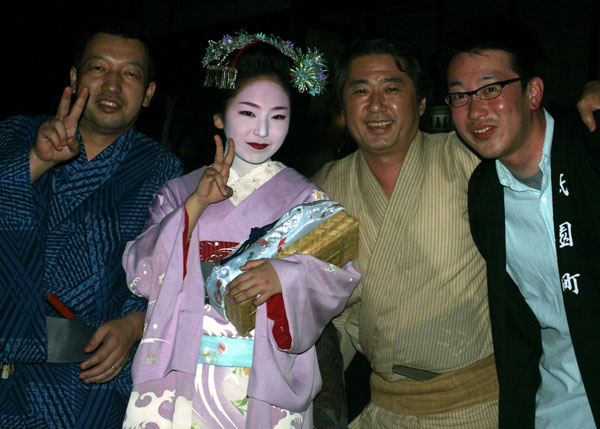
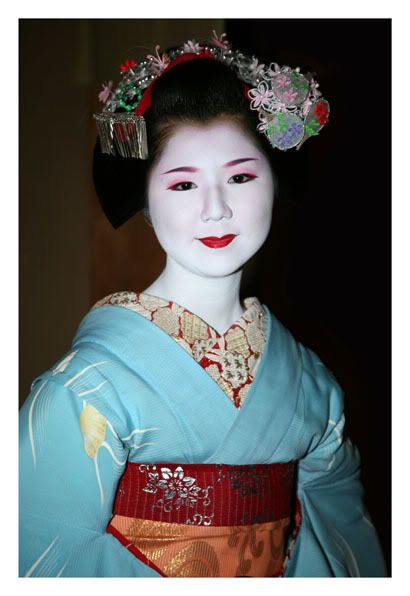
Katsuyuki, originally from Nagoya, is in her second year of service in Gion Kobu.

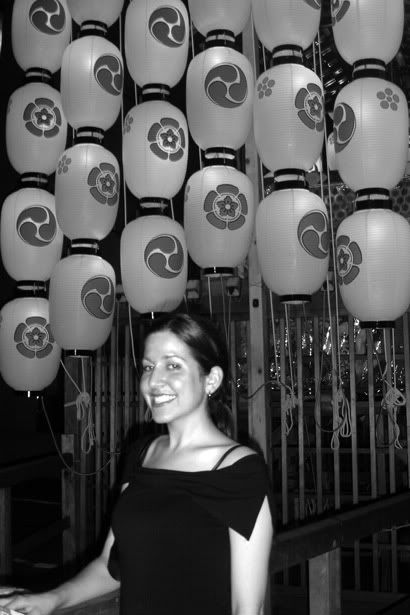
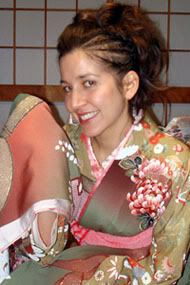
Remember how I said I was off to Kyoto to see Gion Matsuri, and then disappeared of the face of the blogsphere with only an image of Katsuyuki and I to keep you company? Well, despite all my best intentions of photographing what may have been my last Gion Matsuri, fate had other plans for me. Instead I ended up spending an incredible evening with Katsuyuki and a good friend of mine, who shall be henceforth referred to as Shacho-san (Company President).

The day of Yoiyama (the night before the Yamahoko Junko procession of floats) was grey and rainy as a typhoon tip-toed up the coast of western Japan. I had planned to spend the day walking around, photographing the floats and festivities, but ended up seeking shelter beneath the tiled eaves of a narrow Gion sidestreet. I found myself at Gion Maru Ume, a small teahouse/bar that doubles as a venue for tourists to meet maiko during weekend and holiday afternoons.

I recognized it immediately as the place where Lindsay and I had been given our private audience with Mamechika over three years ago, and where I had met Mamechiho last year! Intrigued, I splashed across the puddled pavement to the covered entrance where a few flyers featuring Mamechiho's coy smile were displayed on a small table. The slow rumbling sound of the door sliding open caught my attention as I turned to see an old friend pop his smooth, silvery head of hair through the noren (Japanese door curtain). He seemed just a suprised to find me standing there, soaking wet, as I was to see him.

"Well! My English teacher from Gifu! It's been a long time hasn't it! How are you?" We stood outside the door chatting as a few customers arrived for their appointment. As he ushered them in through the sliding door and split, hanging curtain, I began to back away, sensing my time to leave had come. "Won't you come in? Or do you have another plan? Are you busy?" He asked. I assured him that, umbrella-less as I was, I was in no hurry to get back out into the pouring rain. I humbly accepted his invitation and hurried into the traditional Japanese entrance, slipping out of my shoes and into the sitting room where I took an empty space around a low, Japanese table.

It wasn't long before Katsuyuki arrived, making a poetic entrance as she gently lifted one side of the noren curtain, bowing her head slightly as she floated through it. She positioned herself in the center of the table, sitting upon her knees and smoothing her kimono. She bowed her beautifully adorned head to the tatami mats, raising up again with a sweet smile as she smoothed her kimono once more.

The guests were given a breif introduction to the life and work of the maiko of Gion and encouraged to ask any questions they may have. The room was very quiet, as I believe everyone was struck by adorable smile and overwhelming opulent powder blue kimono. I, on the other hand, was eager to learn more about her. I tried to restrain myself, limiting myself to a very few, well-timed inquiries, hoping to inspire the other guests to make their own. The breif silence must have made Katsuyuki as nervous as it had I, because as soon as I spoke she turned gratefully toward me with a smile of relief.

I quickly learned, to my suprise and delight, that she is originally from Nagoya. Not only had she heard of Ena, she had actually eaten our beloved goheimochi. We giggled about how delicious it was while other guests were left to wonder what on earth we were talking about. At 17, she has been a maiko for just two years, as her beautifully embroidered collar, emblazoned with threads of crimson, gold and silver, would suggest. She showed us this year's specially designed Gion Matsuri hanakanzashi (flowered hair ornament), embellished with Japanese fans and silvery summer blossoms is sweet, pastel shades of pink and violet, complimented with cherry. Hidden among her crown of flowers I spotted the emerald ring of linked dumblings, the tsunagi dango emblem of Gion Kobu, worn only by maiko of Gion Kobu under the age of 18.

Katsuyuki served us matcha (Japanese powdered green tea whipped with a bamboo wisk into a frothy green deliciousness) with charming Japanese sweets shaped like dancing fans and okobo (the tall, wooden sandals worn by maiko) before treating us to a single dance. Despite her relative inexperience, she moved with a captivating grace and elegance. I was so captivated, in fact, that I forgot to take any pictures. That, in itself, should say it all.

Before I knew it, our time was up. Katsuyuki led us into the entrance, where she bowed to each of us as we disappeared through the noren. My friend called after me, asking me to wait a moment if I had the time. The rain was still coming down, so I was in no rush. After a few minutes he popped his head back out through the noren. "Are you busy? Do you have any plans?" He asked again.

"My only plan was to walk around the floats tonight..."

"Well, how about if we walk around seeing the floats with Yuki-chan?"

"Yuki-chan?"

"Katsuyuki-san. If she's free. Just wait a moment, OK? I'll see."

Again he disappeared into the teahouse. It wasn't long before I heard Katsuyuki make her way into the entrance, slipping into her tall, wooden sandals. Her pale white hand gently raised the hanging noren as she stepped out, followed by Shacho-san. "Let's walk her back to her Okiya. She'll meet us a bit later." He said, handing her her oiled paper umbrella. I stepped out of the way, planning to follow behind them, but Katsuyuki called "Walk with me, Oneesan!"

So, down the narrow side street and out to the Hanamikoji, full of tourists in town for the famous Yoiyama Gion Matsuri, I brushed shoulders with a maiko beneath her umbrella.

Luckily the rain stopped as we arrived at her okiya. Shacho-san followed her into the entrance, but I stood shyly outside waiting, trying to decide whether or not the entire scenario was just a dream. Katsuyuki emerged while our friend chatted with the mother of the house, and began talking to me. Everyone in the street was stunned, first by the sight of maiko in all her breath-taking regalia, and then again when they realized she was talking to some strange foreigner.

Thankfully the Shacho-san soon followed and we began walking towards Shijo, closed to traffic and full of festival-goers in colorful yukata. The camera-toting toursit crowd, of whom I admit I am a card-carrying member, had started to swarm, and I was amazed at how rude and brazen many of them were. Some, assuming I was not with her, pushed me out of their way, held their camera up in front of her face and tried to get a picture of themselves walking with her. Some ran in front of us, stopping directly in our path to take pictures until we had to trip over them or stop and wait for them to move. Any time we did stop we were surrounded, and so we tried are best to keep moving. It was her first time to the festival, so Katsuyuki had brought her camera, tucked in her obi, hoping to get a shot of the lantern-lit yama and hoko floats. It was impossible. I felt so sorry for her, but she handled it all with grace. I never heard her say an unkind word.
"Are any of your 'sisters' coming to see the floats tonight?" I asked.

"No, they can't. I think there are too many people."

On our way back to the okiya we stopped at a Haagen Dazs stand to buy omiage, or souveniers, for Katsuyuki's sisters. When we arrived back at her okiya, I once again lingered outside the door unitl Katsuyuki invited me in. First we were greeted by a maiko in casual kimono who chatted with the Shacho-san until the mother came. She kneeled on the tatami mats thanking the Shacho-san, and even thanking me. They were all very excited about the tiny, one-serving ice cream cups we had brought, and soon another maiko in a beautiful midnight blue kimono fluttered by the shoji (papered screens), peeking her head over the kneeling okaasan to choose her cookie-and-cream delight. "Neesan, what would you like?" Katsuyuki asked me.

"Me? No, that's OK!" I assured her, refusing out of rudimentary good manners and a nasty intolerance to dairy. "Please, I want to be sure there is enough for all your sisters."

"That's Ok! We got one for you, too. You like strawberry, right?"

"Yeah! Strawberry! That sounds delicious!" I said excitedly, realizing that there is no way to say no to a maiko.

And just like that, my magical evening came to an end. I have no pictures of yoiyama or Katsuyuki and I flashing peace signs in front of the impressive festival floats, but I have memories that will last me for as long as I live, as maukish as that may sound. I must admit that walking past the enormous wooden floats, hung with softly lit paper lanters and antique tapestries and loaded with yukata-clad boys playing the famous wooden flutes of Gion Bayashi (festival music)with a maiko at my side, I couldn't help but feel I was living a dream. Kyoto has been so kind to me in so many ways. The thing I'll miss most about being in Japan is being able to go there whenever I wish.

I've always felt that Kyoto and I have a fate. Perhaps this will not be my last adventure there.

Saturday, July 29, 2006

Yoiyama Kyomai : Gion Matsuri

Photobucket - Video and Image Hosting
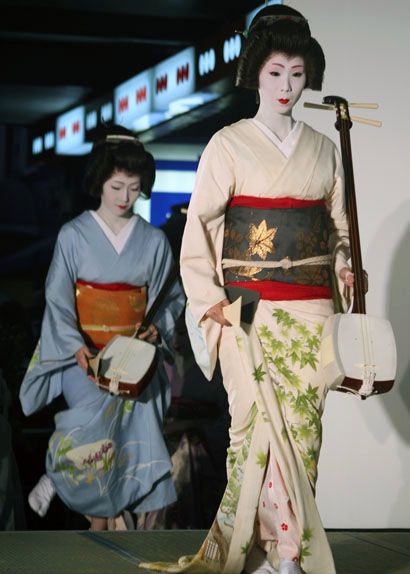
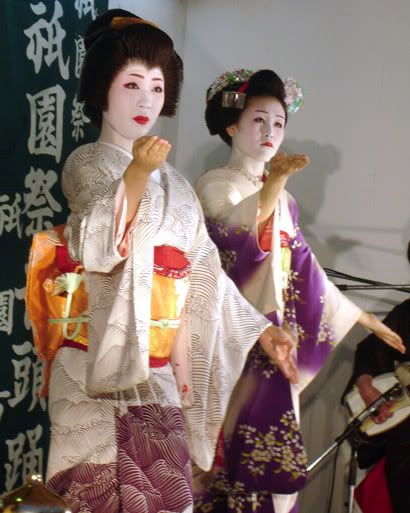
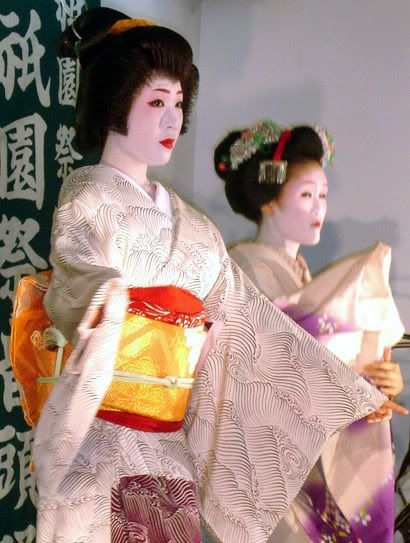
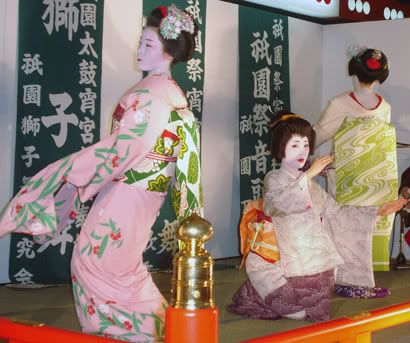
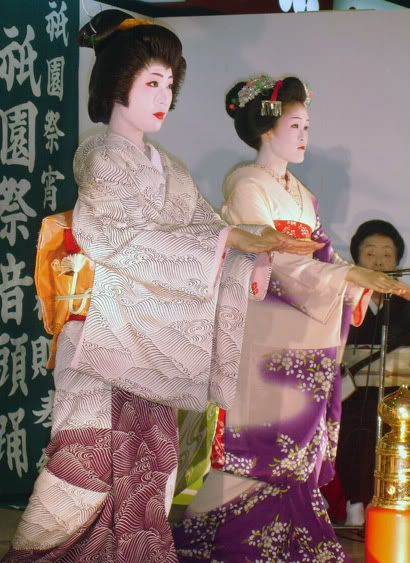
Geiko from Gion glide gracefully across the stage with their shamisens, as the long trains of their kimonos flutter behind them.

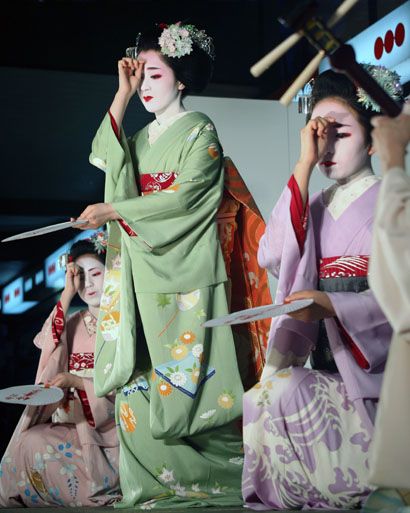
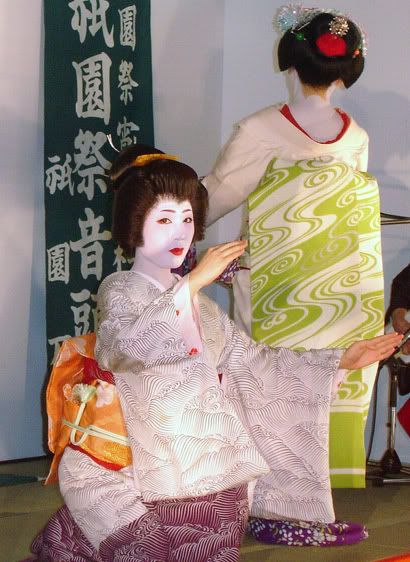
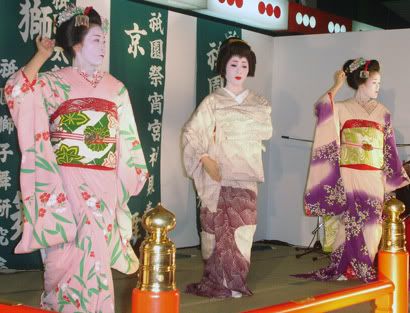
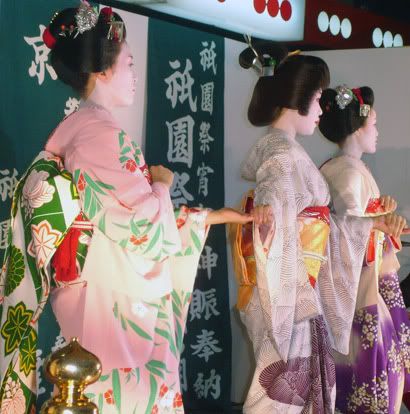
The Geiko took their place on the side of the stage, sitting seiza style, on their knees, and played as 3 maiko danced in the traditional Kyoto style. The maiko in the purple Kimono is Suzuha, who if I am not mistaken, recently appeared on the cover of the Japanese Playboy magazine! She is renowned for her classic beauty among many of Gion's customers.

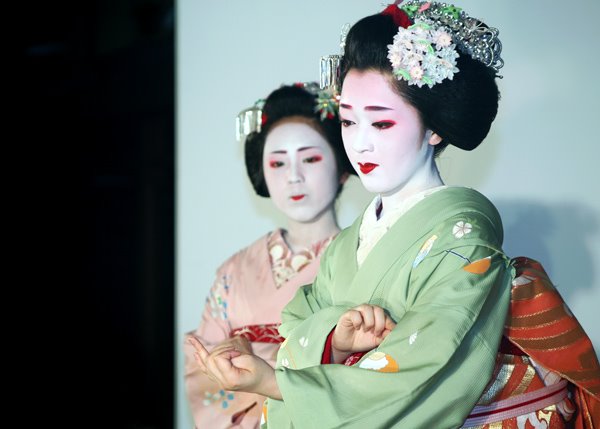
Kotoha, a high ranking maiko (in green) and superb dancer, performed the lead role in the short performance. The young maiko behind her is only in her first year. Her upper lip is not yet painted, and her collar is still predominantly red.

Photobucket - Video and Image Hosting
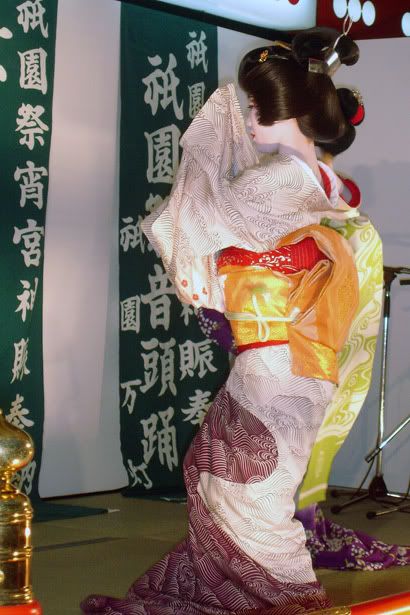
The extravagance of the flowing layers of colorful silk kimono, the breath-taking contrast of the porcelian-white makeup and delicately painted red lips, and the grace and dignity of the dance set to the haunting music of the shamisen create a scene of ethereal beauty beyond description.

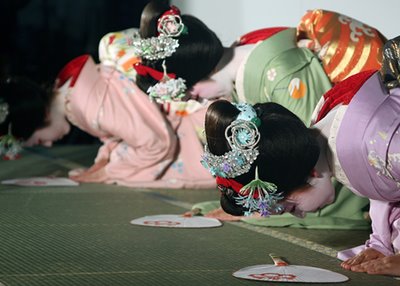
As their dance ends, the maiko bow low to their audience. The maiko wear a very special hairstyle during the month of July specifically for Gion Matsuri.
Friday, July 21, 2006

Gion Matsuri: Yoiyama 2006

Photobucket - Video and Image Hosting
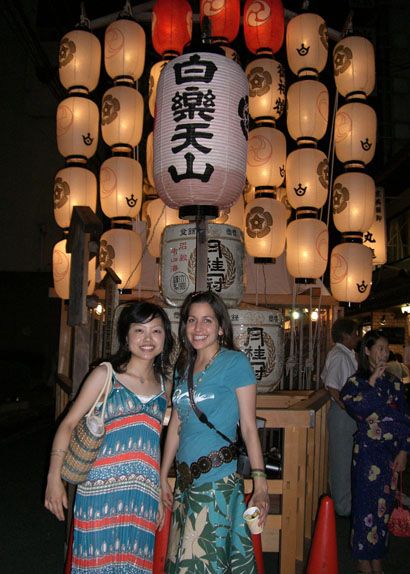
Yuko and I in front of one of the smaller festival floats, haku raku ten yama (White Paradise Mountain) at Gion Matsuri's Yoiyama (the night before the main procession, Yamahoko Junko). Yuko has played a major part in my adventures in Japan since my first day at Kansai Gaidai, when she and a bunch of friends waited for me outside after class and very politely asked if they could be my friend (^-^)/ Look at her! How could I say no? Kawaii! (^-<) *wink*
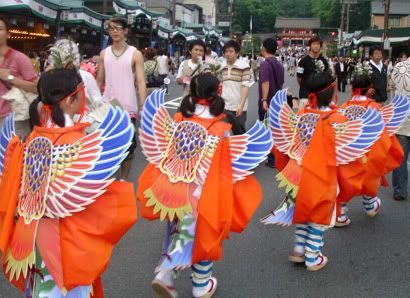
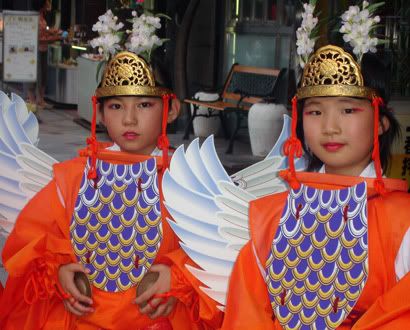
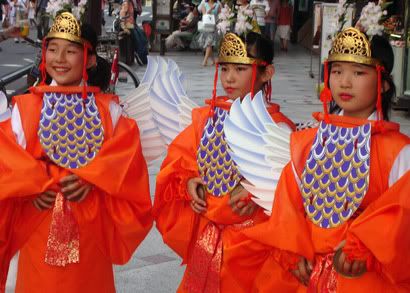
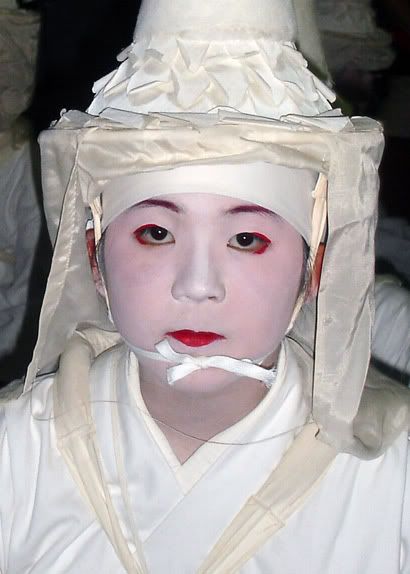
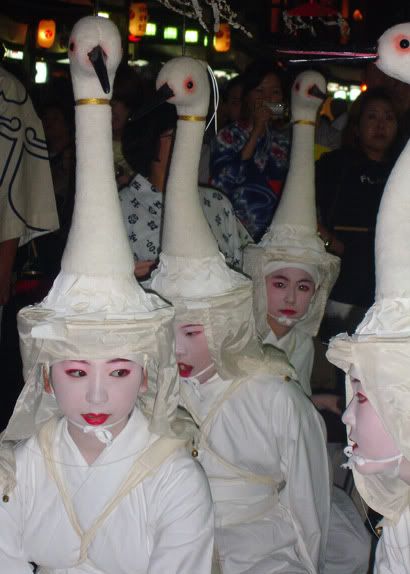
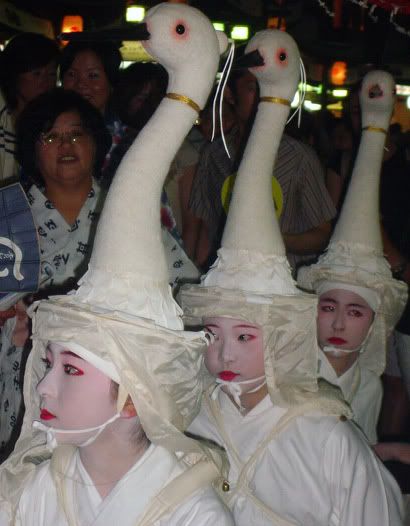
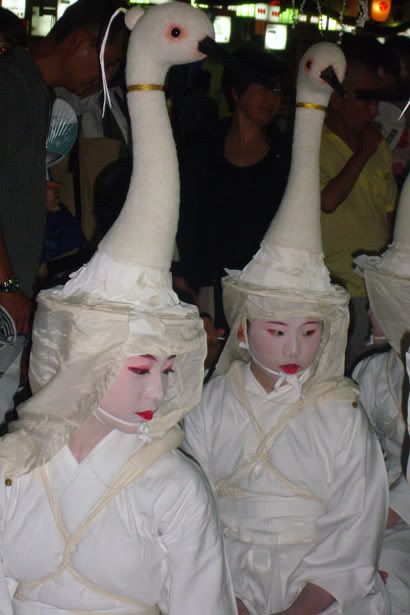
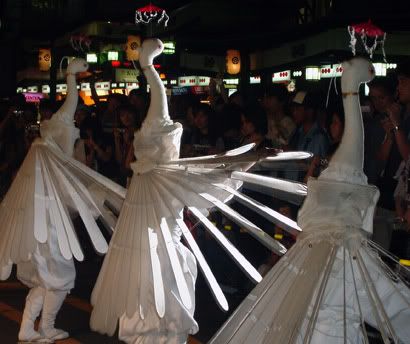
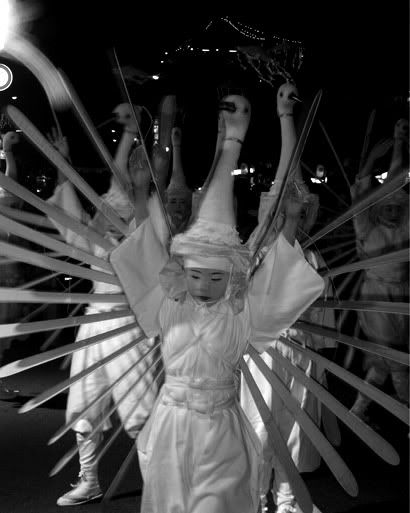
An elementary student performing the sacred Shirasagi Mai, the White Herron Dance, infront of Yasaka Jinja (Shrine) on Shijo dori (Avenue).

A high ranking maiko taking time out of her busy schedule to teach a younger maiko how to count.
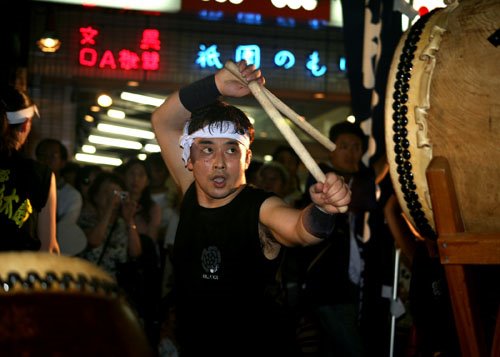
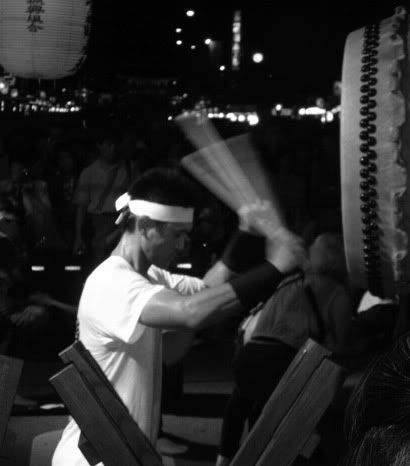
Taiko: It's an art.

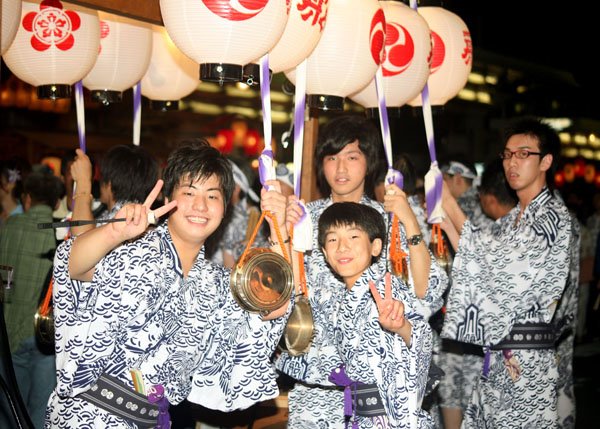
Zettai Shounen! A group of young boys donning their neighborhood yukata making music in the streets.

Suzuha, one of Gion's most beautiful and popular maiko, enjoying Yoiyama with a few friends.Say Peesu! (^-^)v

More Coming Soon!

Saturday, July 15, 2006

Gion Matsuri, Here I Come!

Image hosted by Photobucket.com
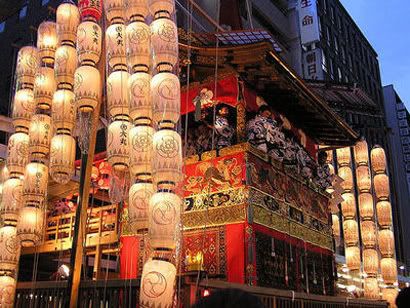
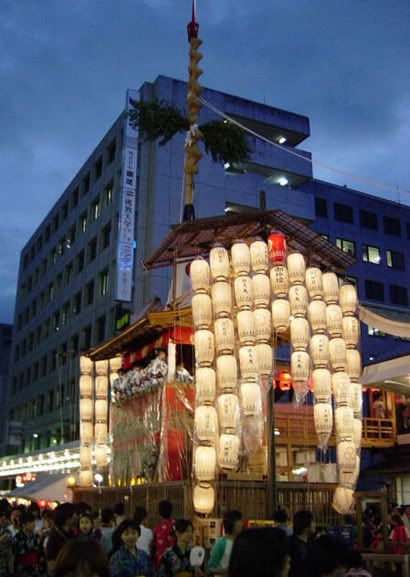
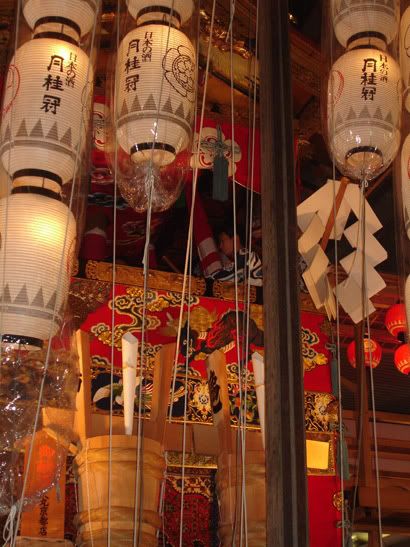
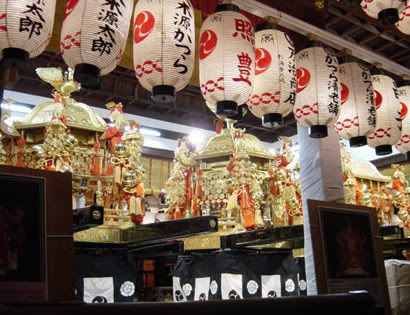
One of the many floats that Gion Matsuri is famous for, softly lit by paper lanters during Yoiyama.

I'm on my way to Kyoto's Gion Matsuri, on of Japan's biggest festivals. Expect me to be MIA until Monday (^o^)< Washoi! If you've never heard of this ancient, month long party in Japan's traditional culture capital, check these out!

Gion Matsuri:Yoiyama
Gion Matsuri: Yamahoko Junko

Don't worry! I haven't quite finished expounding the finer points of anime, as exhibited by BLEACH. All previously scheduled programming will resume with when I return! Have a great Ocean Day Weekend, everyone (^-^)v. Let us join Japan in expressing " our gratitude for the favor of the sea," and the Happy Monday System, too!

Monday, September 12, 2005

Modern Maiko

Image hosted by Photobucket.com
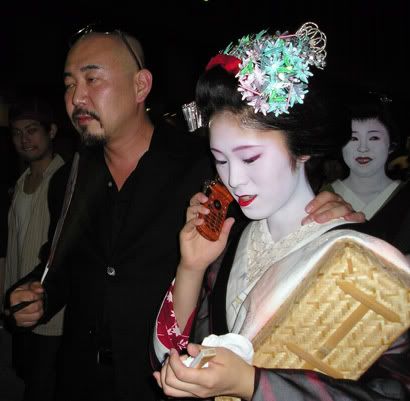
A maiko checks in with her Okiya on her ketai, or mobile phone, as she strolls Shijo-dori with her Yakuza-looking patron during Gion Matsuri's Yoiyama. A few geiko followed behind. (The Yakuza is like the Japanese mafia).

Sunday, July 24, 2005

Gion Matsuri : Yoiyama Kyomai 

祇園祭り:よい山の京舞

Image hosted by Photobucket.com
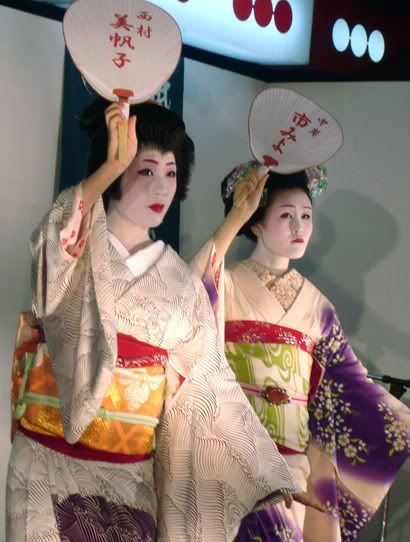
Mihoko (left), recently graduated from senior ranking maiko to full-fledge Geiko, performs Kyomai for the Yoiyama festivities with the maiko Ichimiyo. Their uchiwa, (Japanese fans) are decorated with their name, and the districts of Gion that they represent. When Geiko or maiko entertain during Gion Matsuri, they give their patrons one of these fans as a keepsake.
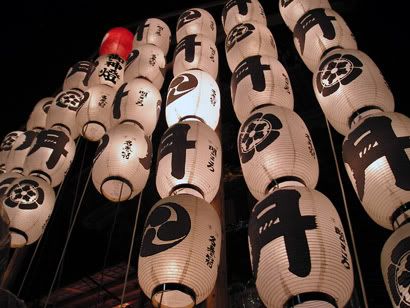
Image hosted by Photobucket.com
Last time I saw Mihoko, she was dancing as an apprentice in the Miyako Odori. She looks so much more refined and elegant as a Geiko!

Image hosted by Photobucket.com
Kyomai, or Kyoto Style Dance, developed in western Japan under the influence of Noh theatre. Unlike other odori, or kabuki styled dances developed in Edo, Kyomai is performed in Washitsu, Japanese style tatami mat rooms, where its subtle movements, the embodiment of the elegance and sophistication of the imperial court, can be viewed at close range .

Image hosted by Photobucket.com
Kyomai is not meant to be performed on stage, but in the intimacy of Japanese rooms .

Image hosted by Photobucket.com
Gion's entertainers practice the Inoue school of Kyomai. This style of dance is very different from that performed in Kyoto's other entertainment districts

Image hosted by Photobucket.com
The Inoue school is characterized by minimal motions based on the masked drama of Noh and the puppetry of Bunraku.

Image hosted by Photobucket.com
Even in this picture, if you compare the gesture of the hands between the Mihoko (Geisha) and Ichimiyo (maiko), the difference in mastery of these simple movements is clear.

Image hosted by Photobucket.com
Geiko present themselves in a much more subdued fashion because they do not need the bright colors and flashy ornamentation to compensate for their lack of skill.

Image hosted by Photobucket.com
Kyomai symbolizes the gracefulness and lifestyle of the imperial family.

Image hosted by Photobucket.com

This is the fruit of my Japanese language labour...I was able to read the kanji foretelling the appearance of Geiko and Maiko performing Kyomai, as well as the names written on their uchiwa! Obsessed as I am, this gave me a great sense of accomplishment and furthur motivated me to press on! Who knows what gems of information are hidden in the kanji that clutter this country (besides the people that can read them)? Let's fighting ganbaro!

Stay tuned...more Matsuri Maiko pix to come...

Check out Justin Klien's Gion Matsuri Video to get a better idea of what this festival is all about!

Thursday, July 21, 2005

Kyoto's Gion Matsuri : Yoiyama

Image hosted by Photobucket.com

Gion Matsuri is one of the biggest, most famous, and most beautiful festivals in Japan. Although the festival actually lasts the entire month of July, the climax is the Procession of Floats on July 17. For a few nights leading up to Yama Hoko Junko, the people of Gion display their magnificent festival floats and priceless family treasures, handed down from generation to generation for hundreds of years.

Image hosted by Photobucket.com

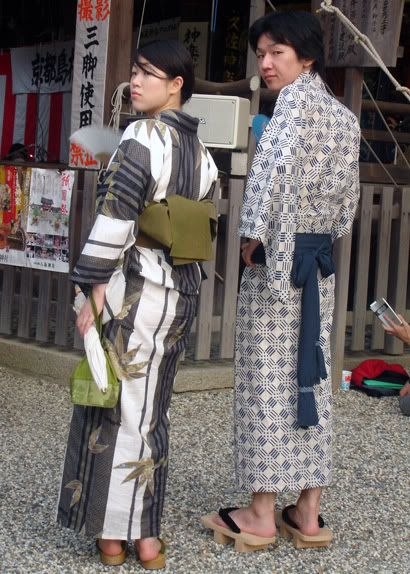
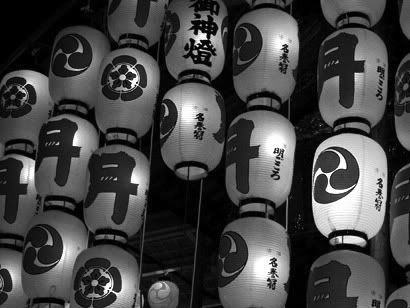
As the sun disappears behind the mountains that embrace the city, the soft light of paper lanterns sets the floats a glow. The kon-chiki-chin of Gion bayashi (traditional festival music of Gion) mingles with the sound of traditional flutes dancing on the Kyoto air, thick with the chants of young men pulling mikoshi (portable shrines) and the ringing of the bells that dangle down on each side of the floats. Dressed in yukata, a summer kimono made of cotton, geta, high wooden sandals, and traditional festival regalia, the people that fill the streets only add to the heavy sense that if only for tonight, Kyoto is the same today as it was over a thousand years ago, when this festival began.

Image hosted by Photobucket.com

We arrived in Kyoto the night of Yoiyama, the eve of the big procession. Jen, the High school ALT in Ena, had never been up to Kiyomizudera, so I took her on a walking tour of Higashiyama. The narrow roads up to the temple were begining to fill with brightly colored yukatas, and the clip-clop of geta on the stone-paved roads echoed in the alleyways.

Image hosted by Photobucket.com

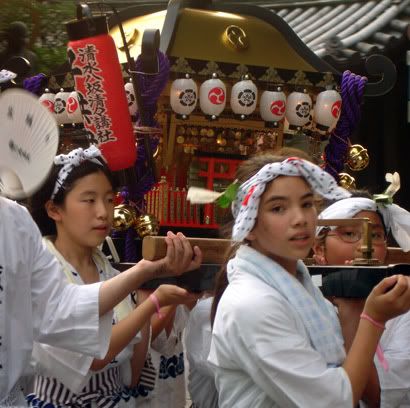
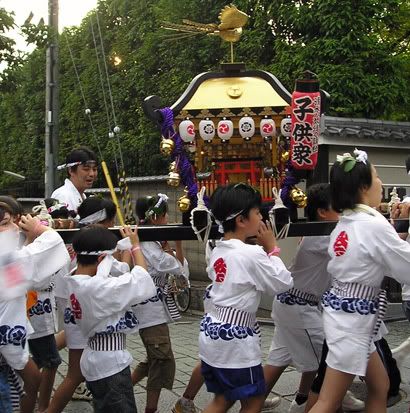
As we headed back towards Shijo, the main avenue, the sound of festival flutes and chants of "Wa-shoi! Wa-Shoi!" filled the air. Near Kodaiji (temple) we came across school of elementary school students, preparing to make their runs with their own Mikoshi (portable shrine).

Image hosted by Photobucket.com
Festival participants wear happi, traditional festival gear something like a short yukata decorated with the emblem of their group (neighborhood, school, club...).

Image hosted by Photobucket.com
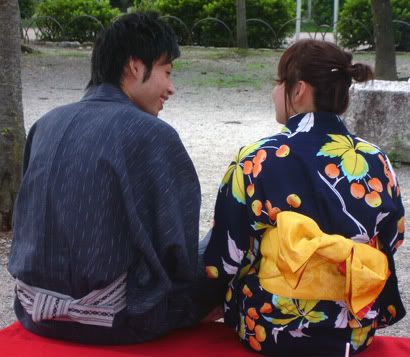
Maruyama Koen was a romantic refuge from the bustle of the busy streets. Many couples, dressed in yukata, sought shelter beneath the famous cherry trees as they shared snow cones, a summer festival favorite.

Image hosted by Photobucket.com
Yasaka Shrine, once known as Gion Shrine and namesake of the festival, was full of stylish spectators seeking a glance of the sacred mikoshi. (The man above is wearing geta, high, wooden sandals.)

Image hosted by Photobucket.com
The sacred mikoshi, at rest at Yasaka Shrine.

Image hosted by Photobucket.com
A flock of exotice birds head for Yasaka shrine.

When we finally made it down to the main Avenue, the streets had already been closed to traffic, and were steadily filling with a constant stream of spectators and participants. As we waked towards Minamiza, I noticed a stage set up near the Starbucks just before the Hanamikoji, the most famous street in Gion. The banners hanging in the background read " Maiko, Geisha, Kyomai." All my kanji study had finally payed off! Check out my next post to see those pictures!

Image hosted by Photobucket.com
These elementary students preformed a sacred dance in full regalia.

Image hosted by Photobucket.com
Unfortunately I missed while watching the geiko and maiko dance!

Image hosted by Photobucket.com
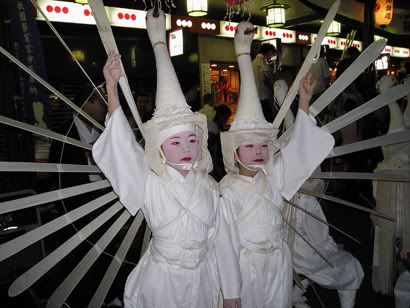
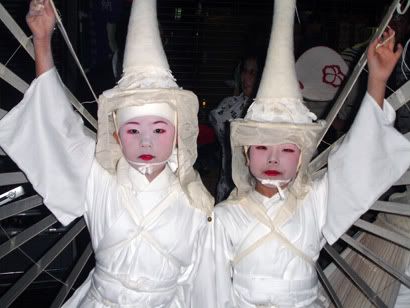
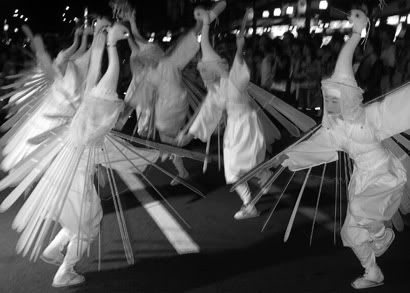
The Swan Dance is another sacred dance performed by young children.

Image hosted by Photobucket.com

Image hosted by Photobucket.com

Image hosted by Photobucket.com

Image hosted by Photobucket.com

Image hosted by Photobucket.com

Image hosted by Photobucket.com

Image hosted by Photobucket.com

Image hosted by Photobucket.com


Image hosted by Photobucket.com
After the swan dance, a taiko group performed. They were awesome! Taiko is the art of playing a Japanese Drum with exaggerated, theatrical movements. Aside from the awesome beat, its really exciting to watch! Lindz and I got really excited and started talking about how awesome this guy was, and a little old obaasan (grandma lady) turned around and shushed us, finger to the lips, librarian style! Those little obaasans have some nerve yo! I'm sure we were almost interupting the performance, consisting of atleast 15 drums, not to mention the thousands of sake-sipping spectators and mikoshi crews chanting on their rounds of the city!

Image hosted by Photobucket.com
After watching the swan dance, we wandered thru the lantern-lit side streets admiring the floats, family treasures, and festival food. We came across more than a few Maiko, but that's for another post!

Image hosted by Photobucket.com

Ever since I first came to Japan and heard about Gion Matsuri, it has been at the top of my list of things to do here. As we wandered the streets, casually strolling past maiko, geisha, and their yakuza (Japanese Mafia) patrons, watching young girls in brightly colored kimono chat on perfectly accessorized ketai (cell phones), inhaling the mix of takoyaki (octopus dough balls), yaki soba, and squid on a stick, I can't imagine there is anywhere else I would have rather been. With total disregard for the sacred train timetable, we meandered thru the narrow sidestreets, glowing with the lantern light of the festival floats.

Image hosted by Photobucket.com

Some how we made the last train back to Shichijo, even though first we got off at the wrong stop and had to hop back on the next train. Before leaving Shijo, which had been magically transformed for the event, the streets reopened and the crowds slowly shifted to the sidewalk. As we tred towards the subway station, a fleet of Japanese deko trucks and pimp mobiles slowly rolled by, bouncing to the beat of Japanese hip-hop. Not exactly the kon-chiki-chin of Gion Bayashi. Once again the juxtoposition of ancient custom and ultra-modern sensitivities left me feeling like the night had been nothing more than a dream.

A dream in which I lost the key to the hostel, still got in the door, but was forced to try to sleep (I failed) in the brightly-lit lounge, the sweat of a day hiking around Kyoto crystalizing on my sun kisssed skin. Luckily I planned to wake up early the next day to get a decent spot on the parade route...