Sunday, September 23, 2007

Gion's Hassaku "Uniform": 祇園の八朔の正装

Photo Sharing and Video Hosting at Photobucket
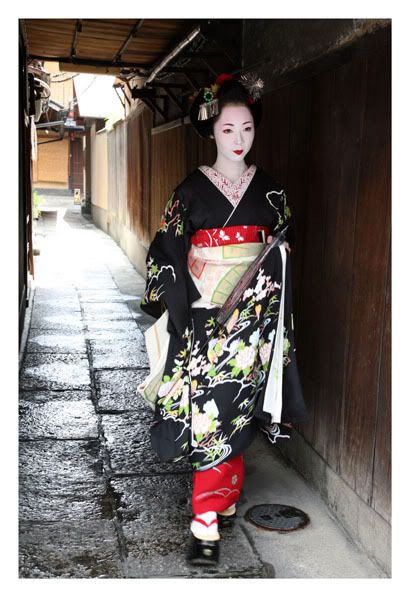
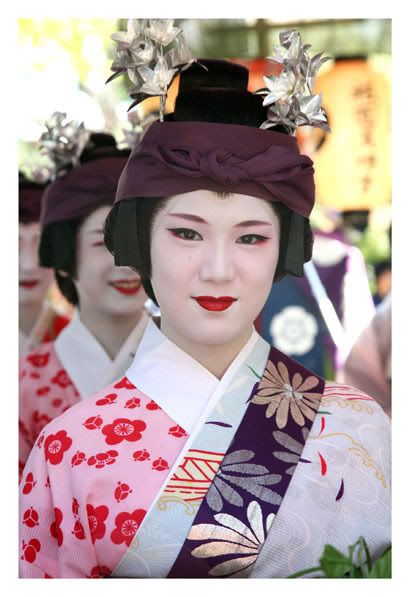
Kosen emerges from a narrow, covered alleyway as she returns to her okiya.

Photo Sharing and Video Hosting at Photobucket
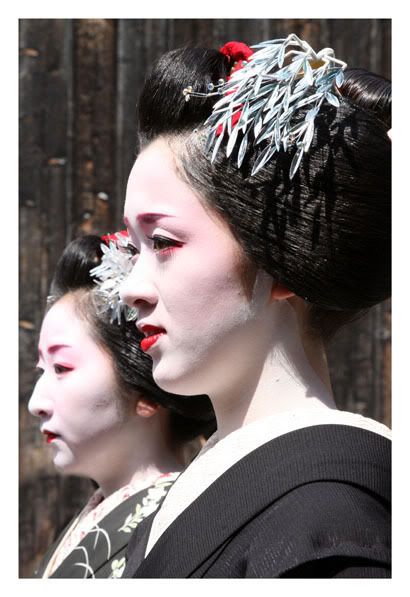
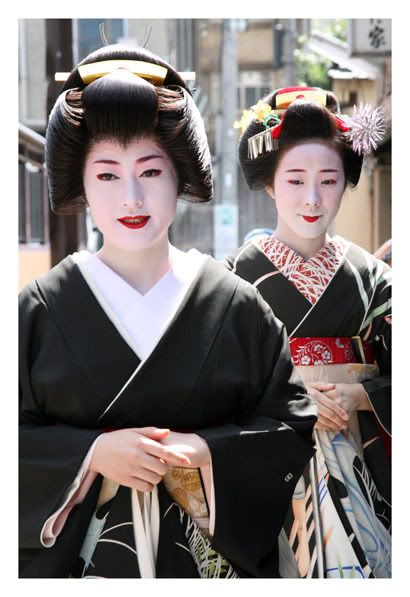
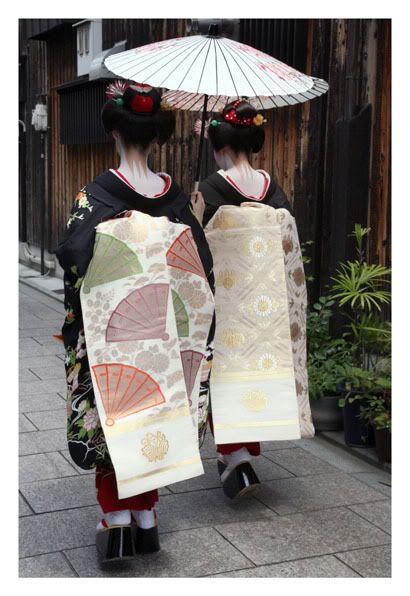
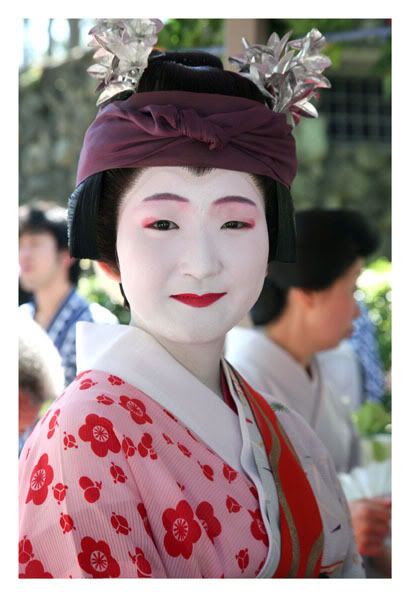
Kotoha and Yasuha headed back to their okiya after a long morning of visits beneath the brutal summer sun.

Photo Sharing and Video Hosting at Photobucket
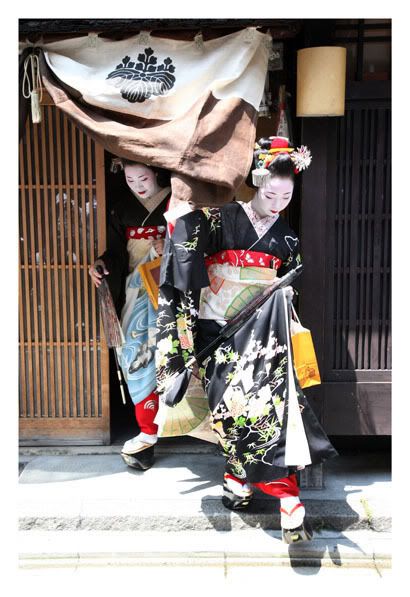
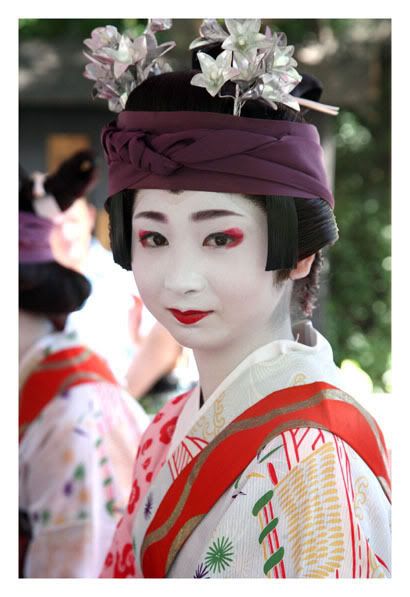
Kosen and Koyuki slip through a noren, carefully stepping into the street with her black laquered okobo. Kosen wears the typical susuki kanzashi ( Japanese Pampas Grass hair ornament).

Photo Sharing and Video Hosting at Photobucket

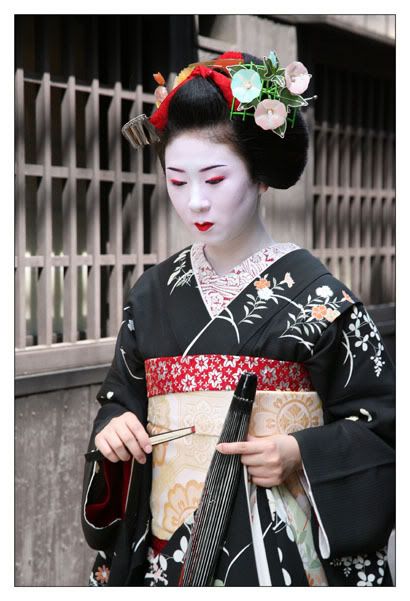
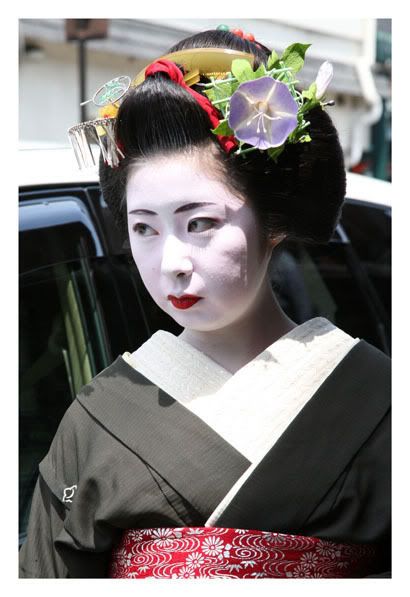
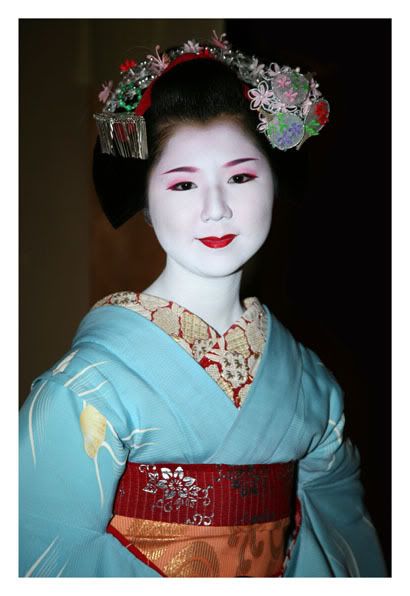
While many maiko wear kanzashi (hair ornaments) based on summer grasses, Mameteru wears a rare asagao, or Morning Glory, perfectly complimenting the flowery theme of her kimono.

Photo Sharing and Video Hosting at Photobucket
Teruyuki also wears the asagao, but as a senior maiko her hair is ornamented with only a single, large blossom.

Kotoha wears another rare kanzashi.
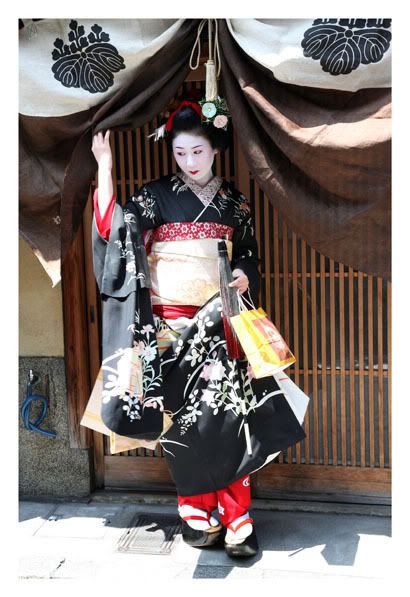
Photo Sharing and Video Hosting at Photobucket
Mameteru lifts a festive noren as she leaves a teahouse.

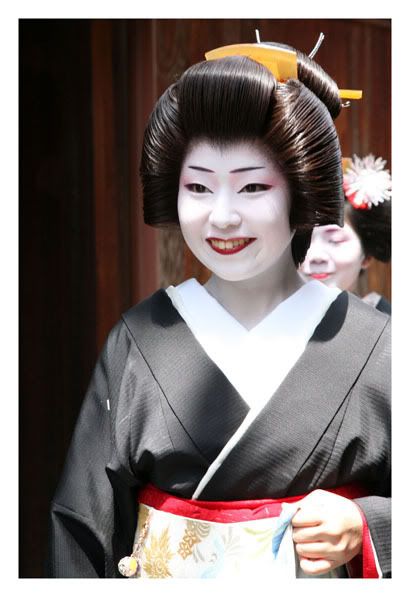
Because it is a very formal occasion, maiko leave three tapered prongs of skin bare on their painted white necks, as opposed to the usual two. This is called sanbonashi, or "three legs". Lower ranking maiko wear their hair in the wareshinobu style, characterized by the mage, or top knot, woven through with a peice of silk and topped with a special ornament called a kanko dome.

Senior maiko wear the Yakko Shimada hairstyle.

The difference is easily observable, as seen above.

The shimmering silver kanzsahi sparkle in the sunlight.

Friday, September 21, 2007

Seven Samurai : 七人の侍


Remember how I said this would be the next movie I saw? That was before I found out that Seven Samurai was playing at the Cleveland Institute of Art's Cinematheque . I've been wanting to see it for ages, and the chance to see it on the big screen was just too much for me to bear!

Could they be any cooler? Maybe... If they were Shinigami! (^_<)

This is a great review of the movie.

The archetypal action film, Seven Samurai is also one of the richest works to ever be committed to celluloid. Each of its characters is extraordinarily realized; each has his or her own arc, his or her own vital part to play in the film's slow progression towards its dramatic finale. Kurosawa put the film together using an exceeding degree of artistry; each and every shot, each action sequence, is exquisitely composed; and yet none seems contrived or out-of-place within the overall fabric of the work. Everything is beautifully conceived and in focus, both literally and figuratively.

When watching Seven Samurai, movie lovers will immediately recognize that several of its key elements can be readily detected in countless similar films made during the last half-century. The audition scenes, in which several samurai are recruited for the difficult task of defending a farming town from a group of bandits, strikes a particularly familiar chord, as do those showing the samurai training the lowly villagers to fight and use weapons. Indeed, the theme of a highly experienced group of "tough guys" taking up the cause of the disenfranchised has become something of an action film cliche, portions of which echo throughout the American western, as well as its progeny (think The Dirty Dozen, The Road Warrior or even television's The A Team).

What really stands out in Seven Samurai are its characters. They run the gamut, from elder teacher to hopeful youth, stoic warrior to undisciplined brigand. Kurosawa even finds room for a youthful romance, not to mention the mix of poor and beleaguered townspeople he depicts within the setting of the town. Perhaps its no wonder the enemy bandits are virtually faceless-- there is so much conflict and passion present within the group of protagonists, the villains need not be more than a vague threat.

Through it all Kurosawa never forgets who these people are and where they stand in comparison to one another. Obviously, the samurai are samurai, while the townspeople are merely peasants, lacking even in funds to pay their noble defenders... The film thus wraps a a portrait of class conflict in a cloak of solidarity. The samurai unite to defend the poor peasants, but the ending is not exactly happy for them. Nor are the peasants completely honorable. We learn, for instance, that they have in the past murdered defeated samurai and looted their bodies, and it becomes apparent late in the film that their claims of poverty are perhaps not as truthful as at first seemed apparent.

So why do the samurai defend them so valiantly? For honor? For love of adventure? The answer to this question is left intentionally vague; it is up to each viewer to draw his or her own conclusions. It is to the film's credit that it forces such questions upon us while never allowing them to cause the motivations of its characters to seem untrue...

Thursday, September 20, 2007

Hassaku in Gion : Continued! 祇園の八朔

Photo Sharing and Video Hosting at Photobucket
A smiling Suzuha, Gion's most successful geiko. Yes, that's right! More images from Hassaku, my final day in Kyoto, with the promise of still more images to come. What can I say? I am a picture-taking machine! (^_<)

What makes Hassaku so special? Most people would say it's the special sort of "uniform" many maiko and geiko wear for the occasion: Formal black, silk gauze kimono adorned with the family crest of their respective okiya. It is possible, however, to see many senior geiko dressed in lovely, subtley colorful kimono looking every bit as beautiful making their Hassaku visits.


Why? It's true that independent geiko own all of their own kimono, but before earning their indepen- dence, they rely on the collection of the okiya. Since these special silk gauze kimono can only be worn once a year, even independent geiko choose to rent them from the okiya.

In some okiya, however, there are many maiko and geiko. When a large family of maiko and geiko must make their Hassaku greetings together, there may not be enough of these special kimono for them all. In these cases, the most senior geiko gives up her claim on the kimono so that one of her juniors may wear it.

A large family of maiko, led by the geiko Takamaru. The senior maiko, Takahiro (left), holds the umbrella for her big sister as the two youngest maiko wait respectfully. A Shikomi, a young girl "in training" to make her debut as a maiko, closes the door behind them.

In order of rank, from geiko (right) to shikomi (left), the family bows to show their respect. The lower the rank, the deeper the bow.

Having paid their respects, Takamaru leads the girls to their next stop

Photo Sharing and Video Hosting at Photobucket
Another lovely smile: Takamaru.

Thursday, September 13, 2007

Saturday, September 08, 2007

Big Dreams Little Tokyo


If I have any say in the matter, this will definately be the next movie I see!

Big Dreams Little Tokyo is the story of Boyd, an American with an uncanny ability to speak Japanese. Boyd aspires to succeed in the world of Japanese buisness but finds himself mostly on the outside looking in. Meanwhile, his roommate Jerome is a Japanese American who has always felt too American to be Japanese but too Japanese to be American. He aspires to be a sumo wrestler but finds his weight and blood pressure are thwarting his dreams. Together they struggle to find their place in a world where cultural identity is seldom what it seems.

Hmmm... I wonder what that's like.

Anyways, I'm really looking forward to seeing it! Not to mention, his next film, White on Rice! Tonoshimi ne!


If you get a chance, check it out....


For Mr. Takita's sake!

Saturday, September 01, 2007

Hassaku in Gion : 祇園の八朔

Photo Sharing and Video Hosting at Photobucket
The geiko Takamaru leads a young new maiko celebrating her first Hassaku.

The changing of seasons has long been observed and celebrated with festivals and sacred rites throughout the world. In ancient Japan, these celebrations and rituals, important for strengthening the bonds between gods and men, as well as among the farmers, were woven with the seasonal rhythms of growing rice, a sacred act on which their lives depended and their culture flourished. From planting to polishing, the roots of the agragarian culture penetrated every aspect of their lives, measured by and dedicated to the cultivation of okome, "honorable rice", the foundation of Japanese culture as we know it today.

A family of geiko and maiko cross the street according to rank, with senior geiko at the front the most junior maiko following behind.

So what does rice have to do with Hassaku? According to Japan's old lunar calender, the first day of a the new month, when the moon was not yet visible, was called tsuitachi 朔 or saku. As the first day of the eight month approached, the brilliant green rice filds began to ripen and bear fruit. With harvest near, the peasant farmers offered these first fruits to their patrons in a show of gratitude with hope for a good harvest.

Photo Sharing and Video Hosting at Photobucket

The custom caught on, and soon even samurai families and members of the imperial court began offering the "first fruits" to those they felt indebted to as a way of expressing their gratitude. This festival, held on the first day of the eighth month, or Hassaku, became known as "Tanomi" ( 田 ta , or rice field, の no, showing possesion, and 実 mi, fruit ), the "Fruit of the Rice Feilds". A play on words, "Tanomi" (頼み), meaning request or favor, also served as a petition to the gods for a good harvest.

In Gion Kobu, Hassaku is a lot like a New Year's. In the heat of the summer, robed in the most formal black kimono, young geiko and maiko visit the teahouses, teachers, senior geiko and establishments they depend upon to express their gratitude for their support and beg their favor in the future.

A group of geiko greet each other with a bow as they make their Hassaku rounds.

More photos coming soon!

Friday, August 31, 2007

Coming Soon: Hassaku 八朔

Photo Sharing and Video Hosting at Photobucket
The geiko Koiku, dressed in her Hassaku best: A black kimono and tortise shell hair ornaments. Hassaku, observed on the first of August, is a day to express thanks to those who have been helpful to you during the first half of the year. In Gion, all maiko and geiko visit the teahouses and teachers they have relationships with, dressed in their most formal kimono, to show their gratitude and ask for their favor in the future. As the mistress of one teahouse described it, "It's like new year's in the summer."

Wednesday, August 22, 2007

Hanagasa Gyoretsu: Gion Higashi

Photo Sharing and Video Hosting at Photobucket
The stunningly sweet Tsunemomo, highest ranking maiko of her district. Can I just reiterate how much I love this? Hidden in a huddle of photographers and spectators, she spotted me. She remembered me! She went out of her way to talk to me and make me feel special. Isin't she beautiful? Good luck, Momo-chan!

Photo Sharing and Video Hosting at Photobucket
The district's newest geiko, Masayo led her younger sisters with her noticeably superior dancing skills and captivating stage presence.

Photo Sharing and Video Hosting at Photobucket
Miharu, the lowest ranking maiko in Higashi. Whatever she may lack in experience or skill, she more than makes up for with charm and beauty.
Photo Sharing and Video Hosting at Photobucket
One of two new faces in Gion Higashi, this young girl will make her debut as a maiko in September. For the moment, she is a shikomi, "in training" to prepare her for that day.
Photo Sharing and Video Hosting at Photobucket
Before making their debut as maiko, shikomi study kimono, Kyoto dialect, and classical Japanese etiquette.

Sunday, August 19, 2007

Hanagasa Gyoretsu: Pontocho

Photo Sharing and Video Hosting at Photobucket
The maiko Hisano looks calm and composed before joining the geiko of Pontocho in offering a dance to the dieties of Yasaka Shrine.

With a rare view of their own hair pulled back in a sleek, simple pony tale, the geiko of Pontocho ride through Kyoto in a flowered float during the Hanagasa Kyoretsu, the Procession of Flowered Hats.

Photo Sharing and Video Hosting at Photobucket
Dressed as miko, or shrine maidens, Hisano performs "Kabuki Odori" with her fellow geiko.

Photo Sharing and Video Hosting at Photobucket

Tuesday, August 14, 2007

Cover Girl

Photo Sharing and Video Hosting at Photobucket
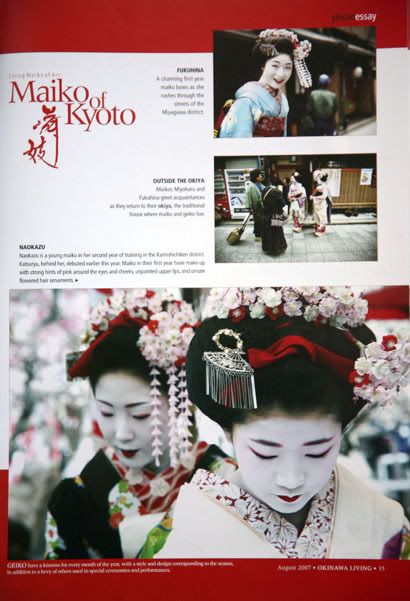
Hmmm... This image certainly looks familiar. Now where have I seen it before?

Sunday, August 12, 2007

I Went to Tokyo...

Photo Sharing and Video Hosting at Photobucket
And all I have to show for it are these silly pictures (^-^)/Ye Old Coot and I jumpin' around at Sensoji (Temple) in Asakusa.

Holy backpack, Batman! The Old Coot, The World or Bust and Mboogiedown go to Tokyo!

Photo Sharing and Video Hosting at Photobucket
West Side represent! Chillin' with our homie the Emperor at the Imperial Palace.

Aaaand...
Which promptly inspired this puri classic...
Photo Sharing and Video Hosting at Photobucket

Wednesday, August 08, 2007

Katsuyuki: Kawaii!

Photo Sharing and Video Hosting at Photobucket
Katsuyuki, originally from Nagoya, is in her second year of service in Gion Kobu.

Remember how I said I was off to Kyoto to see Gion Matsuri, and then disappeared of the face of the blogsphere with only an image of Katsuyuki and I to keep you company? Well, despite all my best intentions of photographing what may have been my last Gion Matsuri, fate had other plans for me. Instead I ended up spending an incredible evening with Katsuyuki and a good friend of mine, who shall be henceforth referred to as Shacho-san (Company President).

The day of Yoiyama (the night before the Yamahoko Junko procession of floats) was grey and rainy as a typhoon tip-toed up the coast of western Japan. I had planned to spend the day walking around, photographing the floats and festivities, but ended up seeking shelter beneath the tiled eaves of a narrow Gion sidestreet. I found myself at Gion Maru Ume, a small teahouse/bar that doubles as a venue for tourists to meet maiko during weekend and holiday afternoons.

I recognized it immediately as the place where Lindsay and I had been given our private audience with Mamechika over three years ago, and where I had met Mamechiho last year! Intrigued, I splashed across the puddled pavement to the covered entrance where a few flyers featuring Mamechiho's coy smile were displayed on a small table. The slow rumbling sound of the door sliding open caught my attention as I turned to see an old friend pop his smooth, silvery head of hair through the noren (Japanese door curtain). He seemed just a suprised to find me standing there, soaking wet, as I was to see him.

"Well! My English teacher from Gifu! It's been a long time hasn't it! How are you?" We stood outside the door chatting as a few customers arrived for their appointment. As he ushered them in through the sliding door and split, hanging curtain, I began to back away, sensing my time to leave had come. "Won't you come in? Or do you have another plan? Are you busy?" He asked. I assured him that, umbrella-less as I was, I was in no hurry to get back out into the pouring rain. I humbly accepted his invitation and hurried into the traditional Japanese entrance, slipping out of my shoes and into the sitting room where I took an empty space around a low, Japanese table.

It wasn't long before Katsuyuki arrived, making a poetic entrance as she gently lifted one side of the noren curtain, bowing her head slightly as she floated through it. She positioned herself in the center of the table, sitting upon her knees and smoothing her kimono. She bowed her beautifully adorned head to the tatami mats, raising up again with a sweet smile as she smoothed her kimono once more.

The guests were given a breif introduction to the life and work of the maiko of Gion and encouraged to ask any questions they may have. The room was very quiet, as I believe everyone was struck by adorable smile and overwhelming opulent powder blue kimono. I, on the other hand, was eager to learn more about her. I tried to restrain myself, limiting myself to a very few, well-timed inquiries, hoping to inspire the other guests to make their own. The breif silence must have made Katsuyuki as nervous as it had I, because as soon as I spoke she turned gratefully toward me with a smile of relief.

I quickly learned, to my suprise and delight, that she is originally from Nagoya. Not only had she heard of Ena, she had actually eaten our beloved goheimochi. We giggled about how delicious it was while other guests were left to wonder what on earth we were talking about. At 17, she has been a maiko for just two years, as her beautifully embroidered collar, emblazoned with threads of crimson, gold and silver, would suggest. She showed us this year's specially designed Gion Matsuri hanakanzashi (flowered hair ornament), embellished with Japanese fans and silvery summer blossoms is sweet, pastel shades of pink and violet, complimented with cherry. Hidden among her crown of flowers I spotted the emerald ring of linked dumblings, the tsunagi dango emblem of Gion Kobu, worn only by maiko of Gion Kobu under the age of 18.

Katsuyuki served us matcha (Japanese powdered green tea whipped with a bamboo wisk into a frothy green deliciousness) with charming Japanese sweets shaped like dancing fans and okobo (the tall, wooden sandals worn by maiko) before treating us to a single dance. Despite her relative inexperience, she moved with a captivating grace and elegance. I was so captivated, in fact, that I forgot to take any pictures. That, in itself, should say it all.

Before I knew it, our time was up. Katsuyuki led us into the entrance, where she bowed to each of us as we disappeared through the noren. My friend called after me, asking me to wait a moment if I had the time. The rain was still coming down, so I was in no rush. After a few minutes he popped his head back out through the noren. "Are you busy? Do you have any plans?" He asked again.

"My only plan was to walk around the floats tonight..."

"Well, how about if we walk around seeing the floats with Yuki-chan?"

"Yuki-chan?"

"Katsuyuki-san. If she's free. Just wait a moment, OK? I'll see."

Again he disappeared into the teahouse. It wasn't long before I heard Katsuyuki make her way into the entrance, slipping into her tall, wooden sandals. Her pale white hand gently raised the hanging noren as she stepped out, followed by Shacho-san. "Let's walk her back to her Okiya. She'll meet us a bit later." He said, handing her her oiled paper umbrella. I stepped out of the way, planning to follow behind them, but Katsuyuki called "Walk with me, Oneesan!"

So, down the narrow side street and out to the Hanamikoji, full of tourists in town for the famous Yoiyama Gion Matsuri, I brushed shoulders with a maiko beneath her umbrella.

Luckily the rain stopped as we arrived at her okiya. Shacho-san followed her into the entrance, but I stood shyly outside waiting, trying to decide whether or not the entire scenario was just a dream. Katsuyuki emerged while our friend chatted with the mother of the house, and began talking to me. Everyone in the street was stunned, first by the sight of maiko in all her breath-taking regalia, and then again when they realized she was talking to some strange foreigner.

Thankfully the Shacho-san soon followed and we began walking towards Shijo, closed to traffic and full of festival-goers in colorful yukata. The camera-toting toursit crowd, of whom I admit I am a card-carrying member, had started to swarm, and I was amazed at how rude and brazen many of them were. Some, assuming I was not with her, pushed me out of their way, held their camera up in front of her face and tried to get a picture of themselves walking with her. Some ran in front of us, stopping directly in our path to take pictures until we had to trip over them or stop and wait for them to move. Any time we did stop we were surrounded, and so we tried are best to keep moving. It was her first time to the festival, so Katsuyuki had brought her camera, tucked in her obi, hoping to get a shot of the lantern-lit yama and hoko floats. It was impossible. I felt so sorry for her, but she handled it all with grace. I never heard her say an unkind word.
"Are any of your 'sisters' coming to see the floats tonight?" I asked.

"No, they can't. I think there are too many people."

On our way back to the okiya we stopped at a Haagen Dazs stand to buy omiage, or souveniers, for Katsuyuki's sisters. When we arrived back at her okiya, I once again lingered outside the door unitl Katsuyuki invited me in. First we were greeted by a maiko in casual kimono who chatted with the Shacho-san until the mother came. She kneeled on the tatami mats thanking the Shacho-san, and even thanking me. They were all very excited about the tiny, one-serving ice cream cups we had brought, and soon another maiko in a beautiful midnight blue kimono fluttered by the shoji (papered screens), peeking her head over the kneeling okaasan to choose her cookie-and-cream delight. "Neesan, what would you like?" Katsuyuki asked me.

"Me? No, that's OK!" I assured her, refusing out of rudimentary good manners and a nasty intolerance to dairy. "Please, I want to be sure there is enough for all your sisters."

"That's Ok! We got one for you, too. You like strawberry, right?"

"Yeah! Strawberry! That sounds delicious!" I said excitedly, realizing that there is no way to say no to a maiko.

And just like that, my magical evening came to an end. I have no pictures of yoiyama or Katsuyuki and I flashing peace signs in front of the impressive festival floats, but I have memories that will last me for as long as I live, as maukish as that may sound. I must admit that walking past the enormous wooden floats, hung with softly lit paper lanters and antique tapestries and loaded with yukata-clad boys playing the famous wooden flutes of Gion Bayashi (festival music)with a maiko at my side, I couldn't help but feel I was living a dream. Kyoto has been so kind to me in so many ways. The thing I'll miss most about being in Japan is being able to go there whenever I wish.

I've always felt that Kyoto and I have a fate. Perhaps this will not be my last adventure there.