Thursday, November 24, 2005

The Book Club's Grand Tour of Kyoto

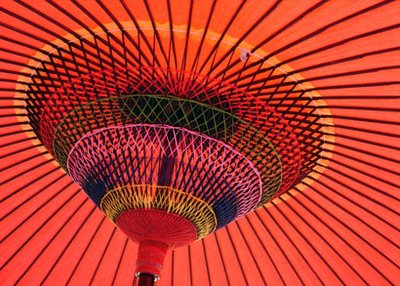
Paper umbrellas popped on the Japanese scene during the Edo period. Featured in many of the woodblock prints of Hiroshige Ando`s '100 scence of everyday life' these wax coated paper umbrella spared the people from the heat of the harsh, summer sun and sheltered them from rain. Utamaro Kitagawa also depicted these traditional umbrellas in his Ukiyoe (woodblock) masterpieces of beautiful women. These days, Japanese umbrellas play an important role in tea ceremony, dance, and Kabuki as an essential representation of Japanese traditional culture.

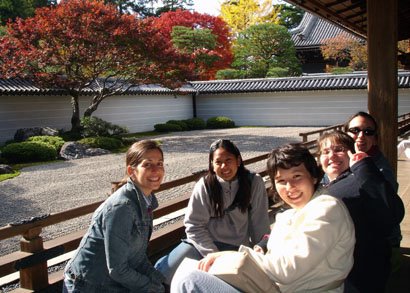
The 'book club' kids pause for a moment of meditation at one of Nanzenji`s rock gardens.

Image hosted by Photobucket.com
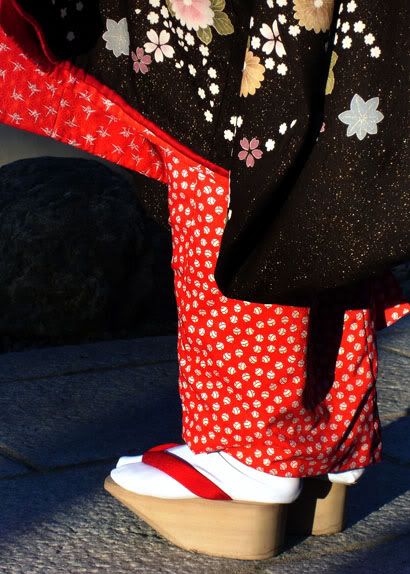
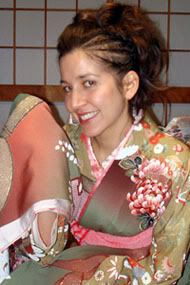
The thick wooden clogs of a maiko, or apprentice geisha. In the crowded Hanamikoji street, we heard the sound of many maiko girls' rushing to make their appointments. 'Kobo-kobo-kobo'is the onomonopia used to describe the sound of these shoes on the stone streets. 'Okobo', as they are called, have extremely thick soles, measuring 11cm.

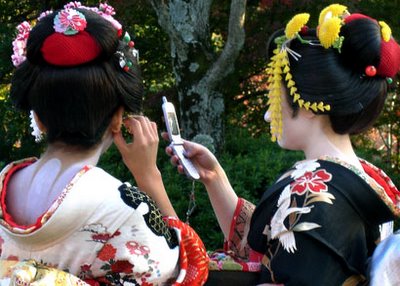
Two nisemono maiko, or imposters (toursits playing dress-up), send pictures of their transformation to friends via keatai, or mobile phone.

Image hosted by Photobucket.com
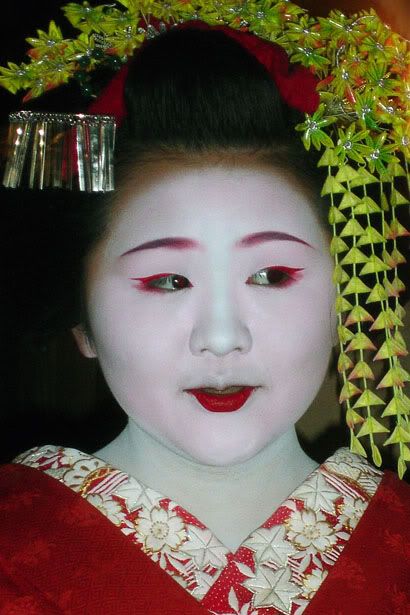
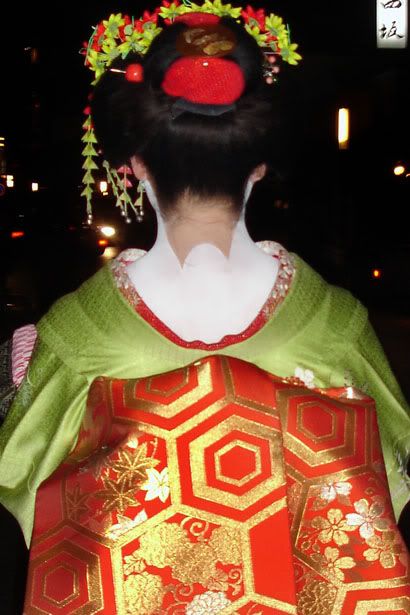
A very young maiko steps out with her 'big sister', one of the 17 maiko and geisha we saw walking the streets of Gion.

Image hosted by Photobucket.com
Another maiko hurrying down the Hanamikoji. Red and green are the 'in' colors this season. Seems even maiko are getting into the holiday spirit.


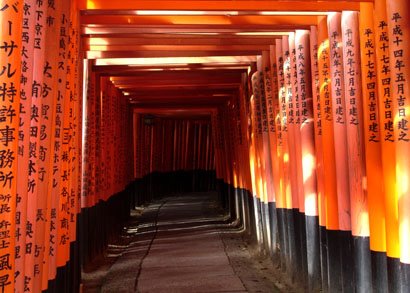
The tangerine tunnel of torii leading through the green trees and autumn leaves of Fushimi Inari.

Image hosted by Photobucket.com
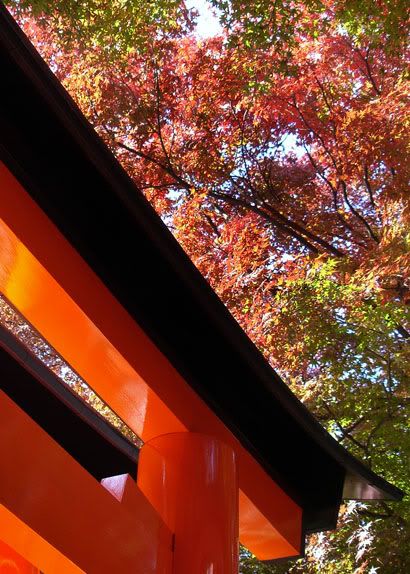
The changing leaves above Fushimi Inari`s tunnel of torii.

Image hosted by Photobucket.com
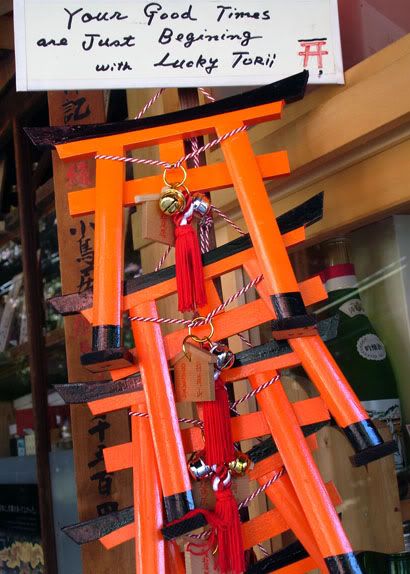
Our trip was coming to an end, but our happy times were just beginning!

Tuesday, November 22, 2005

Japanese Culture and the Colors of Autumn

Image hosted by Photobucket.com
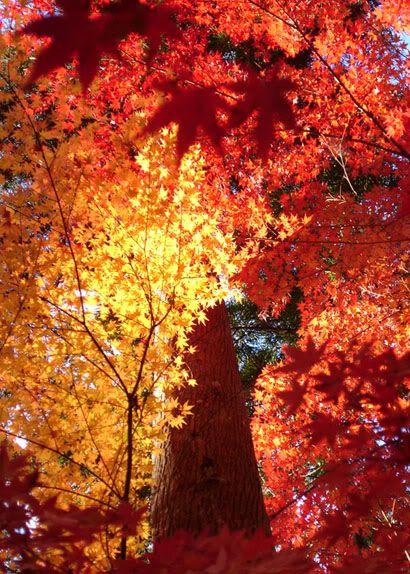
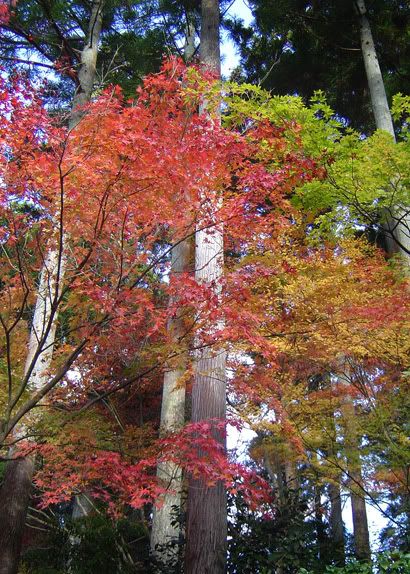
The fall colors of Sanzen-In, Kyoto. When the sun rays hit the red leaves and make them glitter warmly, it is called teriha (照葉 [てりは]).

As autumn deepens, the green leaves of deciduous trees begin to set the countryside on fire in shades of red, orange and yellow. This blaze of glory before winter sets in is admired around the world, but only in Japan has "Autumn Leaf Viewing" been ingrained as a popular cultural passtime.

The bright autumnal tints of Kyoto's foliage captivated the hearts of ancient Japanese people, who used them as motifs in literature and art for centuries. Autumn leaf viewing is thought to have become an organized event sometime during the Heian period, when the nobility would gather to listen to music, compose poems, or quietly delight in natures offering. Enjoying the fall colors is as important a traditional past time as viewing the cherry blossoms in the spring, but unlike cherry blossom viewing, which tends to be a rowdy affair, autumn viewing is a time of solitude and reflection.

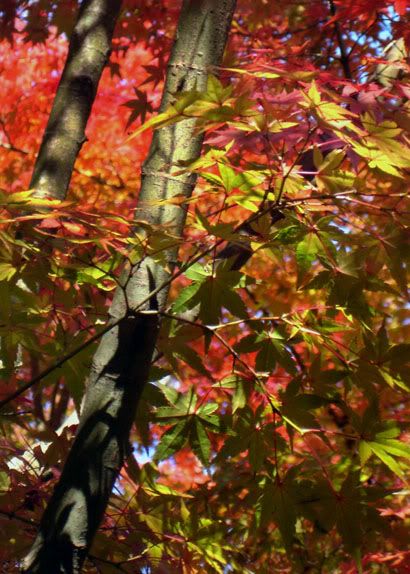
The maple trees most common to Japan are called Takao maple, or Iroha maple. Takao, the place after which the tree is named, is one of the three famous spots in the foothills of Kyoto's northwestern mountains (together with Makino-o and Togano-o).

Because maples flaunt an especially gorgeous array of colors, one tends to immediately think of the maple as the definitive image of momiji. Its impossible to ignore the beautiful arrdisplay of autumn leaves on other trees, like persimmon trees (柿紅葉 [かきもみじ]), cherry blossom trees (桜紅葉 [さくらもみじ]), lacquer trees (漆紅葉 [うるしもみじ]), and rhododendrons (満天星紅葉 [どうだんもみじ]). Seeing the mixed palette of forest foilage (雑木黄葉 [ぞうきもみじ]) covering the mountains is like studying an impressionist landscape painting.

The trees with the most dramatically vivid autumn colors are found in the mountainous and northern regions of Japan, where there is a severe discrepancy in temperature between day and night. Generally, the leaves start to turn color when the temperature dips under 8 degrees Celcius (approximately 46 degrees Fahrenheit). They reach a climax when the day's lowest temperature hits 5-6 degrees Celcius (approximately 41-43 degrees Fahrenheit).Its all very scientific, and the Japanese keep careful track of these temperature changes in order to forecast where the leaves are changing, and when they will be most beautiful. Every news program devotes a special segment, along with it weather forecast, to an autumn leaves update.

Some trees with leaves that turn yellow rather than red-- such as a type of oak (檪 [くぬぎ] kunugi) or gingko trees (銀杏 [いちょう])-- are also called momiji, although when written with Chinese characters, the form is slightly different. The Chinese character for "yellow" (黄) replaces that of the character for "red" (紅). In that case, momiji is written as "黄葉" (yellow leaves), instead of "紅葉"(red leaves).

As a linguist, I have always believed that the amount of words dealing with a subject, as well as the specific meaning contained in a single utterance help shed light on the cultural importance of the subject. The Japanese language has no shortage of words to describe the leaves of fall. For example, the term kusa momiji (草紅葉 [くさもみじ]) describes the way autumn leaves fall and spread themselves over grass. I wonder if they have a word for a pile of leaves gathered together for the expressed purpose of jumping into them--although I doubt it because, sadly, I've never seen anyone jumping into a pile of freshly raked or hand gathered leaves in Japan! Alas...

Other related terms:
初紅葉 [はつもみじ] hatsumomiji, first momiji
薄紅葉 [うすもみじ], usumomiji, pale momiji
紅葉 【もみじ】 momiji, (もみぢ), red leaves / red (maple) leaves
夕紅葉 【ゆうもみじ】 yūmomiji, evening red leaves
むら紅葉 【むらもみじ】 muramomiji, village's red leaves
谿紅葉 【たにもみじ】 tanimomiji, valley's red leaves
紅葉山 【もみじやま】 momijiyama, red-leaved mountain

Thursday, November 17, 2005

Fall in Kyoto 三千院の紅葉

Image hosted by Photobucket.com
The changing leaves of Ohara's famous temple, Sanzenin.(Kyoto).

Sunday, November 13, 2005

Tenryuji's Fall Foilage 天竜時の紅葉

Image hosted by Photobucket.com
The leaves at Sagano's Tenryuji (Heavenly Dragon Temple) are early this year, setting the temple gardens on fire in brillant hues of crimson.(Picture taken Nov.1st!)

Sunday, October 30, 2005

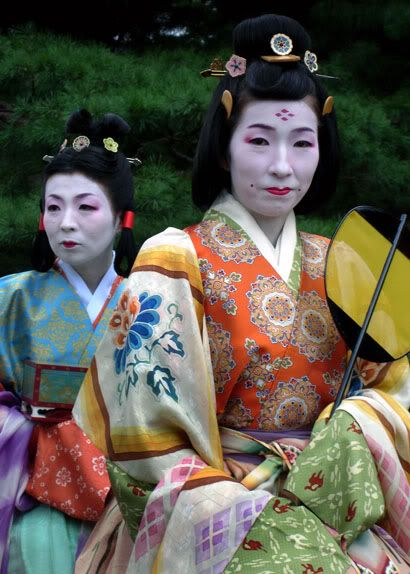
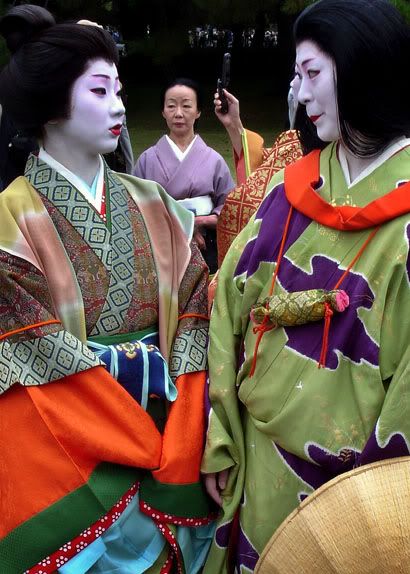
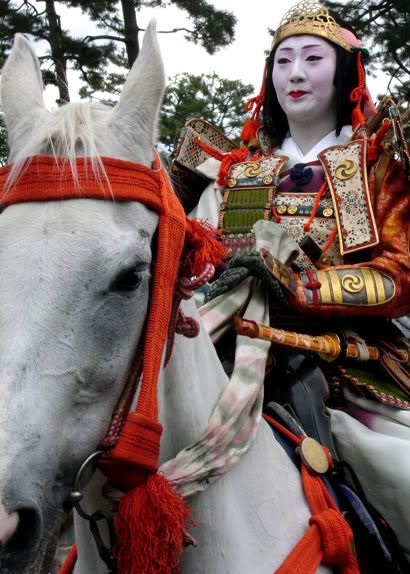
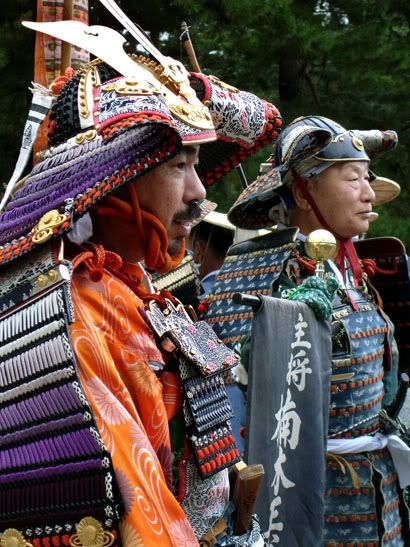
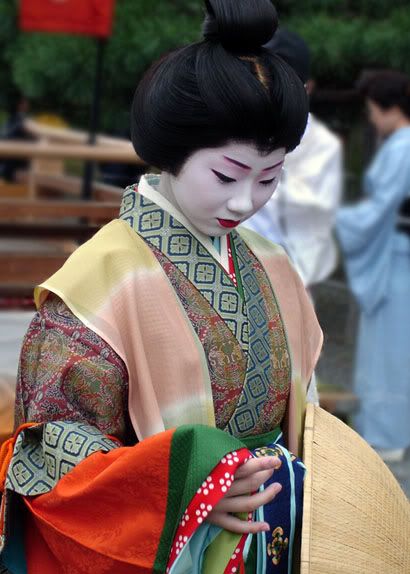
Jidai Matsuri

An apprentice geisha, or maiko, dressed in Heian period costume at Jidai Matsuri.

The Jidai Matsuri, or Festival of Ages, is one of Kyoto's most famous festivals, along with Aoi Matsuri and Gion Matsuri. Held on October 22, it commemorates Emperor Kammu's decision to move the capital of his Empire from Nara to Kyoto on the same day in the year 794.

Image hosted by Photobucket.com
Chinese influence.

Originally instituted to raise Kyoto's moral after the loss of the capital and Imperial Court to Tokyo in 1868, it begins with the mikoshi (portable shrines) of the first and last Kyoto emperors being carried to the Old Imperial Palace, followed by a 5 hour long procession of approximately 2000 Kyoto natives dressed in lavish, period costumes representing styles from throughout Kyoto's history, beginning with the modernized soldiers of the Meiji era, corresponding with the end of the Kyoto capital in 1868, all the way back to the founding of the capital, during the Heian period.

Image hosted by Photobucket.com
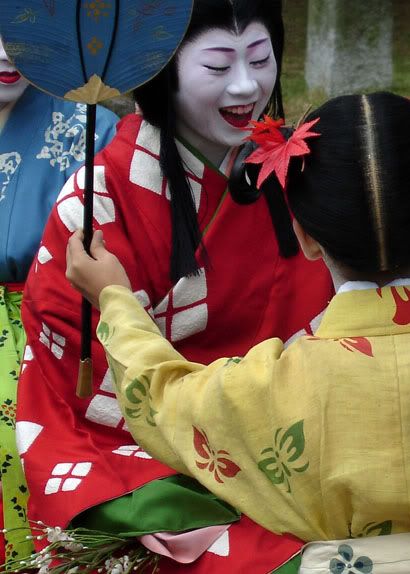
A geisha laughs as she plays with a young girl.

Image hosted by Photobucket.com
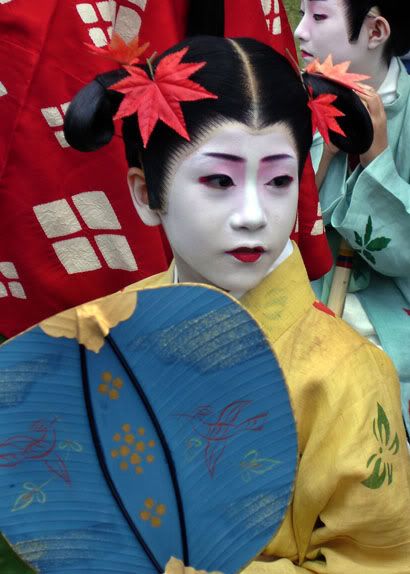
A young girl dressed as a child of the Heian court.

Image hosted by Photobucket.com
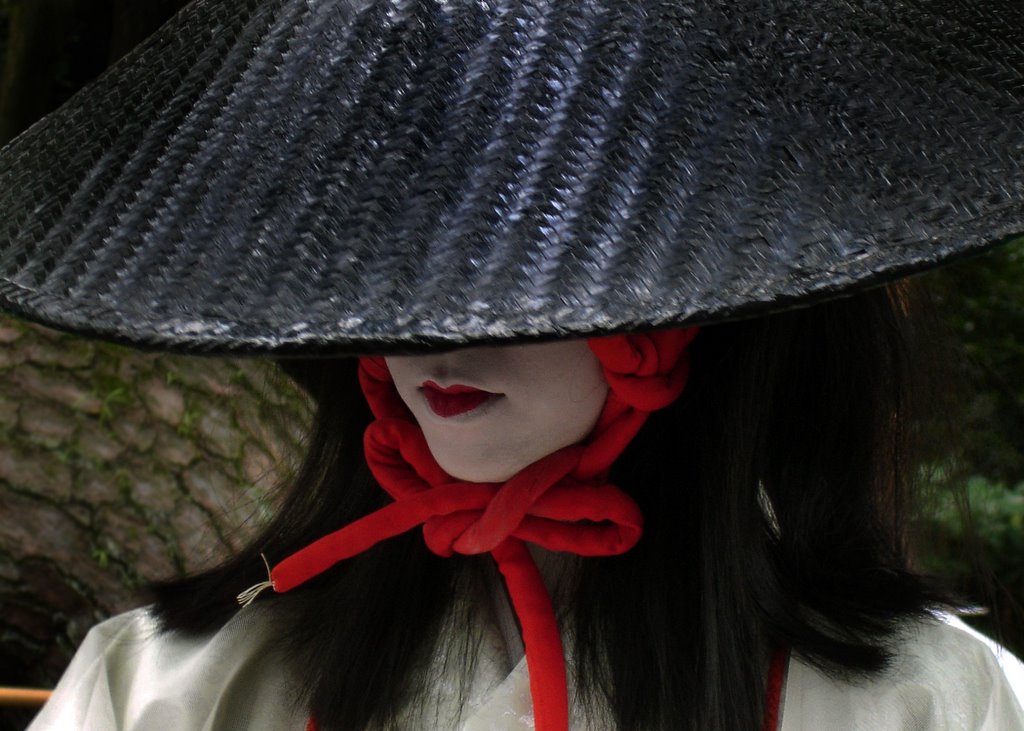
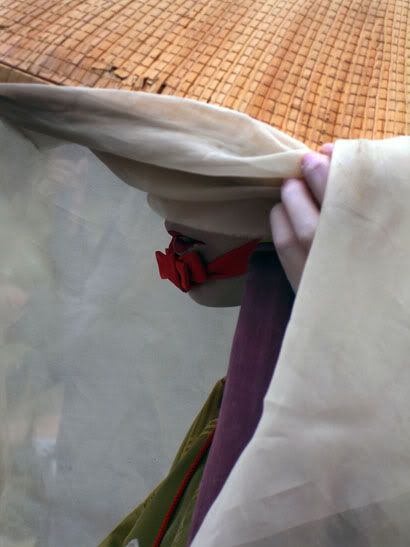
An apprentice Geisha, or maiko, seeking refuge beneath the veil of her Heian period costume.

Image hosted by Photobucket.com
A maiko and geiko chat while an older geisha in the background watches a young maiko take a quit shot with her ketai, or mobile phone.

Image hosted by Photobucket.com
Tomoe-Gozen was the wife of General Kiso Yoshinaka. She fought courageously alongside her husband in battle, one of the few examples of a true female samurai in japanese history.

Image hosted by Photobucket.com

Image hosted by Photobucket.com
MORE COMING SOON!

Wednesday, October 19, 2005

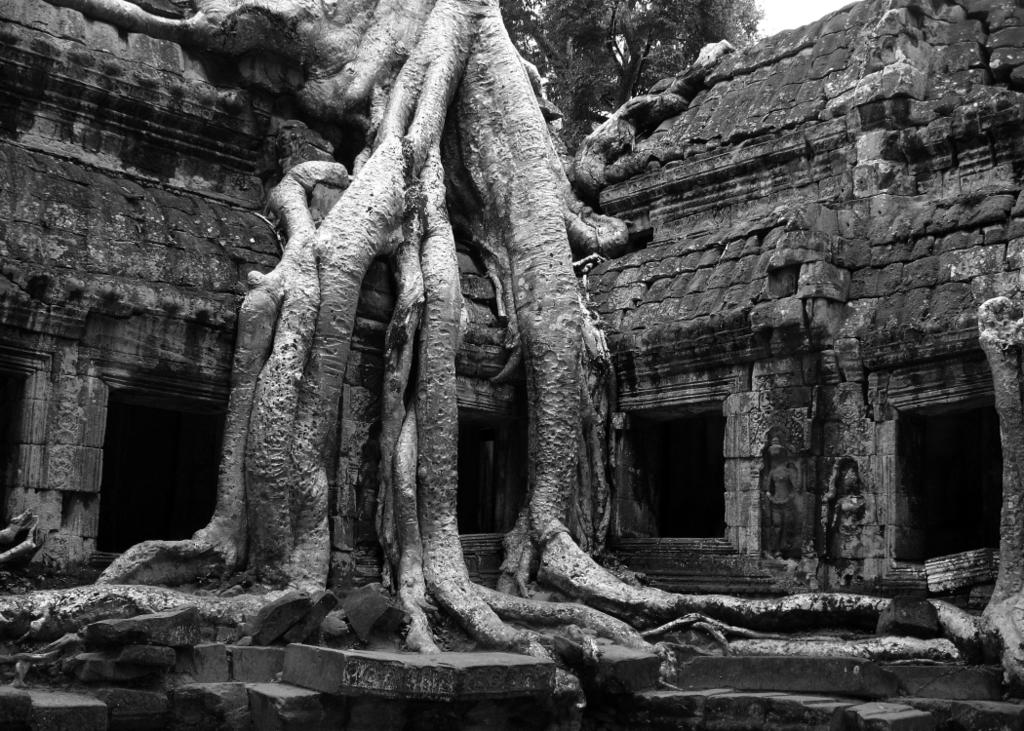
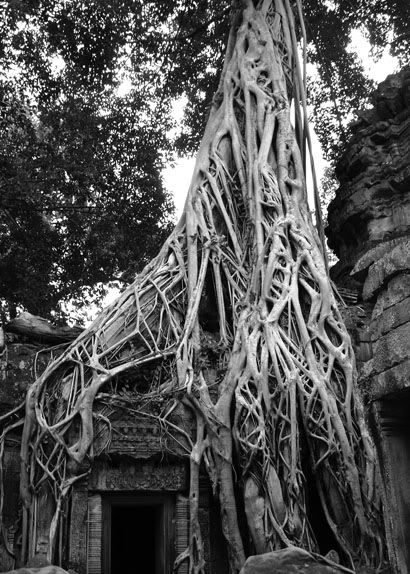
Ta Prom: The Jungle Temple

The temple of Ta Prom has been left more or less as it was found, with an overgrowth of jungle and portions tumbled down. It gives you some idea of what the first westerners found when they began exploring the area in the late 19th century.

When I told people I was going to Cambodia, they often asked "Cambodia? Why? What's there?" Once I said Angkor Wat, a light went off in many of their heads. "Oh! That's where they made Tomb Raider! Sweet!" Well, I haven't seen Tomb Raider (Angelina Jolie), and I probably never will. If you have, this may look a bit familliar.

Image hosted by Photobucket.com

Massive webs of Banyon roots cling to sandstone walls, stained by centuries and dancing with intricately carved apsaras. Mounds of moss-rocks, victims of neglect and the the crushing roots of the encroaching jungle, lie defeated, scattered throughout the temple grounds. Droplets of light trickling through the lush green foilage, caught in the mist of monsoon season, creates a mysterious, ethereal air.

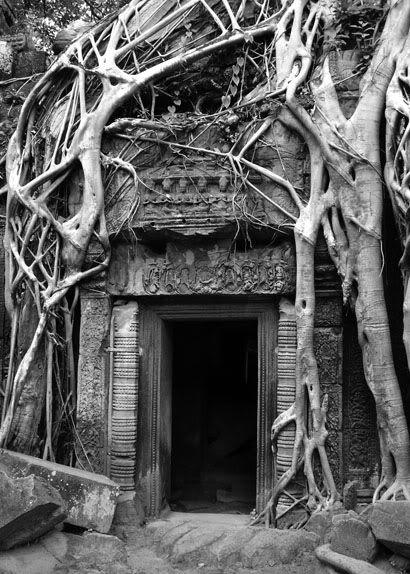
Though many signs warn tourists of the danger of exploring most of the tumbling temple grounds, I couldnt help but scatter up mountains of fallen stones into hidden courtyards,stumbling over the tangle of knarled roots slithering down the walls and through the temple passages, and past the warning signs standing gaurd in the darkened doorways of the temple's shadow-veiled interior. I even stumbled into a small chamber acoustically designed so that when I beat upon my chest, the entire temple seemed to shutter from the thunderous echo. I was in full Indaina Jones mode. I could have stayed there forever.

Image hosted by Photobucket.com
Apparently this is the doorway where Angelina Jolie bends down and picks something up. Anyone who's seen the movie, please feel free to elaborate!

Image hosted by Photobucket.com

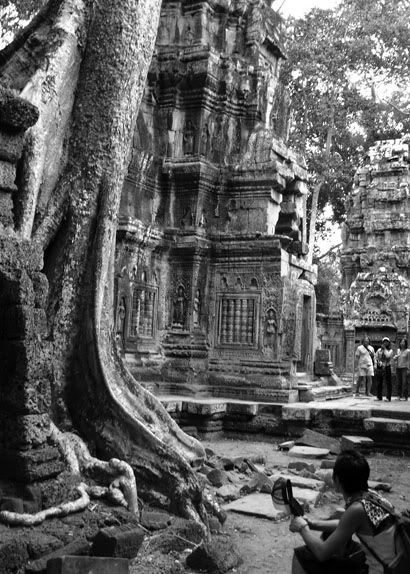
I was lucky to visit the temple at a time when most tourists are headed elsewhere! These few stand in awe.

Monday, October 17, 2005

Angkor's Apsaras

Image hosted by Photobucket.com
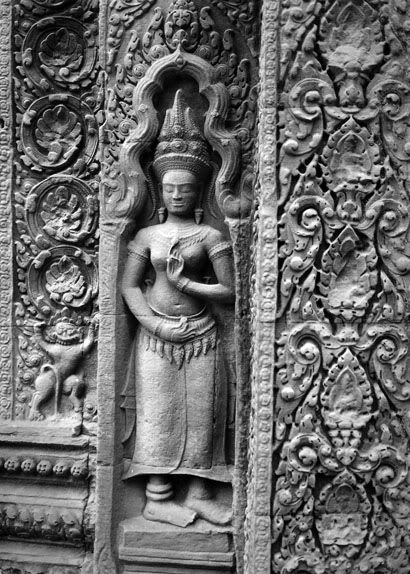
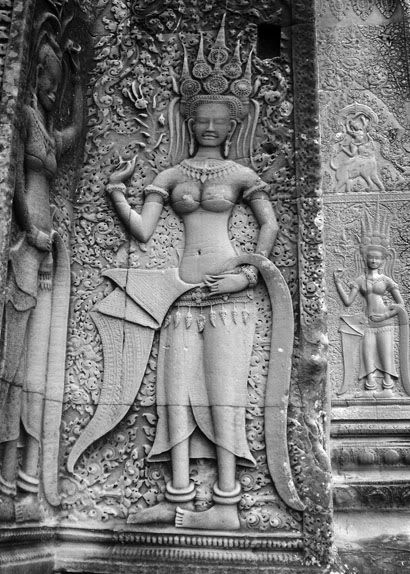
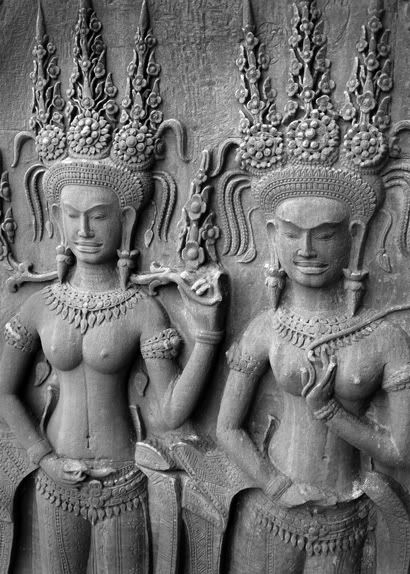
Apsaras are an embodiment of the ideal female beauty in Cambodian culture. Both modern and ancient Khmer artists rendered them elaborately and with great emotional intensity.

Dance in Cambodia is as ancient as the temples of Angkor, whose carved facades seem to dance. A single gallery in Angkor Wat alone features over 1,500 of these dancing nymphs, synonomous with the Cambodian idea of beauty. The word apsara derives, like much of the culture of ancient Angkor, from Indian Hindu influences. Apsaras were lesser goddesses of unimaginable beauty who danced for the entertainment of higher gods.

Image hosted by Photobucket.com

The dancers originally performed topless, and so they are often depicted in has-relief. It was only due to later Chinese influence that they began performing clothed. The dances features over 4,500 body movements known in Khmer as kbach. A pin peat ensemble consisting of oboes, xylophones, gongs and drums provides musical accompaniment along side singers who narrate the stories.

Image hosted by Photobucket.com

The term "apsara dance" today is interchangeable with court classical dance. At the height of the Khmer Empire, it is estimated that there were 3,000 Apsara dancers in the 12th century court of King Jayavarman VII. When Angkor was sacked in at the begining of the 15th century, the Apsara dancers were seized and taken to Thailand. Classical dance survived, and its influence spread throughout the region.

The Khmer Rouge considered dancing to represent the decadent Royalist society itwas determined to stamp out. Its proponents were executed or sent from their city homes to work in a countryside they did not understand. It is estimated that 90 percent of all dancers and musicians were killed during the reign of the Khmer Rouge regime. Along with them died the knowledge of many dance and theatre forms. Thankfully, those who survived have dedicated themselves to preserving this ancient art of Cambodian culture, and passing it on to the next generation.

Friday, October 14, 2005

Cambodia's Royal Palace

Image hosted by Photobucket.com

Almost as soon as I had finished feeding the hungry ghost of Pchum Ben, the sun began to rise on my final afternoon in Phnom Phen. I took a quick nap before making an all-too-quick trip to the Russian Market (so named because the Russians used to shop there), before boarding another tuk-tuk to see the Royal Palace.

Image hosted by Photobucket.com

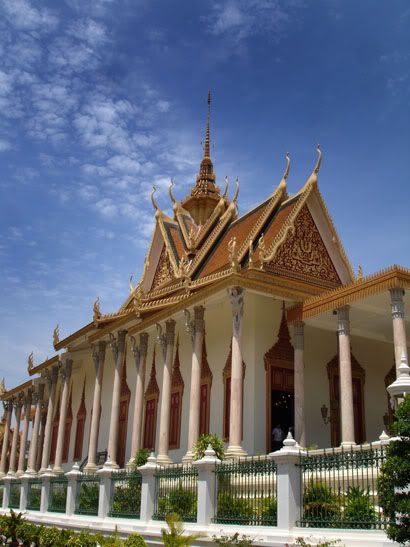
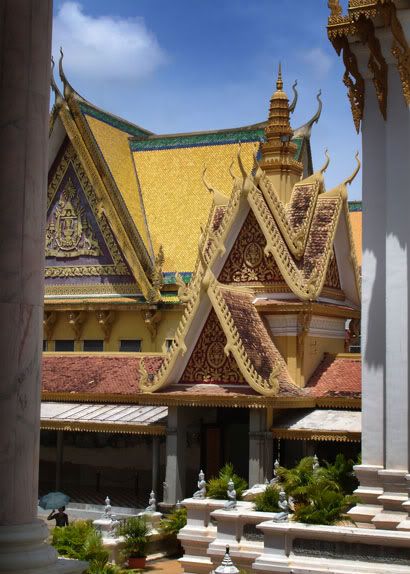
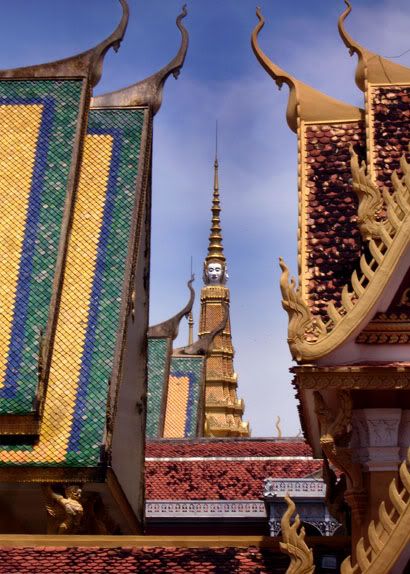
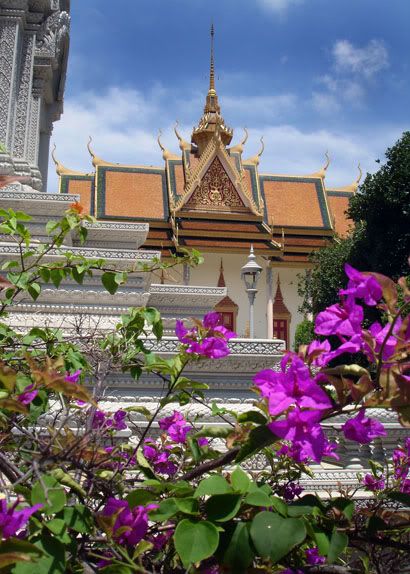
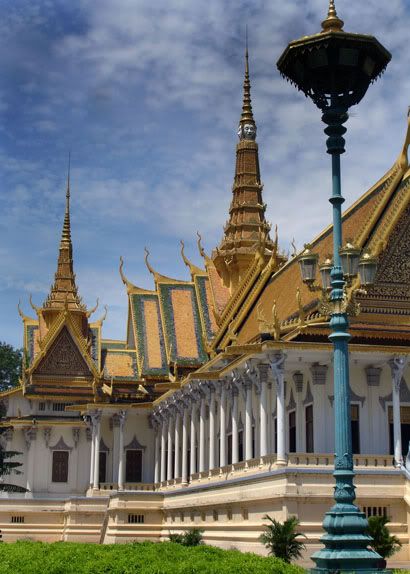
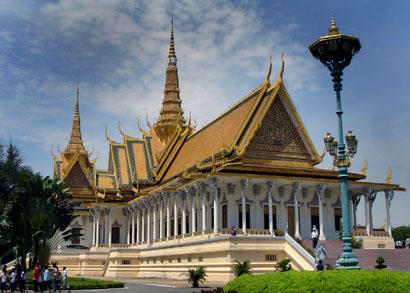
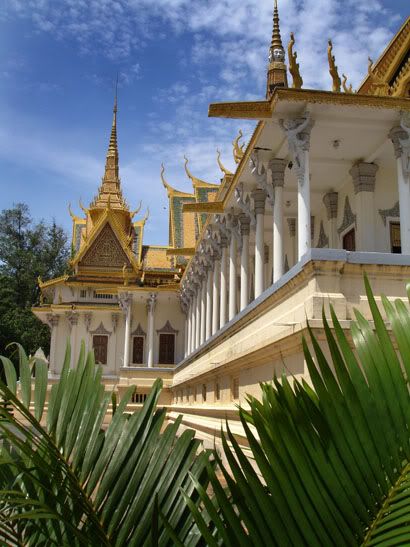
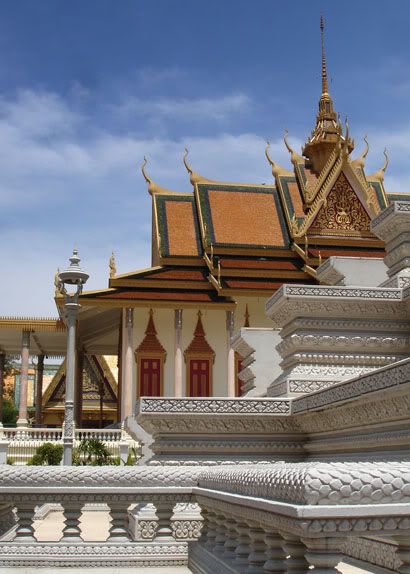
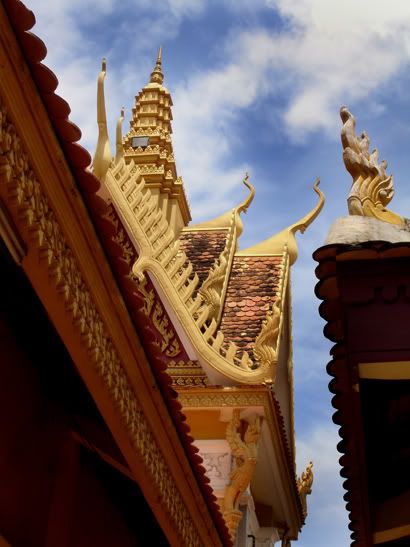
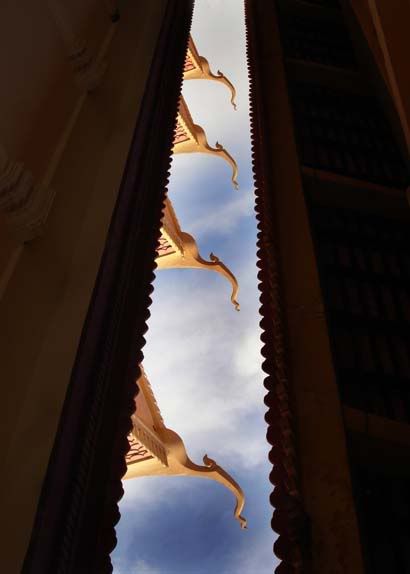
Golden tiles glimmered in the afternoon sun, as the richcolors of the dramatic rooflines anchored themselves firmly in the ocean blue sky like the golden talons of an eagle. As I passed through the gate I was told the palace would close in 30 minutes for the afternoon 'siesta'. Knowing that in 2 hours I would be well on my way to Vietnam, I rushed through the beautifully sculpted gardens overwhelmed by the bold colors, elegant architecture and intriguing skyline of the palace grounds, peirced by strong, A-frame rooftops and spindling spires bent towards heaven like plants towards sunlight.

Image hosted by Photobucket.com

Image hosted by Photobucket.com

Image hosted by Photobucket.com


Image hosted by Photobucket.com

The Royal Palace is the residence of King Sihanouk of Cambodia. It consists of several buildings including the magnificent Throne Hall, where coronations and official ceremomies take place, the Silver Pagoda (so named because the floor is covered with over 5000 silver tiles), an iron house given to King Norodom of Cambodia by Napoleon III of France, libraries, shrines dedicated to the past kings of Cambodia and several royal offices. Many of the precious items once displayed in the Royal Palace and the Silver Pagoda were destroyed by the Khmer Rouge.

Image hosted by Photobucket.com

Image hosted by Photobucket.com

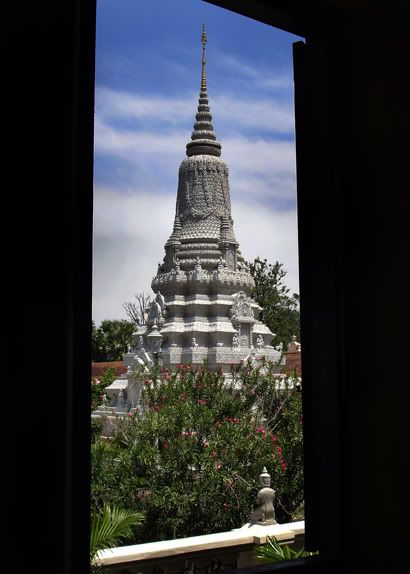
The earliest Buddhist religious monument, built to house relics and remainss and official ceremomies take place, the Silver Pagoda (so named because the floor is covered with over 5000 silver tiles), an iron house given to King Norodom of Cambodia by Napoleon III of France. Many of the precious items once displayed in the Royal Palace and the Silver Pagoda were destroyed by the of the buddha after his death, the stupa evolved into the pagoda as Buddhism spread to other Asian countries. "When a great teacher passes away, his body is no more, but to indicate that his mind is dwelling forever in an unchanging way in the dharmakaya (world of truth), one will erect a stupa as a symbol of the mind of the buddhas" - HH Dilgo Khyentse Rinpoche.

Image hosted by Photobucket.com

Image hosted by Photobucket.com


Monday, October 10, 2005

Tonle Sap: Asia's Great Lake

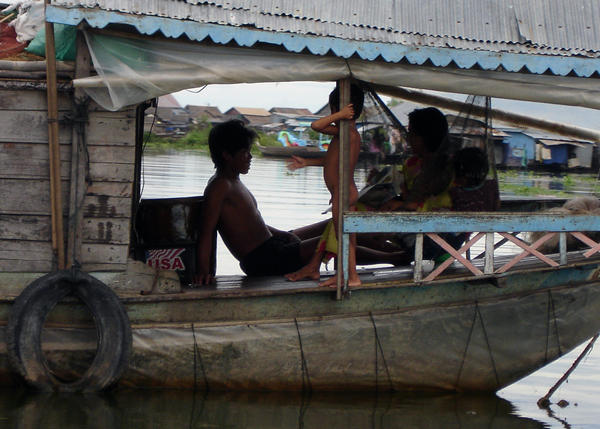
Daily life in the floating villages of the Tonle Sap.

Southeast Asia’s Mekong River flows thousands of miles from its source in the highland plateau of Tibet to its outlet into the South China Sea. The river runs through China, Myanmar, Laos, Thailand, Cambodia, and Vietnam. The giant river is a valuable, and in some countries a pivotal, natural resource, and has supported hundreds of thousands of people through farming and fishing for centuries.

Cruising through the neighborhood.
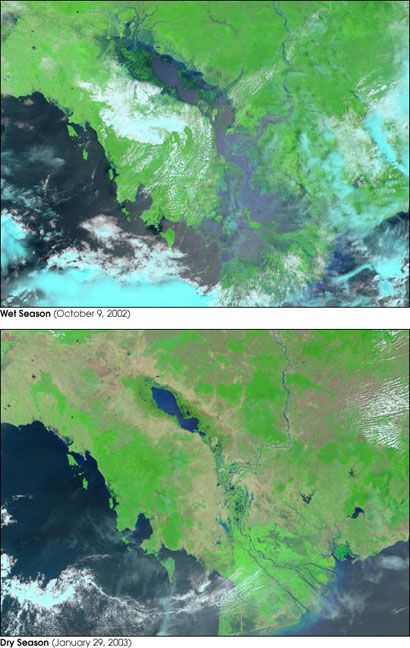
Image hosted by Photobucket.com

Among the most interesting features of the river is that monsoon-season rainfall swells the river’s volume so greatly that in low-lying Cambodia, the Tonlé Sap (meaning Large Fresh Water River but more commonly translated as Great Lake), one of the Mekong’s southernmost tributaries, is forced to reverse course against the rushing floodwaters. Beginning in June, the roughly 100-kilometer-long (62 miles) Tonle Sap River will begin to be inundated by the rising waters of the Mekong, and will slowly backtrack and begin filling the Tonle Sap Lake. The images above show the Tonle Sap during the dry and wet seasons. Vegetation appears bright green, standing water is dark blue, and clouds are light blue or white. In the bottom scene, the Mekong can be seen flowing in at the top to the right of center, and the Tonle Sap makes a distinct blue splash to the west. By October, much of central Cambodia is underwater (top scene).
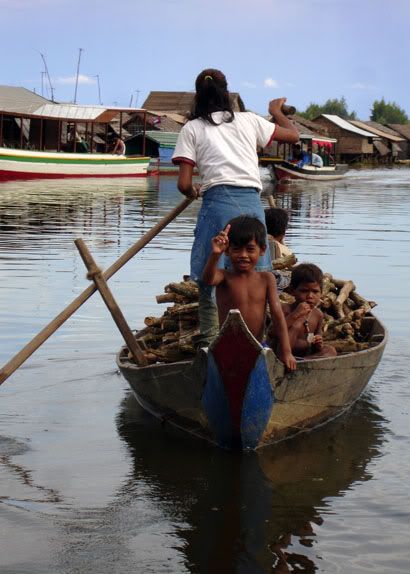
Image hosted by Photobucket.com

For most of the year the lake is around one meter deep with an area of 2,700 square km, but during the monsoon season, water is pushed up from the Mekong into the lake, increasing its area to 16,000 square km and its depth to up to nine meters, flooding nearby fields and forests. This provides a perfect breeding ground for fish and makes the Tonle Sap ecosystem one of the most productive inland fisheries in the world, supporting over 3 million people and providing over 75% of Cambodia's annual inland fish catch and 60% of Cambodians' protein intake. At the end of the rainy season, the flow reverses and the fish are carried downriver.

Notice the treetops of the submerged forest shattering the glassy reflection of the lake in the background.

Luckily I chose to visit Cambodia in the midst of monsoon season, while the Lake was at its largest. After an early morning at Angkor Wat to see the sunrise, and an afternoon of temple hopping through the jungle, we decided to take a short cruise on the lake, through the floating villages. As we made our way out of the bustle of tuk-tuks and motorbikes that swarm around Siem Reap's provincial center, the narrow, dirt road wandered through many small neighborhoods, until it was surrounded on both sides by the bank of the river, like a bridge to over time. As we drove through the tiny village that springs up along the edge of the lake during this season, children ran after the bus, waving, laughing, and dragging their friends along with them.
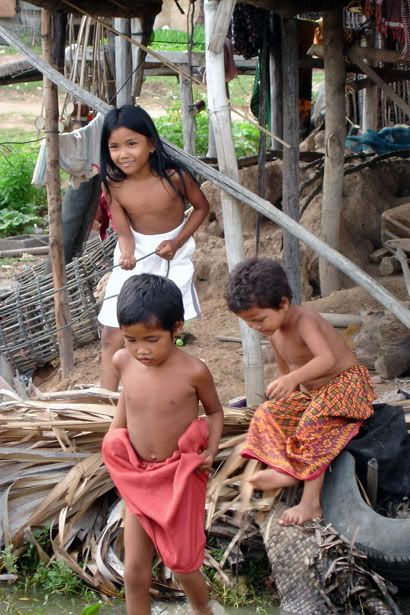
Image hosted by Photobucket.com

On tall, slender stilts, the thatch houses wading in the shallow waters along the banks of the lake towered above the children playing beneath. They ran to us as we made our way to the boats, and even tried to follow us out on the water.

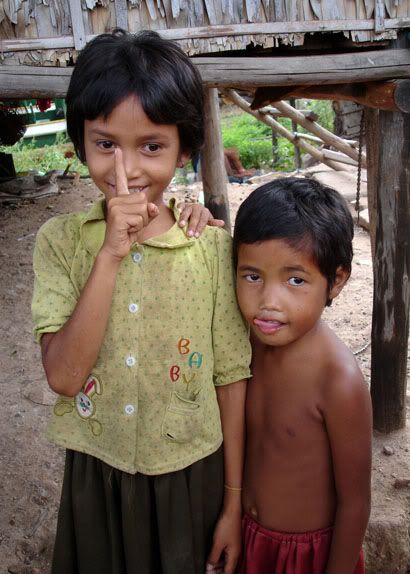
Image hosted by Photobucket.com

While some villagers choose to make their homes on dry land, many more live their lifes on the lake, in floating houses, or in boats.

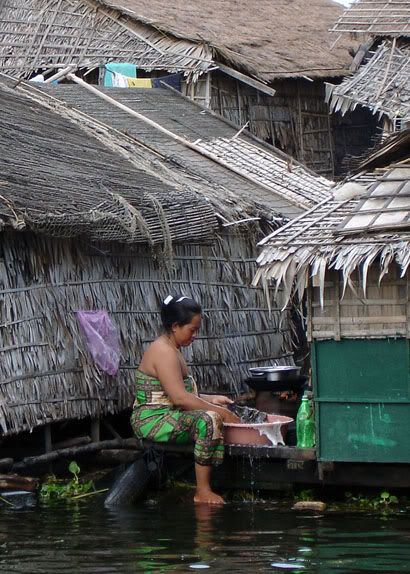
Image hosted by Photobucket.com
A woman bathes outside her floating home. Many of the houses had huddled together closer to shore.

A young boy bathing along the banks.

A man works to repair his boat.
Modern and traditional come togeter along the bloated banks of the Tonle Sap. If Jesus walked on water, I thought, all this man needed was a little faith. With a floating Catholic church nearby, no wonder I turned back to see him to ride off into the sunset on his trusty (soon to be rusty) motorbike.
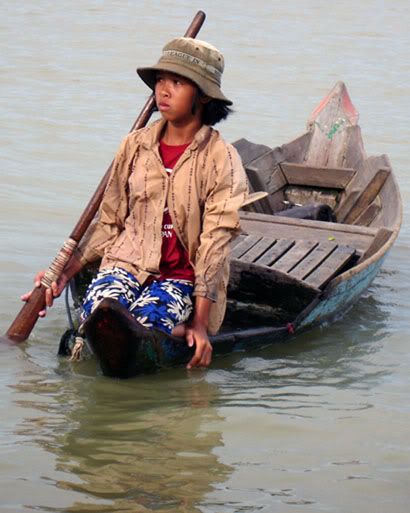
Image hosted by Photobucket.com
While we were quite far from any of the floating houses, this young girl caught sight of our boat at paddled with a passion to catch up to us.
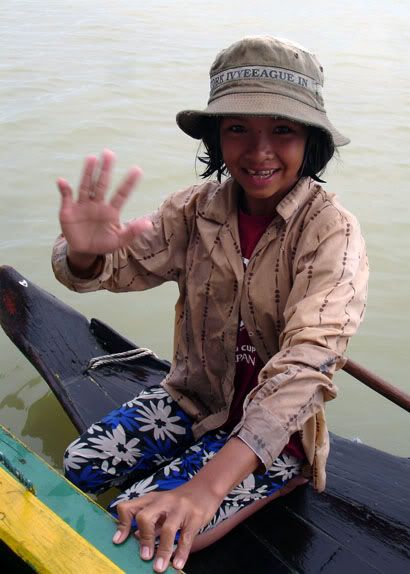
Image hosted by Photobucket.com
From a distance I could see her tiny body heaving as she struggled to catch her breath, clutching her chest. I watched her the entire time, amazed by her strength and determination. I pointed her out to the rest of the passangers, who were all equally stunned. She paddled right up to me and said hello.
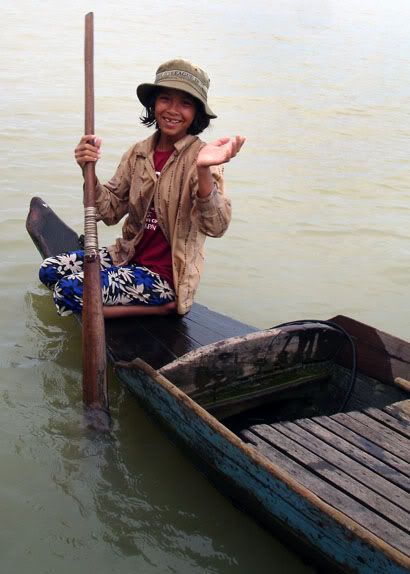


Image hosted by Photobucket.com
She was so cute, and she had already won my respect and admiration, so when she asked for a dollar, I was more than happy to give it to her. She definately earned it! She was so happy she did a flip off her little boat, waving to us all as we drove off.
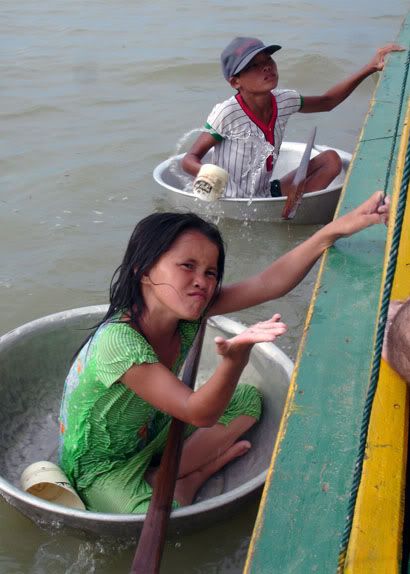
Image hosted by Photobucket.com

Who needs a boat when you have...these things!
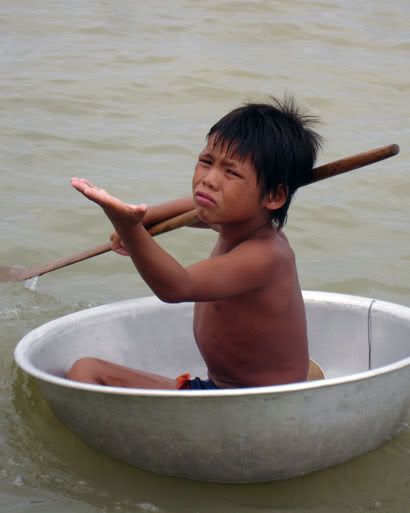
Image hosted by Photobucket.com

Image hosted by Photobucket.com
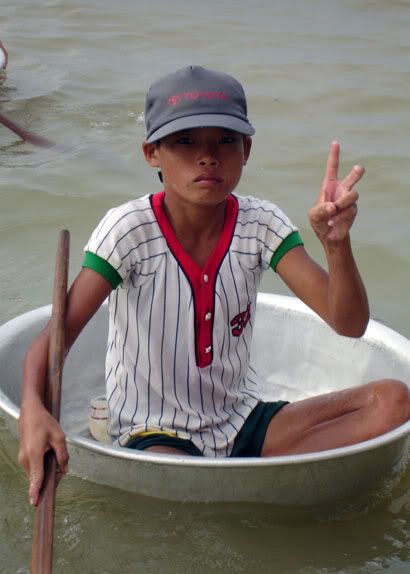
The legacy of Japanese tourism...The ubiquitous peace sign.
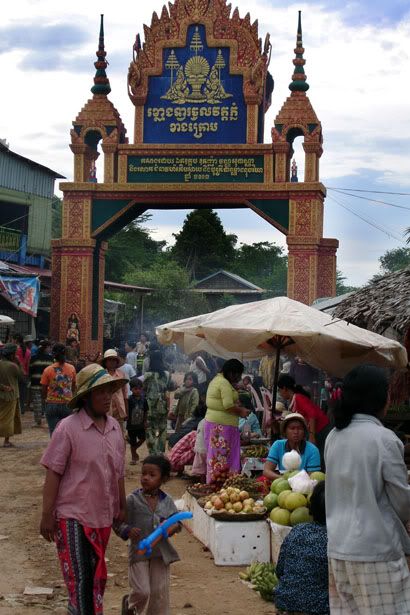
Image hosted by Photobucket.com
Afterwards, we took a stroll through the market outside the gate of a Buddhist temple. It was just starting to come to life.
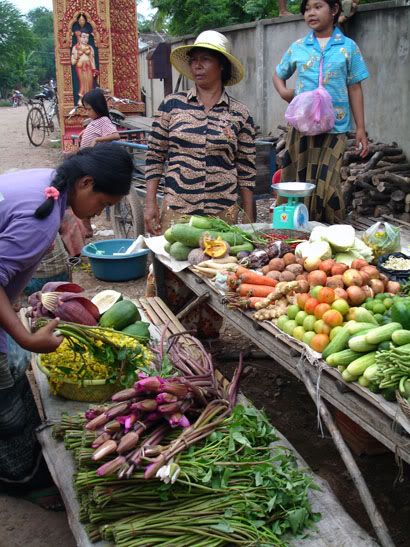
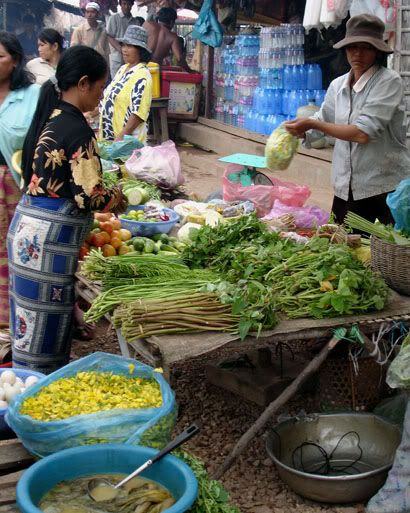
Image hosted by Photobucket.com

Image hosted by Photobucket.com

Image hosted by Photobucket.com
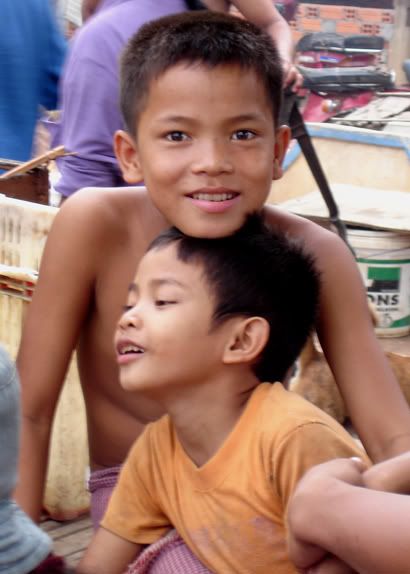
New friends from the market place. So cute.
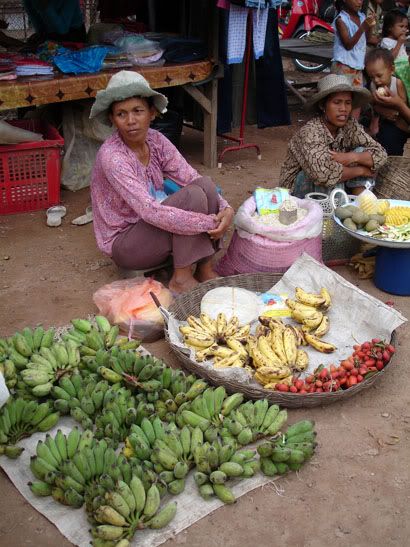
Image hosted by Photobucket.com

Image hosted by Photobucket.com
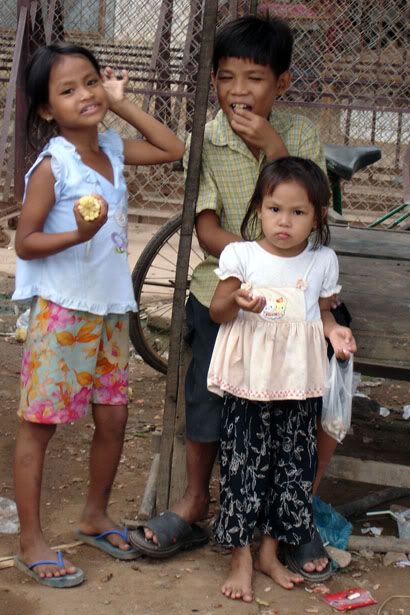
Children in the market.

The ecological importance of the seasonal flood cycle can’t be overstated. The huge lake and surrounding wetlands created by the flooding support a diverse freshwater fish ecosystem, and the silt deposited by the floods renews forest and farmland alike. As the countries along the course of the Mekong make plans for more upstream dams and navigation channels, the seasonal cycle of the lower Mekong becomes threatened, as do the fisheries and farmlands dependent on it. What is good for one country or region might have devastating consequences for another. The governments in the area face a difficult problem as they try to balance the competing interests of flood control, hydroelectric power, shipping, fishing, agriculture, and environmental protection.