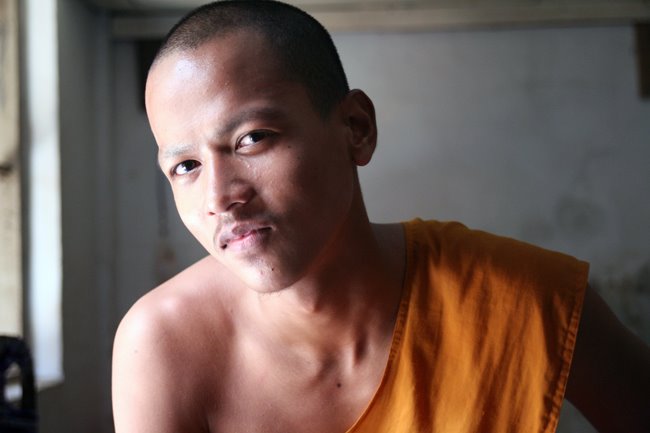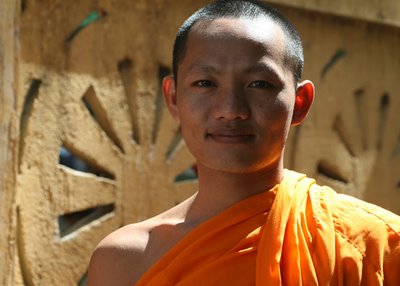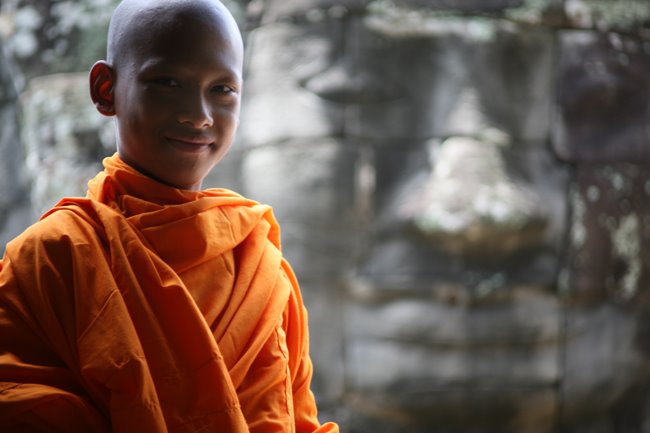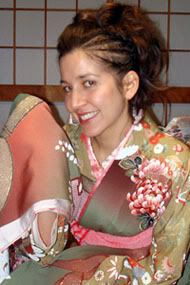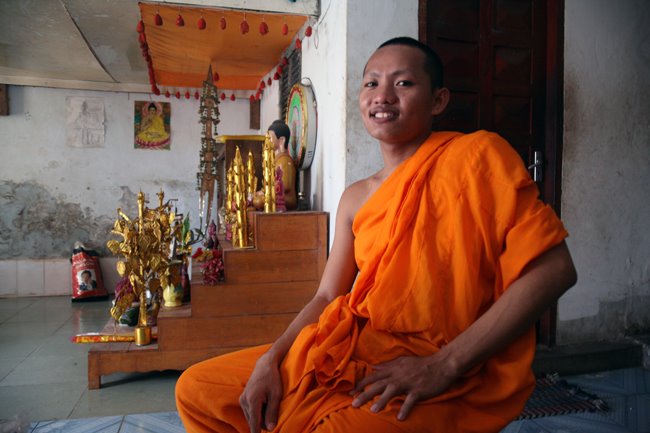
Vutha passed through the faded, honey-and-cream washed walls surrounding the many apartments shared by monks of the nearby pagoda. Three floors high, the simple, beautiful buildings surrounded me like a silent city. Tangerine robes hung from balconies and railings as monks gathered together on porches and verandas, talking, reading, and now, staring at the strange girl stepping lightly into their quiet little world. I smiled, because that is what I do, especially when I'm nervous and dont know what to do. Someone smiled back, and suddenly a chorus of giggled hellos began to rain down from above me. Vutha looked up and laughed, and then back at me. "We don't get visitors often!"
I followed him through his tiny village of brightly colored walls, hung like faded robes, looking all the lovlier for the wear. When it seemed we had wandered through all the secret passageways, we came at last to a thin wall separating their peaceful sancutary from the busy world outside. Vutha stopped in front of "House No. 39" and calmly scaled the scallopped steps fanning out from the narrow door. He disappeared inside the dark room for a moment, popping his head back out to look for me. Unsure if I should follow or wait, I had stopped at the bottom of the steps, nervously looking everywhere but into the darkness. "Ok, come on. Come in."

I climbed the stairs slowly, stopping at the threshold. Vutha was clearing a place for me on a long wooden arm chair. "Come on. Please. Sit here." I stepped shyly into the room, bowing (its a habit) and raising my hands in prayer, as Cambodians do, trying my best to say "Soksabay che te" without sounding as ridiculous as I felt. The other monks scattered about the room stopped for a moment, looking blankly from me to Vutha, then smiled at me and returned my greeting. I sat down very conscious of my movements and appearance, unsure of how to act, but Vutha casually pulled up a chair in front of me and started asking me questions about my life in America and Japan. In a few minutes we were talking and laughing as if we were good friends reunited after a long separation.
In the background, a monk stood sweeping the room, an MP3 player clipped to his shoulder, earphones hidden in his ears. Another sat on the floor behind us, studying. Some had gathered to begin preparing lunch. One by one, the slender silhouettes of young monks appeared in the flood of light streaming through the doorway as they returned from their classes. Many of them smiled saying "Oh! Hello! So, what`s your name? Where are you from? How long have you been in Cambodia?" sitting down to join in the conversation, or simply listen. Soon the long wooden sofa was full and I moved to the floor to ensure a safe distance between us.
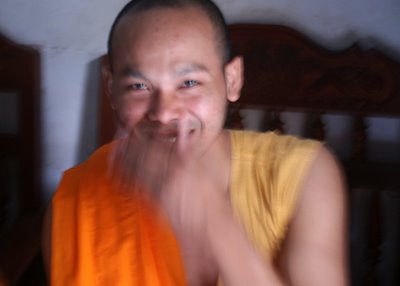
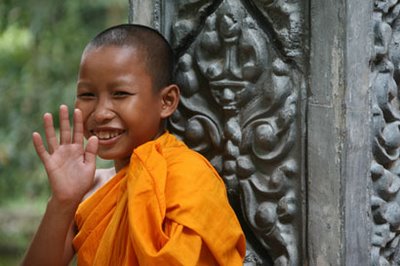
Soksopheakdey laughing...
As we sat around laughing, an older monk appeared from a separate room and leaned up against the wall, smoking a cigarette. I was shocked at first to see him smoking, but he looked down at me and smiled kindly. "Soksabay che te" I said, pressing my palms together below my down cast eyes. He smiled and nodded "soksabay," launching into a beautifully melodic stream of Khmer, which turned out to be his complimenting me on my clearly spoken Cambodia and asking how long I had lived in Cambodia. "The Venerable asks your name ." Vutha translated, and I answered. As Vutha later explained, he was the most senior monk in the house and treated with a great deal of respect. After awhile he disappeared back into his room, and the monks began to tell me about their daily life.
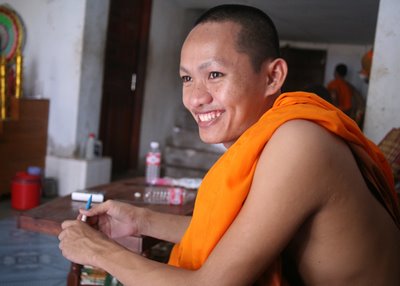
Vutha told me that Cambodian monks, like most in southeast Asia, followed Theravada, "The Way of the Elders," the oldest surviving school of Buddhism. At 25 years old, Vutha has been studying Pali, the ancient language of the Theravada's canon, for 8 years. As a monk, he serves his community by presiding over religious ceremonies and providing instruction in basic Buddhist morality and teachings. As a scholar, he dedicates his life to his studies, both religious and secular. He hopes to someday become a teacher of Khmer Literature, and studies both English and Japanese as well.
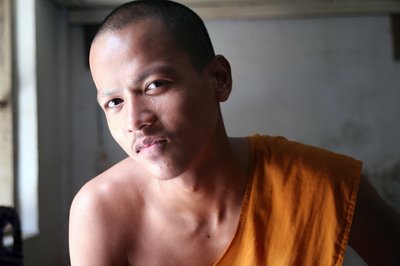
Vutha also introduced me to another young monk with impeccable English named Sensovesai. His name, he told me, means "I meet you, I am lucky. You meet me, you are lucky." At 21, he has been a monk for 5 years, and is dedicated to studying English and Japanese, despite the fact that he hopes to someday become a singer. "My friends tell me I dance like Micheal Jackson!" He laughed.
Micheal Jackson? That I had to see! Only one problem. As a monk, Sensovesai can't dance, and he can't sing. He isin't even supposed to listen to music.
Monks vow to undertake 10 Precepts, abstaining from: 1) harming or taking life, 2) taking what is not given, 3) sexual misconduct, 4) false speech, 5) using intoxicants, 6) eating after midday, 7) dancing, singing, music, or any kind of entertainment, 8) using garlands, perfumes, unguents and adornments, 9) using luxurious beds or seats, and 10) accepting or holding money.

But whatever the idealized, romantic preconceptions of monks may be, they are just people like you and me. In Cambodia, becoming a monk is sometimes the only way to get an education, fill your stomach and relieve the burden of your family. Very few young men (boys can usually enter the monkhood at the age of 13) become monks with the hopes of living a monastic life forever. There is no stigma attached to leaving the monkhood, and even in House No. 39, a young ex-monk and fellow aspiring singer continued to live just as he always had, among the monks in the monastery. Being ordained as a monk, even for a short time, is thought to be very virtuous. Just taking the vows, regardless of whether or not you keep them, is a virtue.
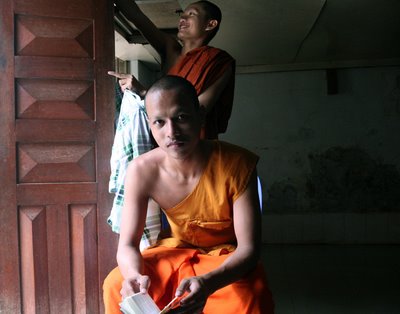
Vutha brings in the laymen's laundry, as Vesai paruses my trusty travel companion, the JET Diary.
Worried I was imposing on people too polite to tell me to leave, I asked if perhaps I should go so that they could prepare for their next round of classes. "No, no, no, don't worry! Aren't you hungry? You should have something to eat!" Vutha insisted.
By this time, the two young women, (Vutha's sister, and a cusin), had finished preparing the final meal of the day. The monks began to lay mats and gather infront of the buddah shrine, and the venerable emerged from his room carrying a small, low table. "Would you like to eat here?" Vutha asked.
"I would love to, but I don't want to eat all your food! There won't be enough for everyone! That food is for the monks..."
"Oh, there's more than enough. Now, we have to eat. You can't eat with us, but you can wait. And then afterwards you can eat with them (the girls). It is like a blessing for you!"
My western educated mind reeled for a moment. Oh yeah. How blessed! I get to sit and watch you eat, and then, when your finished you will allow us second class citizens to partake of your leftovers. This all shot through my mind in an instant, almost too quickly for me to realize I had thought it. It disappointed me. I would rather believe it was something I was programmed to think than consider it an original thought of my own. The truth is, I did feel greatly blessed: Blessed to have been able to come back to Cambodia, to have met Vutha, to have been welcomed into his home and treated so kindly, and to be invited to eat with them, observing their lifestytle, learning about their culture and taking part in their customs.
"Today the food is very delicious," the Venerable added (translated by Vesai). "You should stay and eat."
Good food? A personal invitation from the Venerable? How could I argue with that?
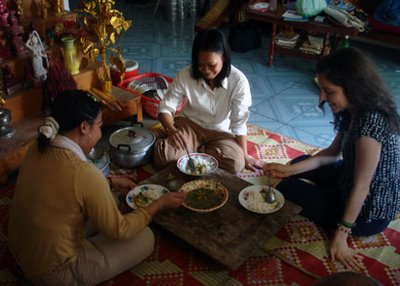
The girls and I enjoyed our meal, trying to communicate in my non-existent Cambodian, gestures, and smiles. I'm not sure what we we were eating, but it involved fish and was delicious.

Vutha heads off to class.
After lunch Vutha rushed off to bathe before his next round of classes at 1PM. Vesai, who was finished for the day, offered to show me around the temple grounds and accompany me to the National Museum after Vutha left.
As Vutha left for class he asked me to come again when I returned (the next day I planned to head back to Siem Reap and Angkor Wat) and blessed me, wishing me health, happiness and good luck. Vesai headed upstairs to put on his formal robes and we headed out into the temple grounds for my personal tour.

Vesai and I wait out the rain beneath the shelter of a colorful temple pavillion.
We headed back through the muted maze of monk dwellings and out onto noisy (in comparison) streets towards the National Museum. In order to keep the lay people from criticizing him, Vesai asked me to walk behind him until we were in the museum. I understood, and kept my distance, even after entering the museum grounds. " Are you sure its OK for you to talk to me out here?" I asked, concerned I was about to horribly offend the entire Cambodia capital. "No, its ok. In here there are only foreigners. They don't care, I'm sure."
So together we explored the amazing collection of Khmer carving and craftsmanship. Vesai patiently explained the symbolism and context of each of the beautifully carven statues and stellas, and even tried the ancient inscriptions written in a flowing form of Pali. Knowing the Vesai was eager to practice his Japanese, I secretly scoped the scene for a large Asian tour group, straining my ears to hear the languages being spoken all around me. There were many Koreans and Chinese tourists, who traveled in pairs or small groups, but it took awhile before a true Japanese your came through, fluent Japanese guide, flag and all.
I approached them apologetically (as is the custom-- sumimasen!) and began to ask them where they were from. Amazed that I could speak Japanese, they were thrilled to talk to me and try to understand how that could be. Knowing the tour had to be short on time, I introduced Vesai and told them that he,too, was studying Japanese. A chorus of "Eeee! Sugoi!" echoed through the lofty rooms as they tried to converse with the young monk. When it proved more difficult than they had hoped, they turned their attention back to me. The tour guide was a bit kibishii (strict) and urged the group to move along. I offered to take a quick picture, remembering that Vesai had once told me that since he could not travel, it was nice to think at least his picture could.Everyone smiled and shot up the peace sign, except for Vesai, who put on his serious monk face and stood with his hands at his side.
Time was running short for us as well. Vesai asked me to visit when I returned from Angkor, and I promised I would. He headed back towards House No. 39, far ahead of me, and I, overwhelmed by the awesomeness of the day and a creeping sense of sadness that it had to end, turned back to the riverside, where it had all begun.

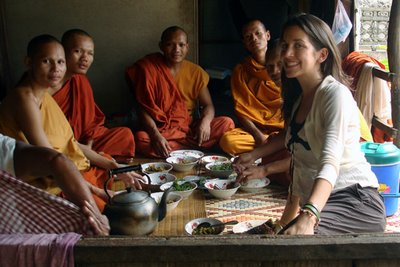 August 28, 2006: My last lunch with the monks.
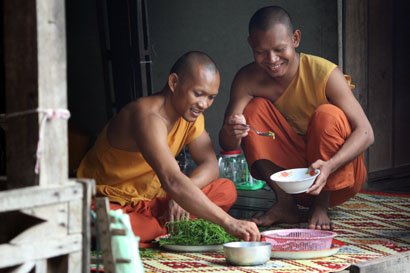 Sammuth and Cham Reourn helping to prepare the meal. They look so kind and gentle, right?
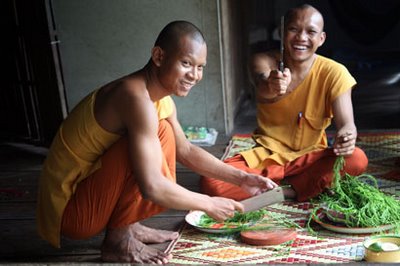 Wrong!
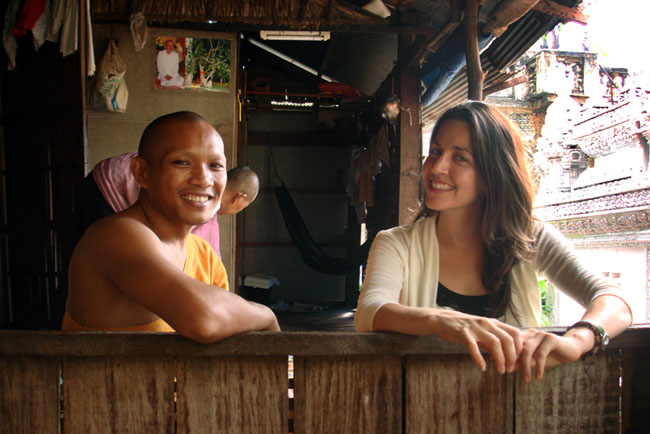 Sammuth and I.
 Post-feast siesta time!
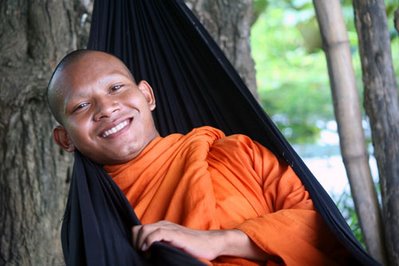
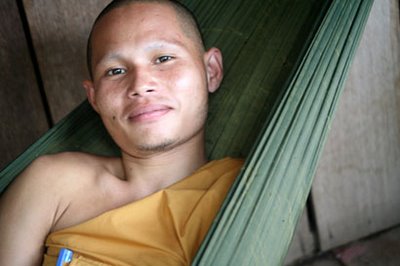 Ratha in his hammock.
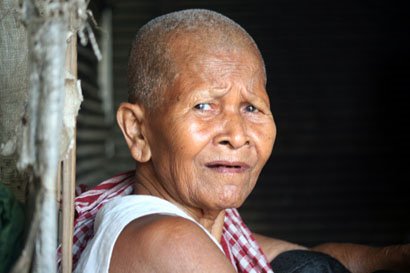 Yeay (grandmother) Ping.
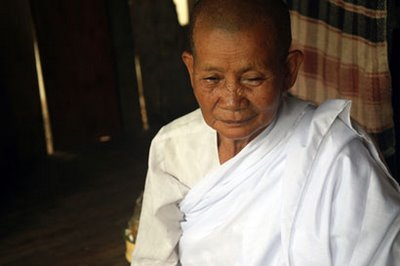 Yeay Vouy.
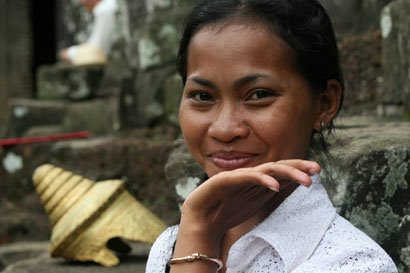
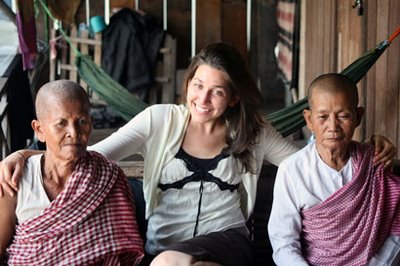 The girls and I. I know they don't look thrilled, but they actually asked to take a picture together so that I wouldn't forget them.
 As if I could!
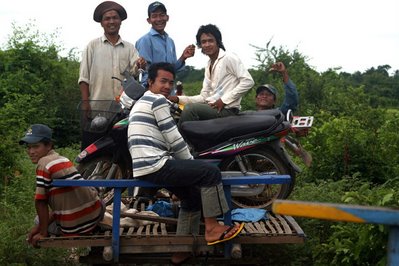
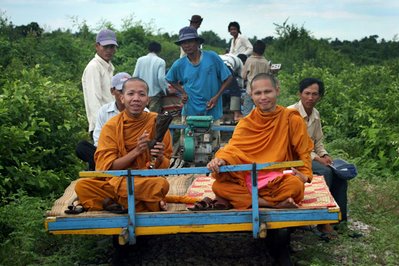 August 2006, Battambang Day 3: Kosul, Ratha, and my fellow passengers on Battambang`s Bamboo train.
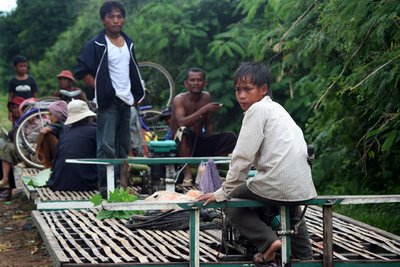 A young conductor pulling into the "station".
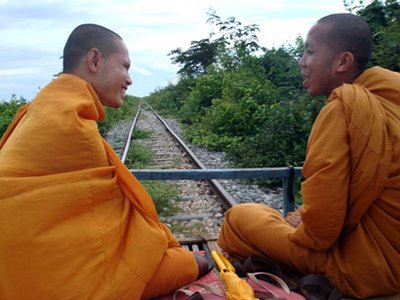 Ratha and Kosul enjoy the ride.
 Another bamboo train chucking along in our general direction.
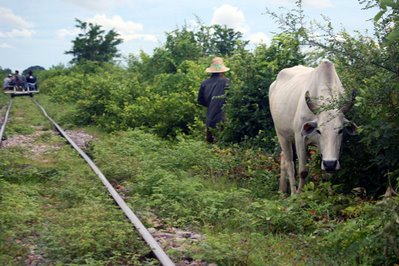 Having disembled our train so that the other might pass, I note that we are being watched. A spy for the anti-norry authorities, perhaps?
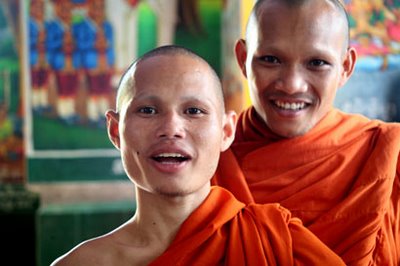 Ratha and Sammuth share a laugh about my fortune, which they translated for me: "Soon I will find the love of my life and be married within two years." This after the first one warned me to be careful about traveling. Have I mentioned the moto-burn/toothpaste incident?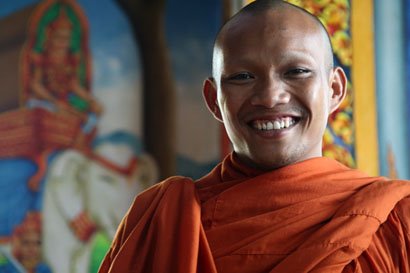

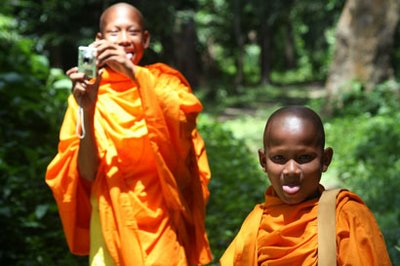 Hey! Who's taking the pictures here? My new friends lead me through the lush jungle to their secluded forest temple.
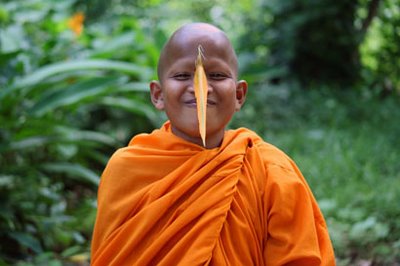 Tucan Sam-uth!
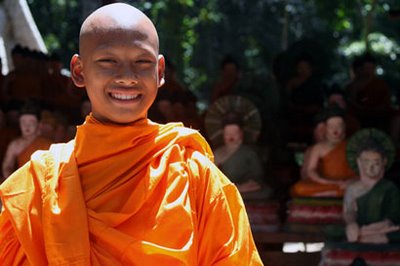 Smiling as he showed me around the temple grounds. Little buddhas everywhere!
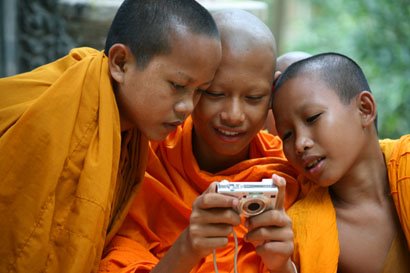
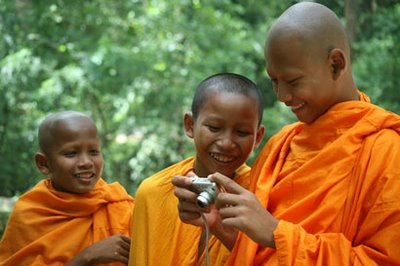 Ah the joy of digital cameras!
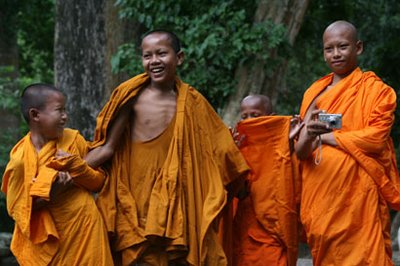 Looks like there's a budding photographer in their midst...
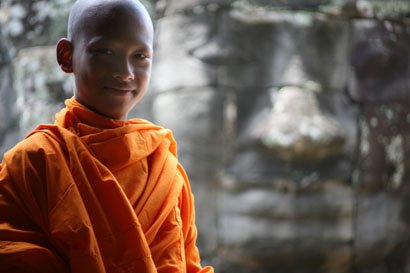
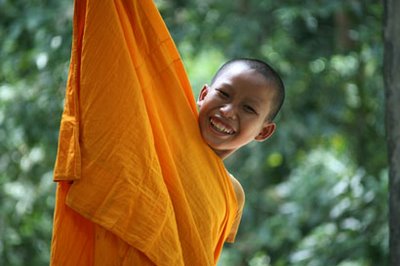 In the process of wrapping himself up in his brilliant orange robes.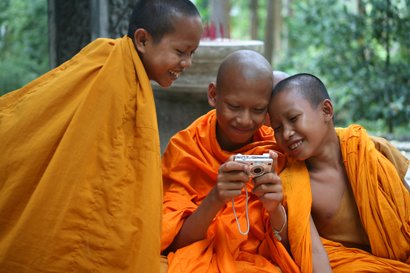



 Soksopheakdey laughing...