Monday, October 10, 2005

Tonle Sap: Asia's Great Lake

Daily life in the floating villages of the Tonle Sap.

Southeast Asia’s Mekong River flows thousands of miles from its source in the highland plateau of Tibet to its outlet into the South China Sea. The river runs through China, Myanmar, Laos, Thailand, Cambodia, and Vietnam. The giant river is a valuable, and in some countries a pivotal, natural resource, and has supported hundreds of thousands of people through farming and fishing for centuries.

Cruising through the neighborhood.

Image hosted by Photobucket.com

Among the most interesting features of the river is that monsoon-season rainfall swells the river’s volume so greatly that in low-lying Cambodia, the TonlĂ© Sap (meaning Large Fresh Water River but more commonly translated as Great Lake), one of the Mekong’s southernmost tributaries, is forced to reverse course against the rushing floodwaters. Beginning in June, the roughly 100-kilometer-long (62 miles) Tonle Sap River will begin to be inundated by the rising waters of the Mekong, and will slowly backtrack and begin filling the Tonle Sap Lake. The images above show the Tonle Sap during the dry and wet seasons. Vegetation appears bright green, standing water is dark blue, and clouds are light blue or white. In the bottom scene, the Mekong can be seen flowing in at the top to the right of center, and the Tonle Sap makes a distinct blue splash to the west. By October, much of central Cambodia is underwater (top scene).

Image hosted by Photobucket.com

For most of the year the lake is around one meter deep with an area of 2,700 square km, but during the monsoon season, water is pushed up from the Mekong into the lake, increasing its area to 16,000 square km and its depth to up to nine meters, flooding nearby fields and forests. This provides a perfect breeding ground for fish and makes the Tonle Sap ecosystem one of the most productive inland fisheries in the world, supporting over 3 million people and providing over 75% of Cambodia's annual inland fish catch and 60% of Cambodians' protein intake. At the end of the rainy season, the flow reverses and the fish are carried downriver.

Notice the treetops of the submerged forest shattering the glassy reflection of the lake in the background.

Luckily I chose to visit Cambodia in the midst of monsoon season, while the Lake was at its largest. After an early morning at Angkor Wat to see the sunrise, and an afternoon of temple hopping through the jungle, we decided to take a short cruise on the lake, through the floating villages. As we made our way out of the bustle of tuk-tuks and motorbikes that swarm around Siem Reap's provincial center, the narrow, dirt road wandered through many small neighborhoods, until it was surrounded on both sides by the bank of the river, like a bridge to over time. As we drove through the tiny village that springs up along the edge of the lake during this season, children ran after the bus, waving, laughing, and dragging their friends along with them.

Image hosted by Photobucket.com

On tall, slender stilts, the thatch houses wading in the shallow waters along the banks of the lake towered above the children playing beneath. They ran to us as we made our way to the boats, and even tried to follow us out on the water.


Image hosted by Photobucket.com

While some villagers choose to make their homes on dry land, many more live their lifes on the lake, in floating houses, or in boats.
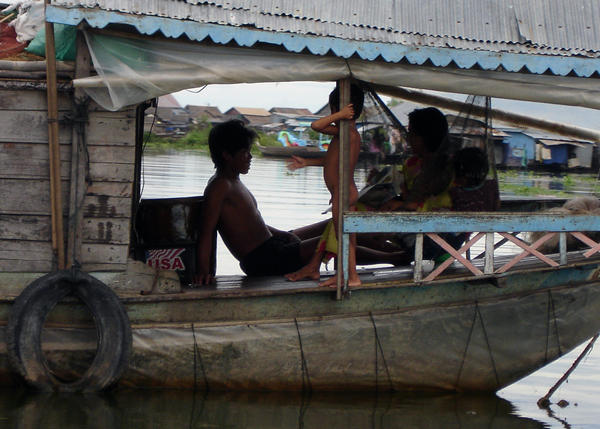

Image hosted by Photobucket.com
A woman bathes outside her floating home. Many of the houses had huddled together closer to shore.

A young boy bathing along the banks.

A man works to repair his boat.
Modern and traditional come togeter along the bloated banks of the Tonle Sap. If Jesus walked on water, I thought, all this man needed was a little faith. With a floating Catholic church nearby, no wonder I turned back to see him to ride off into the sunset on his trusty (soon to be rusty) motorbike.

Image hosted by Photobucket.com
While we were quite far from any of the floating houses, this young girl caught sight of our boat at paddled with a passion to catch up to us.

Image hosted by Photobucket.com
From a distance I could see her tiny body heaving as she struggled to catch her breath, clutching her chest. I watched her the entire time, amazed by her strength and determination. I pointed her out to the rest of the passangers, who were all equally stunned. She paddled right up to me and said hello.


Image hosted by Photobucket.com
She was so cute, and she had already won my respect and admiration, so when she asked for a dollar, I was more than happy to give it to her. She definately earned it! She was so happy she did a flip off her little boat, waving to us all as we drove off.

Image hosted by Photobucket.com

Who needs a boat when you have...these things!

Image hosted by Photobucket.com

Image hosted by Photobucket.com
The legacy of Japanese tourism...The ubiquitous peace sign.

Image hosted by Photobucket.com
Afterwards, we took a stroll through the market outside the gate of a Buddhist temple. It was just starting to come to life.

Image hosted by Photobucket.com

Image hosted by Photobucket.com

Image hosted by Photobucket.com
New friends from the market place. So cute.

Image hosted by Photobucket.com

Image hosted by Photobucket.com
Children in the market.

The ecological importance of the seasonal flood cycle can’t be overstated. The huge lake and surrounding wetlands created by the flooding support a diverse freshwater fish ecosystem, and the silt deposited by the floods renews forest and farmland alike. As the countries along the course of the Mekong make plans for more upstream dams and navigation channels, the seasonal cycle of the lower Mekong becomes threatened, as do the fisheries and farmlands dependent on it. What is good for one country or region might have devastating consequences for another. The governments in the area face a difficult problem as they try to balance the competing interests of flood control, hydroelectric power, shipping, fishing, agriculture, and environmental protection.

Sunday, October 09, 2005

The Killing Fields

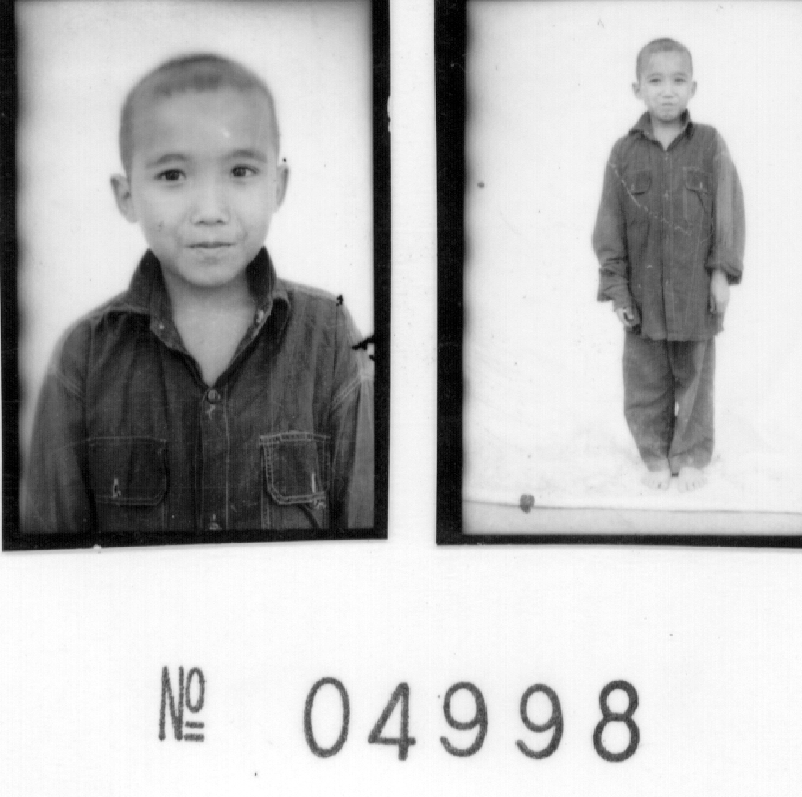
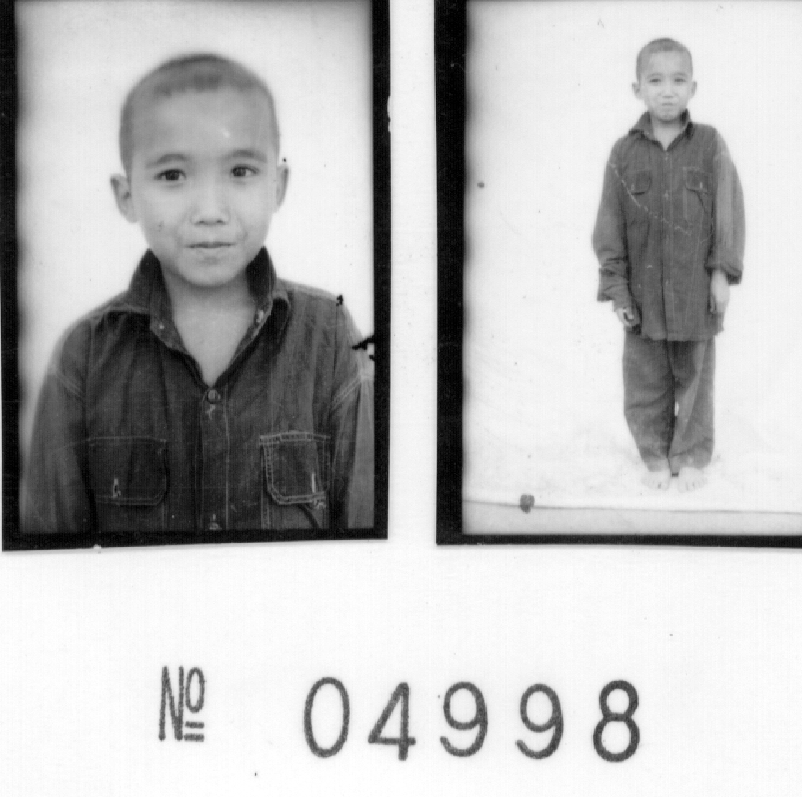
A nameless victim of the Cambodian genocide. Few Americans know that close to two million people died, that none of the perpetrators have been brought to justice and that the United States helped bring about the crisis that lead to the Khmer Rouge takeover.

On April 17, 1975, "The Day of Anger", as it is remembered, thousands of Phnom Penh residents celebrated in the streets as Khmer Rouge troops victoriously entered the capitol. This joyous celebration of the end of the five-year civil war was an expression of hope that Cambodia would finally be at peace.

Hope quickly turned to fear as the Khmer Rouge troops, embittered and toughened by years of brutal civil war and American bombing, marched the boulevards of Phnom Penh ordering people to abandon their homes and evaquate the city. When the residents questioned their orders, the Khmer Rouge claimed they wanted to save as many people as possible from the imminent attack of the Americans, who would soon be bombing the city. Residents would only be gone a few days, they were told, so there was no need to take personal belongings or much food. 2 million people were forced from the city to the countryside, on foot. The wounded were forced out of hospitals to make the trek; some of them were wheeled out on hospital beds. Many died along the way.

There were no American plans to attack the city, as the Khmer Rouge well knew. Cities, they believed, were living, breathing capitalist tools, and Phnom Phen was "the great prostitute of the Mekong." In an ideal communist society, all people would have to live and work in the countryside as peasants, the Khmer Rouge communist ideal. 'Old people', as they called them, were simple, uneducated, hard-working, and almost incapable of exploiting others. Though their way of life had not changed for centuries, they always managed to survive. City dwellers, or 'new people', were the root of all capitalist evil whether they were teachers, tailors, civil servants or monks, and instantly became the new enemies of Angka, "The Organization".

As was often said by the Khmer Rouge, 2000 years of Cambodian history had now come to an end; April 17 was the beginning of Year Zero for the new Cambodia: Democratic Kampuchea. Religion, money and private ownership were all banned; communications with the outside world elimated; family relationships dismantled. The Khmer Rouge regime arrested, tortured and eventually executed anyone suspected of connections with the former or foreign governments, professionals, intellectuals and any Khmer person who broke their rules. Ethnic Vietnamese, Cambodian Christians, Muslims and the Buddhist monkhood were also targets of persecution. If a person knew a foreign language, had worked for the French or Americans, or dared to express feelings of love to their husband or wife, they were killed. Almost 2 million Cambodians would die, 30% of the Cambodian population during that time. Cambodians began to refer to their country as the killing fields, a land of skulls and bones with rivers of blood.

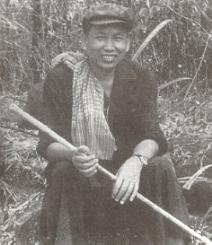
Little was known of the leader of the Khmer Rouge, a Paris-educated communist named Saloth Sar, who went by the nom de guerre “Pol Pot.” Often compared with the regimes of Adolf Hitler, Joseph Stalin, and Mao Zedong, the Khmer Rouge was probably the most lethal regime of the 20th century, in terms of the number of people killed relative to the population. Nevertheless, only three of the Khmer Rouge leaders have been imprisoned since their rule ended, one on unrelated charges.
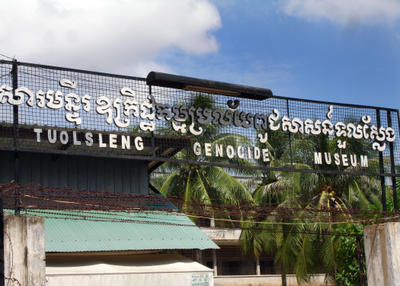
As hundreds of thousands of Cambodians slowly starved in the rice fields, a select number of political prisoners and their families met a terrible fate inside Khmer Rouge interrogation centers. The most infamous of these centers, codenamed S-21, was located in the abandoned suburban Phnom Penh high school of Tuol Sleng, "hill of the poison tree." To workers assigned by the Khmer Rouge to the Tuol Sleng neighborhood, S-21 was known simply as konlaenh choul min dael chenh - "the place where people go in but never come out." Tuol Sleng's reputation was brutally accurate: the sole purpose of S-21 was to extract confessions from political prisoners before they were taken away for execution near the farming village of Choeung Ek. Of the 20,000 people known to have entered Tuol Sleng, only six are known to have survived.

Thousands of confession files, including 5,000 photographs, survive to this day, giving us a grim look at the activities that occured inside Tuol Sleng. The Yale Cambodian Genocide Center has spent many years examining these records, but thousands of the people sent to S-21 have yet to be identified. We may never know who they were or why they were sent there; only their portraits remain to serve as affirmations of their lives - and deaths - at the hands of the Khmer Rouge. When I asked why they had bothered to photograph all their victims, leaving proof of their crimes, my guide told me they wanted to prove to Angka that they were doing their job.

Image hosted by Photobucket.com
The shadows of barbed wire lining the hallways of Toul Sleng, added after a woman committed suicide by jumping from the second floor to escape her torturous fate. Another victim managed to take hold of a gun left in a torture chamber, shoot his gaurd, and then take his own life.

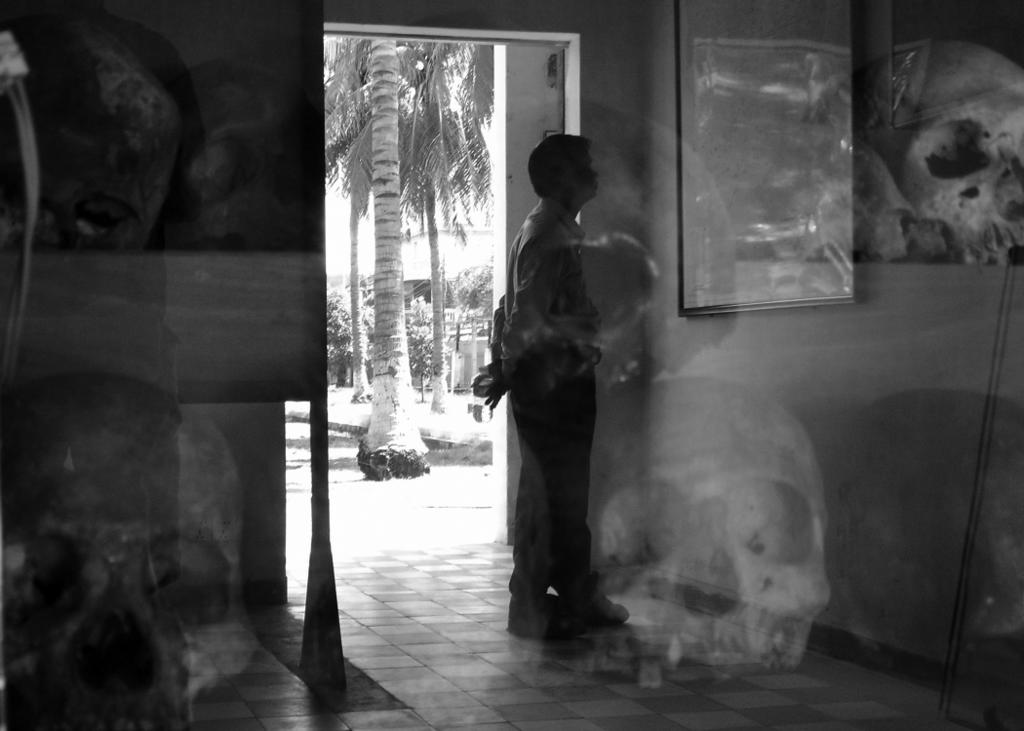
Our guide through Tuol Sleng and Cheong Ek, Mr. Ran, refelcted in a glass case containing the skulls of victims unearthed on school grounds. Hundreds of Cambodians now make a living by guiding visitors through the killing fields, many sharing their harrowing personal stories of how they survived the Khmer Rouge.
The Killing Fields at Choeung Ek. This mass grave, discovered in 1980, was one of the first proofs to the outside world of what had occurred during Pol Pot's regime.

Image hosted by Photobucket.com
Mr. Ran explained that bullets were too precious to use for executions. Pick axes, knives and bamboo sticks were far more common. Even the jagged egde of this common Cambodian plant became a tool for torture and murder.

Image hosted by Photobucket.com
A memorial stupa stands in the center of the killing fields, housing 8,000 skulls from the surrounding mass graves.

Image hosted by Photobucket.com
The Cambodian flag, outlawed by the Khmer Rouge, reflected in the glass shrine of the killing fields.


Image hosted by Photobucket.com
The sight of the skulls stuns visitors into silence. Cambodians will tell you that their genocide is worse than any other because it was carried out on Cambodians, by Cambodians.

Children from the surrounding farms greet visitors to the killing fields, begging for money.

Image hosted by Photobucket.com
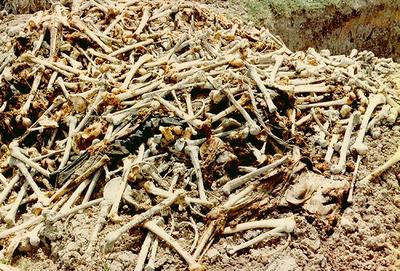
Nine miles from Phnom Penh, the "killing fields" of Choeung Ek are a few of thousands of other such sites around the country where the Khmer Rouge committed genocide during the late 1970s. Water buffalo graze in the surrounding farmland as human bones are unearthed after heavy rains. As i walked through the feilds, I struggled not to step on bones pooking through the dirt paths, discovered by the monsoon rain. Along the path, small barrels were filling with the remains of the thousands of victims massacred here.


Image hosted by Photobucket.com

Image hosted by Photobucket.com

Tuesday, October 04, 2005

Hungry Ghosts of Pchum Ben


My last night in Phnom Pen seemed it would end all too soon after leaving a popular local night club called Spark. I sat, side-saddled, on the back of my friend's motorbike, as we toured the quiet city's mostly empty streets. By the bright lights that illuminated the Royal Palace, I was amazed at the amount of people still awake. Children ran and played as women sold brightly colored fruits and vegetables, while young people hung out. Couples lined the bank of the Mekong River along the Sisowath Quay, and the sidewalks were crowded with the tuk-tuks and motorbikes that had flooded the streets during the day, their drivers curled up beneath their tuk-tuk canopies or balanced along the seat of their bikes, feet crossed, up on the handle bars, catching a few winks before their work began again.

In front of a temple gate I noticed many large groups of people gathering. Young girls were selling plates of brightly colored sweets on mounds of tiny rice balls, decorated with white blossoms and a long stick, planted deeply in the sticky rice, from which hung a paper ornament in the ghostly shape of a person. Curiosity peaked, I asked my friend to stop, and as we slowed down across the street from the temple, the girls ran to us, eager to make a sale. Glancing over their heads I saw enormous crowd filling the street, headed towards the temple, bathed in the unnatural glow of a streetlight. My friend explained that these people had come to celebrate Pchum Ben, the festival of hungry ghosts.

I bought a thin, aluminum platter stacked with small rice balls, flower shaped sweets and two lilies and walked into the temple grounds to sit outside the doors with many of the people hoping to get a good seat for the service. From the moment I passed through the gate I felt and met the eyes of all the people gathered turn towards me in shock and amazement. For the first time in my life I felt out of place, as if my presence was completely unexplainable. Since I knew neither the language nor the custom of the people who wondered at me, I could not help but lower my eyes and stay close to my friend.

A small crew of children followed me to where I sat down, and then stood before me, tilting their heads this way and that, trying to figure me out. Finally they began to smile and giggle before working up the courage to use what little English they knew to introduce themselves: "My name Ran," smiled a small boy, pointing to himself. "My name Dalin," he said, pointing to another. We giggled together, struggling to make sense of one another, until the creaking sound of the great wooden doors of the temple slowly swinging open cut through our laughter and drew my attention to the temple, which seemed to gasp for air as 3 young monks in saffron colored robes subdued in tone by the cover of night struggled to pull them open for the visitors.

We joined the crowd, followed by the children, who's hands I found laid upon my feet as we reached the door, fighting over which of them would watch over them, hoping, as my friend later told me, that they might earn some money in doing so. They did not pass through the doors, but sat, squatting at the threshold, arranging the growing jumble of empty shoes into rows and columns. After checking my shoes at the door, I half expected to feel the smooth, cool, woven texture of tatami beneath my feet as we entered the temple, but instead I turned to see the entire room covered in bright red carpet. At the front of the hall was a large golden buddah, framed by four golden columns, connected by strands of Christmas lights. Behind the buddah's head was a psychedelic, swirling, neon-colored something that looked like it belonged beneath a black light. When I mentioned the difference between this buddah and the ones I had seen in Japan, my friend proudly replied "Ah, yes. We use technology!"

On the far left hand side of the room, the monks began to trickle in, taking their place in neatly arranged lines on the floor, facing the growing audience. They seemed to be shaking off the sleep still thick in their eyes, as I began to feel mine grow heavy. By this time people had packed the temple tight, and were standing along the walls and crowded outside the open door, filling the courtyard. A monk began to chant. It was 4 Am.

The beat of the drum led them in their song, so calming I nearly fell asleep on the shoulder of my friend, until the women behind me pulled one of my toes and explained to us both, in Khmer, how improper it was since he was a boy. I was horribly ashamed, and fought with all my might to sit straight up with my palms pressed together, making my own prayers as the monks led the congregation in reciting theirs. When the chanting finished I opened my eyes to see the monks shifting themselves to face a new direction before starting all over again. If I had not been struggling to keep myself from falling asleep and further disgracing myself, I would have paid much closer attention, but all I remember is struggling to get back up to my feet as people around me picked up their plates of food, many with sticks of incense or candles burning on them, and flowed around me towards the door.

Framed by the open doors I could see the courtyard full with people, their faces dimly lit by the candles of their offerings, as they began to make three loops around the temple, crammed with hundreds of other devotees. The small children that had promised to keep watch of our shoes appeared at my feet, arranging my shoes for me to slip easily into as I joined in journey through the grounds, surrounded by the melting candles, sweet scent of incense and haunting paper spirits, which floated in the gentle wind of the bustling crowd. Each time we reached one of the 8 compass points, the people joyfully threw bay ben, a mixture of sticky rice, black beans, sesame and coconut milk, as an offering to the hungry ghosts of their ancestors, believed to return to earth during these 15 days, during which time their prodigy can ease their suffering.

With over 50% of the population under the age of 20, it is no doubt that this festival carries the weight of remembering all those who died under the genocidal reign of terror imposed by the Khmer Rouge, which killed more than 2 million people, about a third of Cambodia's population at that time, between 1974-79.

I could not stay to make the 3 circumnavigations of the temple before the sunrise called the spirits back to the other world, for soon it would call me away as well, down the Mekong River to the last stop on my journey: Viet Nam.

Sunday, October 02, 2005

The Faces of Bayon

Image hosted by Photobucket.com
When Zhou Daguan visited Angkor in 1297-98, Bayon's towers were covered in gold. While Angkor Wat was kept from the ravages of the jungle by devoted Buddhist monks, Bayon was forgotten, left to the mercy of nature.

From a distance, it seemed the jungle had taken its revenge on the eerie mass of jumbled rocks known as Bayon. I approached it in awe as hundreds of faces began to emerge from the tangled mass of stone and shadow. 54 towers chaotically assaulted the sky, each in its own plain, creating an intimidating sense of height.

When Chinese ambassador Zhou Daguan visited Angkor before the dawn of the 14th century, the city was dripping with the gold and riches of empire.

Image hosted by Photobucket.com

"At the center of the Kingdom rises a Golden Tower flanked by more than twenty lesser towers and several hundred stone chambers," Zhou wrote.

"On the eastern side is a golden bridge guarded by two lions of gold, one on each side, with eight golden Buddhas spaced along the stone chambers."

The"golden" period of the Khmer Empire was not a peaceful one. Rival powers from present-day Vietnam, Thailand, and Burma struggled with the Khmers for regional domination. Ironically, the Khmers' architectural prowess aided in their demise, as extensive temple construction, combined with frequent military conflicts, eventually drained the empire's resources. As the empire declined, Angkor was sacked several times, the gold and jewels stripped as spoil by invading armies. Bayon was one of the last great achievements of the empire, but fell in 1432 to the Thais, and was soon after forgotten.

The gold and jewels may be gone, but the mystique and grandeur of the Khmer kingdom endures.


A translation of King Jayavarman VII`s mystic Buddhist beliefs, Bayon is a spiritual experience. From each of the survivng towers the enlightened grin of the Boddhisattva Avalokitesvara, one of the most worshipped divinities in Mahayana Buddhism and the kingdom's principal divinity, compassion radiates out in the four cardinal directions. Carved in the likeness of the King himself (his portrait is known from other sculptures found elsewhere in Cambodia and Thailand), these enigmatically smiling faces portray the King as god, symbolizing his omnipresence and omnipotence.

Image hosted by Photobucket.com
The Khmer Smile.

Bodhisattva Avalokitesvara is believed to be the embodiment of compassion. A bodhisattva is motivated by compassion to seek enlightenment for all beings. The 216 faces haunting the heights of Bayon project benevolence outward in all directions, and are believed to bring hope, happiness, peace, and protection to all, especially those living in the Khmer Empire.


As I wandered around in wonder, watched by the eyes of Big Brother, Bayon-style, I couldn't help but feel like I was trapped in an MC Escher drawing. I don't think I could ever have believed such a place existed, even in my dreams, and I certainly never imagined that someday I would see it with my own two eyes.


Saturday, October 01, 2005

The Road To Angkor Thom

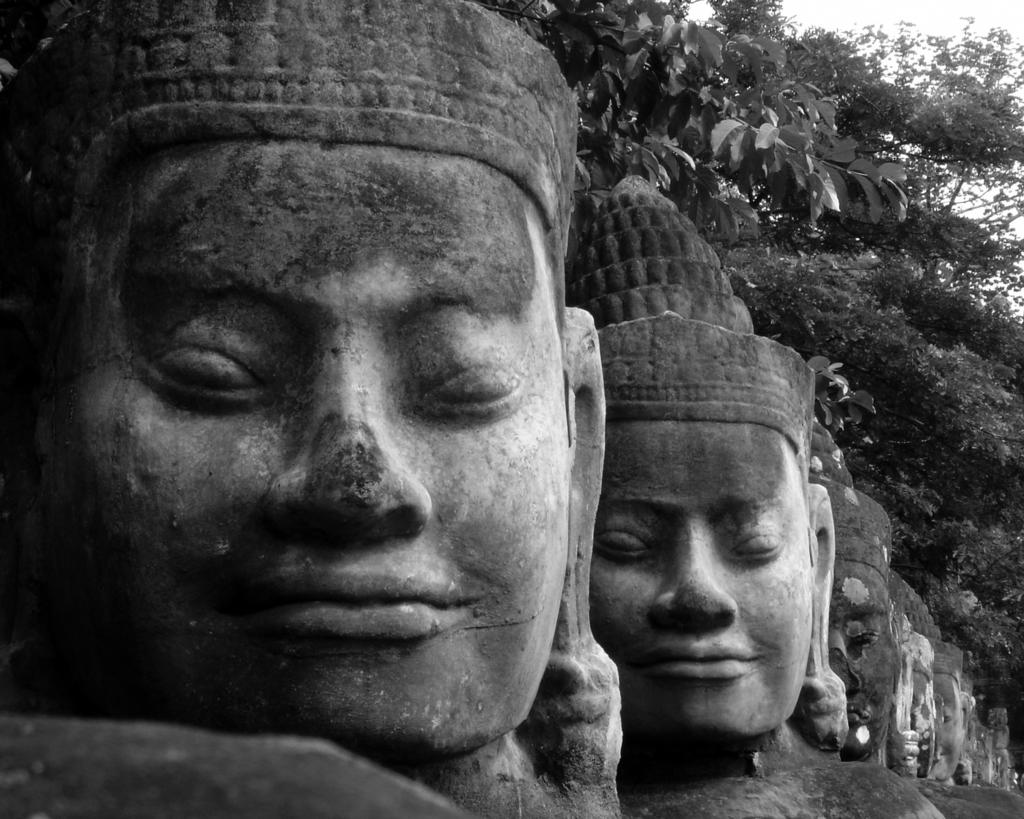
The Enlightened eyes of the 54 devas, or lesser gods, gaurding the gate of Angkor Thom.

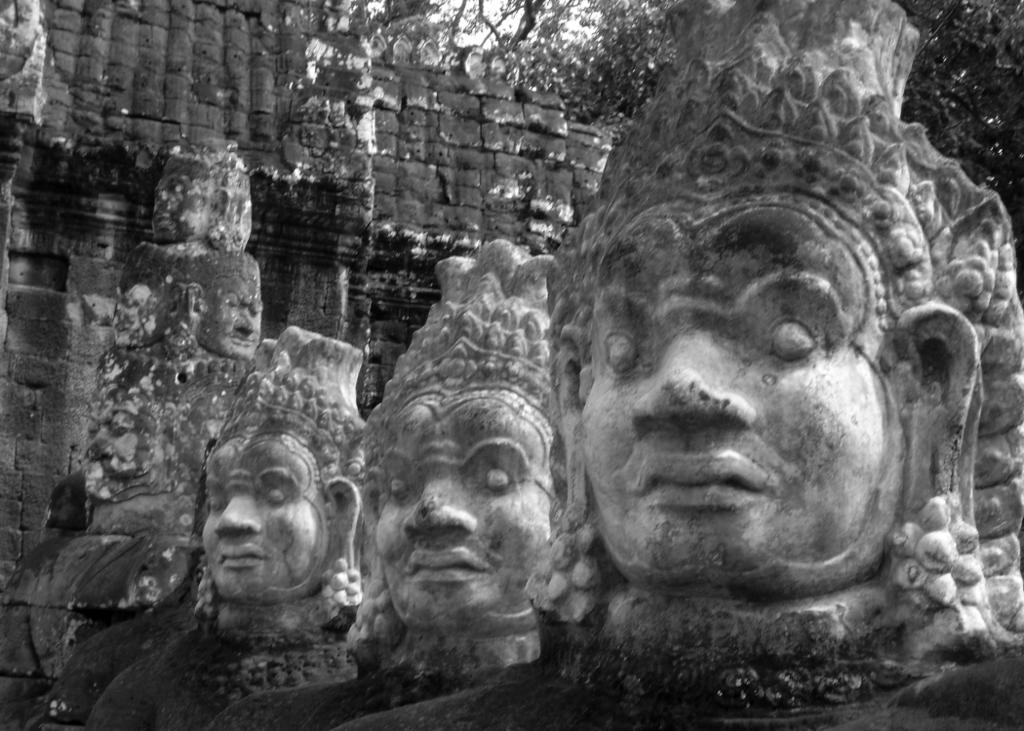
Walking along the narrow road to Angkor Thom, dodging motor bikes and bicycles, a long line of elephants appeared in the shade of the jungle, camouflaged in the shadows of leaves. I watched them as I walked along, until when I finally turned my head I saw a massive stone gate rising up like a mountain, from the peak of which I found a face staring back at me, and two more surveying the jungle in each direction. I came to the foot of a bridge over a large moat, once filled with alligators to detour trespassers like myself. I crossed the causeway, encouraged by the serene smiles of 54 devas on my left, though from my right I felt the heavy stare of 54 demons. Peering down from above, the omniscient eyes of the gatekeeper seemed to watch my every step. I felt as if I were passing through the oracle in the Never Ending Story.

The watchful eyes of Angkor Thom's demons.

Image hosted by Photobucket.com
Niether the gate of Angkor Thom, nor the eyes of its gaurdians, can prepare you for the jewel of the jungle: Bayon.